
Quartz crystals are one of the most common minerals found in nature, but that doesn’t make them easy to identify. With so many variations in color, clarity, and shape, even experienced collectors can struggle to tell a clear quartz from its more valuable counterparts. As a gemstone enthusiast or collector, being able to accurately identify quartz crystals is essential for making informed purchases and building a respectable collection. In this article, we’ll take a closer look at the physical characteristics that distinguish quartz crystals from other minerals, including their crystal structure, hardness, and inclusions. We’ll also explore advanced identification techniques, such as using polarized light microscopy and X-ray fluorescence, to help you confidently identify quartz crystals and distinguish them from more valuable species like amethyst or citrine. By the end of this article, you’ll be able to accurately identify quartz crystals and make informed decisions about your collection.
Understanding Quartz Crystals
Let’s take a closer look at the fundamental aspects of quartz crystals, including their composition and internal structure. This sets the stage for understanding their unique properties and characteristics.
What Are Quartz Crystals?
Quartz crystals are one of the most abundant minerals on Earth, making up a significant portion of the planet’s crust. They’re composed primarily of silicon and oxygen atoms, which are arranged in a repeating pattern to form a crystalline structure. This unique composition is responsible for quartz’s distinct properties, including its hardness, transparency, and electrical conductivity.
Quartz crystals can be found in a wide range of environments, from high-temperature magma chambers to surface deposits that have been shaped by wind and water erosion. Their ability to withstand extreme temperatures and pressures has made them a valuable resource for various industries, from electronics to jewelry.
One of the key characteristics of quartz is its piezoelectric property, which allows it to generate an electric charge when subjected to mechanical stress. This property makes quartz crystals essential components in many electronic devices, including watches, smartphones, and computers. The unique combination of physical and electrical properties that defines quartz has also led to its use in a variety of other applications, from frequency control to scientific research.
Types of Quartz Crystals
There are several distinct types of quartz crystals, each with its own unique characteristics and properties. Clear quartz is one of the most common varieties, prized for its clarity and ability to direct energy. Rose quartz, on the other hand, has a delicate pink or rose-red hue, often attributed to iron impurities. Smoky quartz gets its name from its characteristic brownish-red color, caused by exposure to radiation.
Other notable types include amethyst, which ranges in color from pale lilac to deep purple; citrine, known for its vibrant yellow or orange hues; and milky quartz, with its opaque white appearance. Each type has its own distinct energy signature, making them suitable for different purposes. For example, rose quartz is often used in healing practices due to its soothing properties.
Some quartz varieties are created through heat treatment or irradiation. However, these processes can affect the crystal’s authenticity and value. When identifying a specific type of quartz crystal, it’s essential to consider both its natural color and any treatments that may have been applied. This understanding will aid in accurately categorizing and valuing the crystal.
Identifying Quartz in Nature
When searching for quartz crystals in nature, it’s essential to understand where and how they form. Quartz is a common mineral found in many types of rocks, including granite, sandstone, and shale. It can also be present in veins within other minerals like feldspar and mica.
To spot quartz in its natural state, look for areas with high concentrations of silica-rich rocks. These areas often have a white or light-colored appearance due to the presence of quartz crystals. Some popular locations to search for quartz include riverbeds, beaches, and mountain ranges.
When examining rocks and minerals, hold them up to the light to observe any sparkles or glints. Quartz crystals often exhibit a characteristic “diamond-like” brilliance due to their high refractive index. It’s also essential to examine the rock’s composition and structure, as quartz can form in various ways, including as a primary mineral or as an alteration product of other minerals.
In particular, look for rocks that have undergone metamorphism, such as schist or gneiss, as these often contain quartz crystals. By combining knowledge of geology with observation skills, you can increase your chances of finding and identifying quartz in its natural state.
Physical Characteristics
When it comes to identifying quartz crystals, understanding their physical characteristics is crucial. This section will take a closer look at the unique features that set one crystal apart from another.
Shape and Form
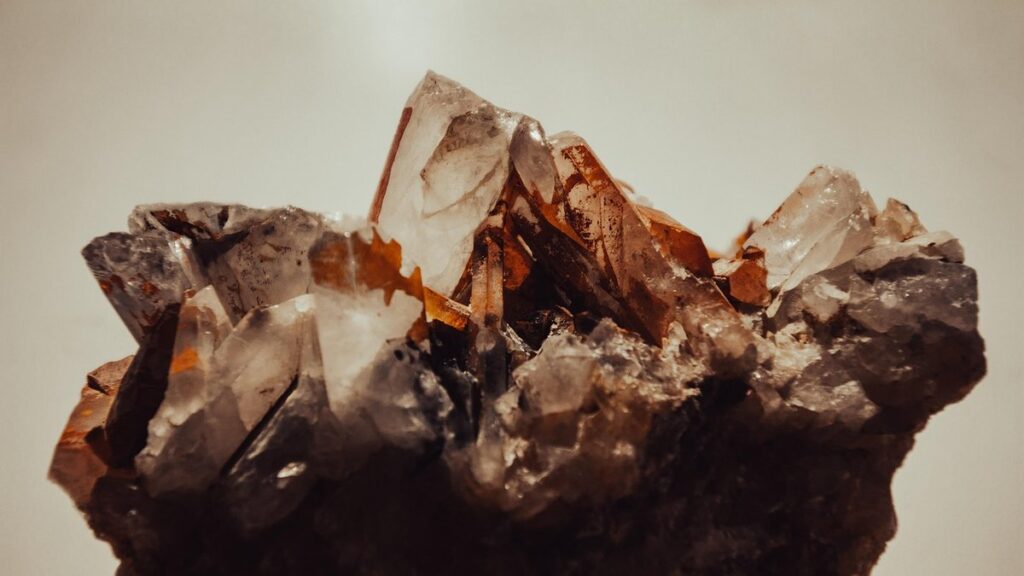
Quartz crystals can manifest in a wide range of shapes and forms. One common occurrence is cluster growth, where multiple crystals form together from the same center point. These clusters often appear as dense bunches of smaller points or tabular crystals. In some cases, individual crystals within a cluster may be remarkably large, while others remain relatively small.
Pointed quartz crystals are another distinct category. They can range in size and shape, with some forming long, slender needles and others developing robust, stout points. Tabular crystals, on the other hand, have flat or slightly rounded faces that provide a striking visual contrast to their pointed counterparts.
In addition to these common forms, quartz crystals can also occur as sprays – loose aggregates of smaller points that resemble a miniature tree or shrub. These formations are often found in vugs (cavities) within larger rocks and can be prized for their unique aesthetic appeal. When examining a specimen, pay attention not only to its overall shape but also the subtle variations in form within each cluster or spray – these details can provide valuable clues about the crystal’s growth history.
Size and Weight
To determine the size and weight of a quartz crystal, you’ll need to use various measurement techniques and tools. Start by measuring the length, width, and height of the crystal using a ruler or calipers. For more accurate measurements, consider investing in a digital caliper or a micrometer. When weighing your quartz crystal, use a sensitive balance or scale with high precision.
It’s essential to note that the weight of a quartz crystal can vary depending on its density. Some types of quartz, such as smoky quartz, have a higher density than others like clear quartz. This means that two crystals of similar size can have different weights.
To calculate the volume and mass of your quartz crystal, you’ll need to know its length, width, height, and density. You can use the following formula: Volume = Length x Width x Height, and then multiply this value by the density to get the mass. For example, if a clear quartz crystal has a length of 5 cm, a width of 3 cm, and a height of 2 cm, its volume would be 30 cubic centimeters (cm³). If its density is approximately 2.65 grams per cubic centimeter (g/cm³), then its mass would be around 79.5 grams.
Keep in mind that these calculations assume a uniform density throughout the crystal. In reality, some quartz crystals may have varying densities due to inclusions or imperfections.
Clarity and Inclusions
A clear quartz crystal should have a transparent to translucent body color with minimal imperfections. However, many crystals exhibit internal features such as growth patterns and imperfections like veils, needles, or rutile tubes. These characteristics can be indicators of the crystal’s origin, formation process, or exposure to external influences.
Growth patterns can include zoning, where different areas of the crystal have distinct optical properties due to varying chemical compositions. Other growth-related features might be visible as inclusions or as distortions in the crystal’s shape.
In more extreme cases, quartz crystals may exhibit significant imperfections such as cavities, fractures, or complete breakage. Less severe damage can manifest as minute cracks, inclusions of minerals other than quartz, or irregularities in the crystal’s growth pattern.
Identifying these features requires a combination of visual examination and knowledge of common inclusions found in quartz crystals. A hand lens or low-power magnification is sufficient for most cases, but higher-magnification tools may be needed to distinguish between minor imperfections and significant issues.
Optical and Electrical Properties
Understanding the optical and electrical properties of quartz crystals is crucial for accurate identification, as these characteristics can be just as distinctive as their physical appearance.
These properties will vary depending on the crystal’s composition and structure, making them a valuable tool in your identification process.
Refractive Index
The refractive index of quartz crystals is a critical factor in determining their optical properties. It’s defined as the ratio of the speed of light in air to the speed of light as it passes through the crystal. In quartz, this value is approximately 1.54 for ordinary rays and 1.55 for extraordinary rays. This birefringence – the difference between these two values – causes quartz crystals to exhibit double refraction, where a single beam of light splits into two separate beams.
When evaluating a quartz crystal’s refractive index, it’s essential to consider its orientation. Quartz has a trigonal crystal system, which means that its optical properties vary depending on the direction of the light passing through it. In general, quartz crystals tend to be more birefringent when their c-axis (the axis along which the crystal grows) is parallel to the direction of incidence.
To accurately determine the refractive index of a quartz crystal, you’ll typically need specialized equipment like a polarizing microscope or a spectrometer. However, even with these tools, identifying the precise value can be challenging due to variations in crystal quality and orientation. A more practical approach is to look for characteristic optical effects, such as double refraction or pleochroism (the appearance of different colors when viewed from different angles).
Birefringence and Dispersion
When light passes through a quartz crystal, it exhibits birefringence and dispersion. Birefringence refers to the splitting of light into two distinct beams with different refractive indices. This phenomenon causes the crystal to appear double or to have a “rainbow” effect when viewed under certain lighting conditions.
Dispersion is closely related to birefringence, as it occurs when light is separated into its individual colors due to varying refractive indices for each wavelength. In quartz crystals, dispersion often manifests as a range of colors that spread outward from the crystal’s center, creating a characteristic “pleochroic” appearance.
To better understand and identify these properties, examine your quartz crystal under different lighting conditions. A desk lamp or sunlight can be used to observe birefringence and dispersion in action. Note how the crystal appears when viewed directly versus at an angle, as this can affect the visibility of its optical properties.
A few key things to keep in mind: some types of quartz exhibit more pronounced birefringence and dispersion than others. Amethyst and citrine, for example, tend to display these characteristics more noticeably due to their unique crystal structures.
Electrical Conductivity
Quartz crystals exhibit a range of electrical conductivity behaviors due to their piezoelectric properties. This means they can generate an electric charge when subjected to mechanical stress, such as pressure or vibration. The most common type of quartz crystal is alpha-quartz, which has a relatively high electrical conductivity compared to other forms.
Piezoelectricity in quartz crystals arises from the unique arrangement of silicon and oxygen atoms within its crystal lattice. When an external force is applied, it causes the atomic bonds to shift, resulting in a separation of electric charges across the crystal’s surface. This phenomenon is essential for various applications, including sensors, resonators, and oscillators.
Quartz crystals’ electrical conductivity makes them useful in electronic devices that require stable frequency sources or precise timing control. For example, quartz crystal oscillators are used in watches, clocks, and radios to regulate their timekeeping and frequency accuracy. When identifying a quartz crystal for its potential electrical properties, look for samples with clear indications of piezoelectric activity, such as surface charge buildup or unusual responses to mechanical stress.
Advanced Identification Techniques
When it comes to identifying quartz crystals, some samples may require more advanced techniques to accurately determine their properties and origin. Let’s explore the methods used for these challenging cases.
Microscopy and Magnification
Using a microscope or magnifying glass allows you to examine quartz crystals up close and reveal their internal structure. When examining a quartz crystal using a microscope, start by setting the stage with a clear background and adjusting the focus until the crystal’s surface is in sharp relief. A 10x or 20x objective lens is ideal for observing the crystal’s exterior features.
To inspect the crystal’s interior, you’ll need to use a higher-powered lens – typically 50x or 100x – and possibly a polarizing filter to reduce glare from any inclusions. This will help you spot internal growth patterns, cavities, or other anomalies that might affect the crystal’s optical properties. When examining quartz crystals under magnification, pay particular attention to any signs of cleavage, etching, or other surface damage.
A hand lens or loupe is also useful for inspecting small or irregularly-shaped quartz crystals. By holding the lens close to the crystal and adjusting its focus, you can get a good look at features like striations, growth habits, or evidence of twinning. Remember that magnification alone cannot guarantee accurate identification – it’s essential to combine this information with other techniques, such as examining physical characteristics or testing optical properties.
Spectroscopy and Crystallography
Spectroscopy and crystallography are advanced techniques used to identify quartz crystals with high precision. Spectroscopy involves analyzing the interaction between matter and electromagnetic radiation, which can reveal a quartz crystal’s chemical composition and molecular structure.
Crystallography, on the other hand, focuses on determining the three-dimensional arrangement of atoms within a crystal lattice. This method is particularly useful for identifying quartz crystals with complex or unusual structures.
One common spectroscopic technique used in quartz identification is infrared (IR) spectroscopy. IR spectroscopy measures the absorption and transmission of infrared radiation by a sample, providing information about its molecular vibrations. By analyzing an IR spectrum, you can identify specific peaks associated with quartz’s unique chemical bonds.
In crystallography, techniques such as X-ray diffraction (XRD) and neutron scattering are often employed to determine the lattice parameters and atomic arrangement within a quartz crystal. These methods involve bombarding the sample with high-energy radiation or particles, which scatters off the atoms and provides data on their spatial distribution.
When choosing between spectroscopy and crystallography, consider the specific characteristics you’re trying to identify.
Certification and Authentication
Verifying a quartz crystal’s authenticity is essential when buying or selling. Certification and authentication are not just measures of quality but also protect against counterfeiting. A reputable dealer or seller will provide documentation, such as certificates of origin and lab reports, to confirm the crystal’s identity.
To verify authenticity, examine the certificate for details like the lab’s name, location, and contact information. Look for any inconsistencies in the report, such as an unusual chemical composition or inconsistent hardness measurements. Some labs specialize in quartz analysis and can provide more detailed information about the crystal’s properties.
A small minority of sellers may try to pass off synthetic crystals as natural ones. These synthetic crystals often have distinct optical and electrical properties that can be detected with a polarizing filter or by measuring their dielectric constant. Check for any signs of tampering, such as scratches or anomalies in the crystal’s surface. If you’re unsure about a crystal’s authenticity, consult with an expert or seek guidance from a reputable dealer.
Practical Applications and Uses
Now that you’ve learned how to identify quartz crystals, let’s see how you can apply your new skills in a practical way, from jewelry-making to healing practices. We’ll explore some exciting uses of quartz crystals in everyday life.
Healing and Metaphysical Properties
Quartz crystals are often associated with a range of healing and metaphysical properties. Many practitioners use them in energy work to absorb, store, and transmit energy. They’re said to have a balancing effect on the body’s energy fields, helping to clear negative patterns and promote relaxation.
In meditation, quartz is believed to enhance mental clarity and focus. Some people hold them during meditation or place them on specific areas of the body to concentrate the mind and calm the spirit. The crystal’s purported ability to amplify thought and intention makes it a popular tool for manifesting goals and desires.
When working with quartz in energy healing, it’s essential to cleanse and charge the crystal regularly. This involves exposing it to sunlight or moonlight, using sage smudging, or placing it on a bed of herbs like lavender or rosemary. Proper care can enhance the crystal’s energetic properties and ensure its effectiveness in various applications.
Some practitioners also use quartz for protection against negative energies. They believe that the crystal’s strong vibrations repel unwanted influences and create a shield around the user. While these claims may not be scientifically proven, many people swear by the benefits of working with quartz crystals in energy healing and meditation.
Jewelry and Ornamentation
Quartz crystals are a popular choice for jewelry and ornamentation due to their unique beauty and durability. In commercial production, quartz is often cut and polished to enhance its optical properties and bring out its natural colors. The most common types of quartz used in jewelry are clear rock crystal, amethyst, citrine, and rose quartz.
Quartz crystals can be cut into a variety of shapes and forms, from simple cabochons to intricate carvings. To determine the quality of a cut quartz crystal, look for evenness of shape and symmetry. The polishing process is also crucial, as it can affect the clarity and brilliance of the stone.
Some popular techniques used in cutting and polishing quartz include faceting, which involves cutting flat surfaces to refract light, and cabbing, which involves shaping the crystal into a smooth, rounded form. The quality of the cut and polish will impact the final appearance of the stone, making it more or less suitable for jewelry and ornamentation.
A good example of well-cut quartz is seen in high-end jewelry pieces where the crystal’s clarity and brilliance are maximized through precise cutting and polishing techniques.
Scientific and Industrial Applications
Quartz crystals are widely used in electronics due to their unique electrical properties. They exhibit piezoelectricity, meaning they generate an electric charge in response to mechanical stress. This property makes them ideal for use in sensors, timers, and resonators. Quartz crystals are also employed in electronic circuits as frequency stabilizers, ensuring that clocks and other devices maintain a consistent timekeeping.
In the field of optics, quartz crystals have several applications. Their transparency across a wide range of wavelengths makes them useful for lenses and windows in instruments such as microscopes and spectrometers. Additionally, quartz crystals are used to create high-quality optical components like beam splitters and polarizers due to their ability to split light into its component colors.
Some notable examples of industrial uses include the production of watches and clocks, where quartz crystals help regulate timekeeping with precision. They also play a crucial role in medical equipment such as ultrasound machines and MRI scanners.
Frequently Asked Questions
How to Verify the Authenticity of a Quartz Crystal Online?
When buying quartz crystals online, it can be challenging to verify their authenticity. Yes, look for reputable sellers who provide detailed descriptions and high-quality images of the crystal from multiple angles. Also, check if the seller offers certification or authentication services, such as reports from gemological laboratories like the Gemological Institute of America (GIA) or the International Gemological Institute (IGI). This can give you confidence in the crystal’s authenticity.
Can Quartz Crystals be Used for Healing if They are Damaged?
While quartz crystals are often associated with healing properties, damaged crystals may not be as effective. Yes, a damaged quartz crystal can still be used for healing, but its energy may be disrupted or weakened. To maximize its potential, cleanse and charge the crystal regularly to restore its balance.
How Do I Store Quartz Crystals to Preserve Their Energy?
Proper storage is essential to preserve the energy of quartz crystals. Keep them away from direct sunlight, moisture, and extreme temperatures. You can store them in a velvet pouch or a wooden box lined with cloth, which will help protect their energy and prevent damage.
What if I Find a Quartz Crystal but Can’t Identify Its Type?
Don’t worry if you’re not sure what type of quartz crystal you’ve found! Take clear photos from multiple angles and consult online resources or expert gem hunters for identification. You can also send the crystal to a reputable laboratory for analysis, which will provide an accurate identification and any relevant information about its properties.
Can Quartz Crystals be Used in Electronic Devices?
Quartz crystals have unique electrical properties that make them useful in electronic devices. Yes, they are commonly used as oscillators or frequency control components in electronics due to their high stability and accuracy. Their piezoelectric properties allow them to generate a consistent electric current when subjected to mechanical stress.
What if I Want to Use Quartz Crystals for Jewelry Making but Am Not an Expert?
Creating jewelry with quartz crystals can be challenging, especially if you’re new to working with gemstones. Consider taking a class or workshop on lapidary arts and jewelry making to learn the basics. You can also start by working with simpler projects and gradually move on to more complex designs as your skills improve.
Are There Any Specific Tools I Need to Identify Quartz Crystals in Nature?
While some basic tools like hand lenses and magnifying glasses are helpful, a polarizing microscope is ideal for examining quartz crystals in detail. This tool will allow you to observe their optical properties, such as birefringence and dispersion, which can aid in identification.
Can I Use Any Type of Quartz Crystal for Healing or Metaphysical Purposes?
Not all types of quartz crystals are suitable for healing or metaphysical purposes. For example, clear quartz is often used for its amplifying and balancing properties, while rose quartz is associated with emotional healing. Research the specific type of crystal you have to understand its unique energies and uses.
How Do I Know if a Quartz Crystal is Genuine or Treated?
Reputable sellers should provide documentation or certification from gemological laboratories that verifies the crystal’s authenticity. Be wary of extremely low prices for high-quality crystals, as this may indicate treatment or tampering.