
The James Webb Space Telescope is poised to revolutionize our understanding of the universe, with its groundbreaking science objectives set to uncover secrets that have long been shrouded in mystery. One of the most significant areas of study will be the formation and evolution of stars, which are the building blocks of galaxies like our own Milky Way. By analyzing the light reflected off distant star-forming regions, scientists hope to gain insights into the process of star birth and death, shedding light on the mysterious life cycles that govern the cosmos. The telescope’s advanced technical specifications also make it an ideal tool for studying exoplanet atmospheres, allowing researchers to search for signs of life beyond Earth. In this article, you’ll learn about the James Webb Space Telescope’s role in modern astronomy and discover what makes its science objectives so groundbreaking, including the study of star formation, exoplanet atmospheres, and more.
Design and Development
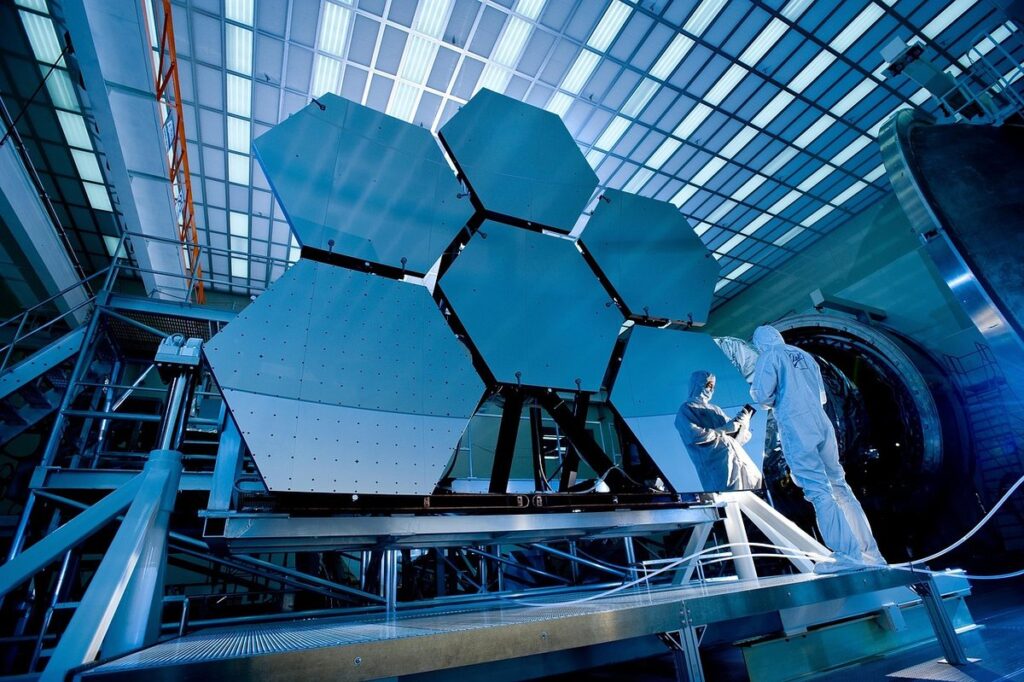
The James Webb Space Telescope’s remarkable design and development process involved innovative engineering solutions, such as its foldable sunshield and segmented primary mirror.
Concept and Planning
The concept for the James Webb Space Telescope (JWST) dates back to 1996 as part of the Next Generation Space Telescope program. This ambitious initiative aimed to create a successor to the Hubble Space Telescope, addressing its limitations and pushing the boundaries of space-based astronomy even further. The program’s planners envisioned a telescope capable of capturing the faint infrared signals from distant objects in our universe.
Key players in the conceptual phase included NASA, the European Space Agency (ESA), and the Canadian Space Agency (CSA). Together, they developed a detailed design for the JWST, taking into account its primary objectives: studying the formation of the first stars and galaxies, investigating the composition of distant planets’ atmospheres, and observing the assembly of galaxy clusters.
As part of this planning process, the team had to balance competing demands. They needed to create a robust yet lightweight structure that could withstand the extreme conditions of space while also ensuring the necessary precision for its complex instruments. This delicate balancing act required innovative solutions and cutting-edge materials science.
Technical Specifications
The James Webb Space Telescope’s primary mirror is its most critical component, measuring 6.5 meters in diameter and composed of 18 hexagonal segments made of gold-plated beryllium. These segments are designed to work together as a single, smooth surface, allowing the telescope to achieve its unparalleled resolution. The sunshield, a critical element for maintaining extremely low temperatures, is a five-layered system that separates the warm instruments from the cryogenically cooled detectors.
The mid-infrared instrument (MIRI), one of Webb’s four main scientific instruments, uses a combination of a 2.4-meter diameter primary mirror and a 1.5-meter diameter secondary mirror to capture images at wavelengths between 5-28 microns. The near-infrared camera (NIRCam) employs a 32-pixel detector array to collect data in the 0.6-5 micron range. Each of Webb’s instruments is specifically designed to capture precise wavelengths of light, allowing scientists to study the universe in various spectrums.
The telescope’s advanced optics and detectors enable it to observe objects that are too faint or distant for other telescopes to detect. For instance, NIRCam can collect data on a single star with an intensity equivalent to just 100 photons per second. These precise observations will allow scientists to gain new insights into the formation of galaxies, stars, and planets in our universe.
Launch and Deployment Challenges
The James Webb Space Telescope’s (JWST) launch and deployment presented numerous challenges. Its complex packaging required precise engineering to ensure a smooth release from the Ariane 5 rocket. The JWST was folded into a compact shape, resembling a giant origami figure, to fit within the rocket’s payload fairing. This intricate design allowed it to be launched with minimal additional mass.
As the rocket reached orbit, the JWST was released and began its deployment sequence. However, this process was not without complications. Due to a software glitch, the telescope’s sunshield did not fully deploy as intended, leaving some areas exposed to direct sunlight. This incident raised concerns about the JWST’s thermal stability and ability to maintain the extremely low temperatures required for optimal performance.
To mitigate these risks, NASA engineers implemented contingency plans, including a series of temperature control maneuvers to minimize the impact on the telescope’s instruments. Despite these setbacks, the JWST eventually reached its intended orbit around L2, marking a significant achievement in space exploration and scientific research.
Science Objectives and Expected Discoveries
The James Webb Space Telescope is poised to reveal groundbreaking answers to humanity’s most fundamental questions, from the formation of stars and planets to the origins of life itself. Its science objectives are designed to push the boundaries of our understanding.
Unlocking the Mysteries of Star Formation
The James Webb Space Telescope (JWST) will study the formation of stars and planetary systems in distant galaxies through a range of innovative techniques. One key method is by observing the spectral fingerprints of certain molecules, such as carbon monoxide and water vapor, which are produced during the early stages of star formation. By detecting these signatures, astronomers can infer the presence of nascent stars and planets, even if they’re not directly visible.
The JWST will also examine the properties of protostars and their surrounding disks, which are thought to be key sites for planetary accretion. By analyzing the spectral energy distributions of these objects, researchers can gain insights into their masses, temperatures, and luminosities. This information is crucial for understanding how stars and planets form and evolve over time.
The JWST’s observations will also shed light on the role of magnetic fields in star formation. By mapping the magnetic field structures around protostars, scientists can better understand how these fields influence the accretion process and the eventual formation of planetary systems. The resulting data will provide a more comprehensive picture of star formation in distant galaxies, allowing researchers to refine their models and predictions for this complex astrophysical process.
Probing the Atmosphere of Distant Worlds
The James Webb Space Telescope’s advanced capabilities enable scientists to study the atmospheres of distant worlds in unprecedented detail. By analyzing the light passing through an exoplanet’s atmosphere, researchers can determine if it harbors conditions suitable for life. One of the key techniques used is transit spectroscopy, which involves measuring the decrease in brightness as a planet passes in front of its star.
This method allows scientists to identify the presence of specific gases, such as oxygen or methane, which are indicative of biological activity. However, the James Webb Space Telescope goes beyond mere detection, providing a wealth of information about an exoplanet’s atmospheric composition and temperature. The telescope’s advanced instruments can even distinguish between different isotopes of carbon dioxide, offering insights into the planet’s geological history.
The James Webb Space Telescope will study numerous exoplanets, each with its own unique characteristics. For example, Kepler-452b, a potentially habitable world discovered in 2015, will be one of the telescope’s primary targets. By analyzing the data from these observations, scientists hope to identify patterns and trends that could help us understand the conditions necessary for life to emerge on other planets.
Peering into the Dawn of Time
The James Webb Space Telescope is poised to revolutionize our understanding of the universe’s earliest moments by observing the first stars and galaxies. Its advanced optics and instruments will allow scientists to study light from these ancient celestial objects, which has been traveling through space for over 13 billion years. This journey will provide a unique glimpse into the cosmos’ formative period, when the first elements were forged in the hearts of massive stars.
The JWST’s observations will focus on the reionization era, a period between 12 and 13.5 billion years ago when the universe underwent a dramatic transformation from a neutral to an ionized state. During this time, the first galaxies and stars began to form, emitting intense radiation that ionized the surrounding gas. By studying the light from these ancient objects, scientists can infer the properties of the first stars, such as their masses, luminosities, and chemical compositions.
The JWST’s observations will also shed light on the role of dark matter in the formation of the first galaxies. Scientists expect to detect faint signals from distant galaxies, which will provide valuable insights into the distribution and properties of dark matter during this critical period in cosmic history.
Observational Capabilities and Instruments
The James Webb Space Telescope is equipped with cutting-edge instruments that enable it to observe the universe in unprecedented detail, from the atmospheres of distant planets to the formation of galaxies.
These instruments include a mid-infrared camera and spectrograph that can peer through dust and gas, allowing us to study objects and processes previously hidden from view.
Near-Infrared Camera (NIRCam)
The Near-Infrared Camera (NIRCam) is a crucial instrument on board the James Webb Space Telescope, tasked with capturing high-resolution images of distant objects in the universe. Its primary function is to observe galaxies that are so far away their light has taken billions of years to reach us. In fact, NIRCam will be used to study some of the most distant galaxies known to date, providing valuable insights into the formation and evolution of these ancient cosmic structures.
NIRCam’s unique ability to detect near-infrared radiation allows it to peer through the dust and gas that often obscures our view of the universe. This capability is essential for studying the most distant galaxies, which are often hidden from our sight by interstellar matter. By capturing images in multiple wavelengths, NIRCam can create detailed maps of these galaxies’ morphology and composition.
To give you a sense of just how far away we’re talking about, consider that some of the galaxies NIRCam will study are seen as they appeared just 200-300 million years after the Big Bang. This is an era known as the “cosmic dawn,” when the first stars and galaxies were forming in the universe. By studying these ancient galaxies, scientists hope to gain a deeper understanding of how the universe evolved over billions of years.
Mid-Infrared Instrument (MIRI)
MIRI’s unique ability to observe objects at mid-infrared wavelengths provides unparalleled insights into the properties and behaviors of cool celestial bodies. This range of observation is particularly useful for studying stars, planets, and comets that emit more heat than light, making them invisible to other instruments. By detecting these faint mid-infrared signals, MIRI can reveal details about an object’s size, temperature, and composition.
One key application of MIRI’s capabilities is the study of exoplanet atmospheres. As planets cool and contract, their atmospheres become more pronounced in the mid-infrared spectrum. MIRI can detect these atmospheric signatures, allowing scientists to infer the presence of gases such as water vapor, methane, or carbon dioxide. This information is crucial for understanding a planet’s potential habitability.
MIRI also excels at observing comets and asteroids, which often have highly eccentric orbits that bring them close to the Sun. As these objects heat up, they emit intense mid-infrared radiation, making MIRI an ideal tool for studying their composition and thermal evolution. By combining data from multiple instruments on the James Webb Space Telescope, including MIRI, scientists can gain a more comprehensive understanding of our cosmic neighborhood’s cool, dark corners.
First Light Imaging of the Universe
The James Webb Space Telescope is poised to capture the first light from distant galaxies, offering a glimpse into an era when the universe was still opaque to our telescopes. This milestone marks the beginning of JWST’s journey to unravel the mysteries of the early cosmos. The telescope’s advanced optics and instruments will allow it to observe the faint glow of light that has traveled through vast distances, carrying information about the formation and evolution of galaxies in the distant past.
JWST’s Near-Infrared Camera (NIRCam) is particularly well-suited for this task, as it can detect the subtle signatures of starlight emitted by ancient stars. By observing these distant galaxies, scientists will gain insights into how they formed and interacted with their surroundings. The data collected during this first light observation campaign will provide a crucial foundation for future studies of galaxy evolution.
To put this achievement into perspective, consider that JWST’s predecessors, such as the Hubble Space Telescope, have observed galaxies as they appear today, but not in their distant past. The JWST will be able to see through the veil of interstellar gas and dust, revealing a universe that was once hidden from our view.
The Role of the James Webb Space Telescope in Modern Astronomy
The James Webb Space Telescope is revolutionizing our understanding of the universe, allowing scientists to study distant galaxies and celestial objects in unprecedented detail. Its cutting-edge technology has opened up new avenues for astronomical research.
Advancements in Technology and Instrumentation
The James Webb Space Telescope (JWST) embodies cutting-edge technology and innovations that have pushed telescope design forward. One of the most significant advancements is the use of advanced cryogenic cooling systems, which enable the JWST to operate at extremely low temperatures. This allows for the detection of faint infrared signals from distant objects, a capability essential for studying the formation of stars and galaxies.
The JWST also features an innovative segmented primary mirror design, consisting of 18 hexagonal mirrors that work together to form a single, precise optical surface. This design allows for a larger collecting area than traditional single-mirror telescopes while minimizing the risk of thermal distortion.
Another key innovation is the use of advanced materials and manufacturing techniques. The JWST’s sunshield, for example, is made from a thin, lightweight material that provides exceptional insulation against solar radiation. Such technological advancements have enabled the JWST to achieve unprecedented levels of precision and sensitivity, making it an invaluable tool for modern astronomy.
The incorporation of these cutting-edge technologies has also facilitated new observational techniques, such as coronagraphy, which allows astronomers to directly image exoplanets and study their properties in detail.
Collaboration with Other Telescopes and Missions
The James Webb Space Telescope (JWST) is designed to work in tandem with other space-based observatories, enhancing our understanding of the universe through coordinated observations. One notable example is its collaboration with the Hubble Space Telescope. By combining their unique capabilities, scientists can gather a more comprehensive view of celestial objects and events. For instance, JWST’s advanced imaging capabilities will be used to observe distant galaxies, while Hubble’s high-resolution spectroscopy will provide detailed chemical analysis.
JWST will also complement future missions to the Moon, such as NASA’s Artemis program. As part of this collaboration, JWST will help scientists study the lunar surface and its effects on solar system objects. This integrated approach will facilitate a more nuanced understanding of planetary formation, evolution, and interaction with their environments. To illustrate this synergy, consider the example of studying exoplanet atmospheres. By combining JWST’s observations with those from future lunar missions, researchers can better understand the composition and properties of these distant worlds.
Challenges and Controversies Surrounding the James Webb Space Telescope
The James Webb Space Telescope has faced its fair share of hurdles, from technical setbacks to heated debates among scientists. Let’s examine some of these challenges and controversies up close.
Delays and Budget Overruns
The delays and budget overruns associated with the James Webb Space Telescope (JWST) have been well-documented. Originally scheduled to launch in 2007, the telescope’s first launch attempt was pushed back to 2011, then again to 2013. The most recent delay occurred in 2020, when a critical valve issue forced NASA to reschedule the launch for December of that year. This series of setbacks has not only extended the project timeline but also increased costs.
The impact on scientific community expectations is significant. Researchers who had anticipated working with JWST data have been forced to revise their plans and adjust their research focus accordingly. Additionally, the delays have led to increased competition for limited funding opportunities, making it more challenging for scientists to secure grants and resources. This situation highlights the importance of project planning and contingency management in large-scale scientific endeavors like the JWST.
Public Perception and Funding Concerns
Public perception and funding concerns have posed significant challenges to the James Webb Space Telescope project. The telescope’s delays and budget overruns have sparked widespread criticism, with many questioning its value and relevance in today’s scientific landscape. Some have argued that the project has been plagued by mismanagement and poor planning, leading to a substantial increase in costs.
A notable example of this is the 2021 budget overrun, which added an estimated $500 million to the project’s total cost. This development sparked heated debates among lawmakers and scientists about the telescope’s future prospects. As a result, NASA was forced to re-evaluate its priorities and make significant adjustments to the project timeline.
The controversy surrounding the James Webb Space Telescope has also raised concerns about the long-term sustainability of space exploration projects in the United States. If high-profile initiatives like this are marred by delays and cost overruns, it may deter future investment and hinder progress in the field.
Frequently Asked Questions
Can I access real-time data from the James Webb Space Telescope?
No, due to security and data management protocols, the JWST’s real-time data will be made available to researchers through a peer-reviewed proposal process. However, data releases will occur regularly, providing scientists with opportunities to analyze and contribute to ongoing research.
How can I contribute to the scientific community’s efforts in analyzing James Webb Space Telescope data?
You can get involved by joining existing research teams or proposing new projects focused on JWST data analysis. Many universities and institutions offer internships, fellowships, or collaborative research opportunities for students and professionals. You can also explore online platforms and resources that facilitate collaboration and knowledge sharing among researchers.
What if I want to use the James Webb Space Telescope’s data for my own research project, but I’m not affiliated with a university?
While direct access to JWST data is limited, you can still participate in research by partnering with a university-affiliated researcher or institution. This collaborative approach enables you to contribute to and learn from ongoing projects while respecting data management guidelines.
Will the James Webb Space Telescope be able to observe objects within our solar system?
Yes, the JWST’s instruments are designed to study cool objects in the universe, including those within our solar system. The Mid-Infrared Instrument (MIRI) will enable researchers to analyze the atmospheres of gas giants and other objects in our cosmic neighborhood.
Can I use data from the James Webb Space Telescope for educational purposes, such as teaching astronomy to students?
Yes, the JWST’s datasets can be used for educational purposes, provided that you follow proper citation protocols and adhere to any restrictions on data use. Many institutions also offer educational resources and tools specifically designed for incorporating JWST data into classroom lessons.