
Comets are often misunderstood as random visitors to our solar system, but their orbits are actually highly predictable. As they approach the Sun during perihelion, comets undergo significant changes that affect both their activity and visibility from Earth. In fact, many historical events have been linked to comets’ perihelion passages, with some even being seen as omens or harbingers of doom. However, it’s not just about superstition – scientists are keenly interested in understanding what happens during this critical point in a comet’s orbit. By studying perihelion, researchers can gain valuable insights into cometary activity, composition, and behavior. In this article, we’ll explore the science behind perihelion, its impact on comets’ orbits, and how it affects their visibility from our planet – by the end of this piece, you’ll have a deeper understanding of this crucial aspect of comet science.
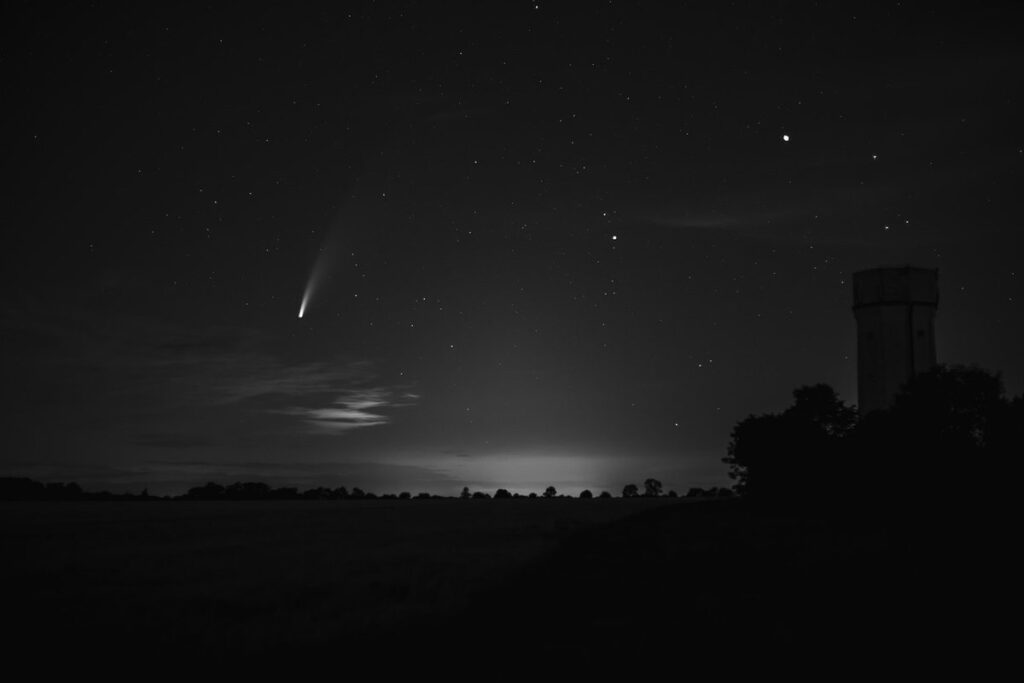
What is a Comet and its Orbit?
A comet is a small, icy body that orbits the Sun, composed of dust and frozen gases. Understanding their unique orbital paths is key to grasping the significance of perihelion.
Defining Comets and their Composition
Comets are icy celestial bodies composed primarily of dust and frozen gases, such as water, methane, and ammonia. As they approach the Sun, these ices vaporize, creating a bright tail of gas and dust that can be seen from Earth. The formation of comets is still not fully understood, but it’s believed to occur in the outer reaches of the solar system, where temperatures are low enough for volatile compounds to condense.
Comets have three distinct regions: the nucleus, coma, and tail. The nucleus is the central, solid body, while the coma is the surrounding cloud of gas and dust that forms when the comet approaches the Sun. The tail is made up of charged particles, such as electrons and protons, which are swept back by the solar wind.
There are several types of comets, including short-period and long-period comets. Short-period comets have highly elliptical orbits and pass close to the Sun relatively frequently, while long-period comets have more circular orbits and make few close approaches to the Sun.
Types of Cometary Orbits and their Characteristics
There are two main categories of cometary orbits: short-period and long-period comets. Short-period comets have orbital periods of less than 200 years, meaning they complete at least one orbit around the Sun within that timeframe. These comets originate from the Kuiper Belt or Oort Cloud and are thought to be remnants from the solar system’s formation. Halley’s Comet is a well-known example of a short-period comet.
Long-period comets have orbital periods exceeding 200 years, taking thousands or even millions of years to complete one orbit around the Sun. They often originate from the Oort Cloud, a distant, spherical shell surrounding our solar system. Long-period comets are typically less active and may not always exhibit a tail during perihelion.
To better understand the characteristics of short- and long-period comets, consider their paths relative to the major planets in our solar system. Short-period comets tend to follow more elliptical orbits that bring them closer to the inner planets, whereas long-period comets have more eccentric orbits that can take them farther out towards the outer reaches of the solar system.
Some comets exhibit even more extreme orbital characteristics, such as hyperbolic trajectories that carry them away from the Sun’s gravitational influence.
The Importance of Perihelion in Comet Science
Comet perihelion is a critical event that determines the fate of these celestial visitors, and understanding its impact is crucial for scientists studying comets. We’ll examine how perihelion affects a comet’s behavior and evolution.
What is Perihelion and its Significance for Comets
Perihelion is a critical point in a comet’s orbit, marking the closest approach to the Sun. At perihelion, comets are at their most active, with increased gas and dust emissions due to the intense solar radiation. This phenomenon has significant implications for understanding cometary behavior.
Comets’ composition and structure become more apparent during perihelion, allowing scientists to gather valuable insights into their makeup. The varying rates of activity among comets can be attributed to differences in their orbital paths and the amount of dust and gas they release at perihelion. For instance, Halley’s Comet is known for its high levels of dust emission during its 1986 perihelion passage.
The significance of perihelion lies not only in its occurrence but also in its predictability. By understanding a comet’s orbital path and perihelion date, astronomers can anticipate increased activity and potentially observe the comet at its most visible point. This knowledge is crucial for planning observational campaigns and gathering data on cometary behavior.
A key aspect of perihelion is the interaction between solar radiation and cometary material. Scientists often use perihelion as a focal point to study the effects of intense solar heating on cometary ices, providing valuable information about their composition and evolution.
How Perihelion Affects Comet Activity and Visibility
As a comet approaches perihelion, its activity increases significantly. This is because the Sun’s intense radiation and heat cause the comet’s ices to vaporize, releasing gases such as water, methane, and carbon dioxide into space. These gases form a coma around the comet, making it visible from Earth.
The formation of a coma is influenced by several factors, including the comet’s size, shape, and composition. Smaller comets tend to have more compact comae due to their lower ices-to-gas ratio. In contrast, larger comets can develop extensive comae as they release more gas and dust.
Perihelion also affects tail development, with some comets forming long, straight tails while others produce short, wispy ones. The shape of the comet’s tail is determined by its speed, direction, and the solar wind’s interaction with the coma.
Key factors influencing a comet’s activity include:
- Distance from the Sun: Comets typically become most active within 1-2 astronomical units (AU) of perihelion
- Composition: Comets rich in volatile compounds tend to produce more gas and dust as they approach perihelion
- Size and shape: Larger comets with irregular shapes can develop more extensive coma and tail systems
Calculating and Predicting Perihelion Events
Now that we’ve discussed what perihelion is, let’s talk about how astronomers calculate when a comet will make its closest approach to the Sun. This process involves complex math and astronomical observations.
Methods for Determining Comet Orbits and Perihelion Dates
Astronomers rely on a combination of observations, simulations, and mathematical models to determine cometary orbits and predict perihelion dates. One key method is orbital fitting, where scientists use historical observations to refine the comet’s orbit and estimate its perihelion date. This process involves analyzing the comet’s motion over time, taking into account gravitational influences from nearby celestial bodies.
Simulations also play a crucial role in predicting perihelion events. By modeling the comet’s trajectory under various scenarios, astronomers can test different orbital paths and identify potential pitfalls. These simulations help to refine predictions and minimize uncertainties.
Mathematical models, such as those based on Newtonian mechanics or general relativity, provide another essential tool for determining cometary orbits. These models account for gravitational forces from both the Sun and other planets, allowing scientists to estimate perihelion dates with greater accuracy.
Astronomers may also use data from space-based observatories like the Hubble Space Telescope or the Spitzer Space Telescope to refine their calculations. By combining multiple lines of evidence, researchers can arrive at a more accurate prediction for the comet’s perihelion date.
Challenges and Uncertainties in Predicting Perihelion Events
Astronomers face significant challenges when predicting perihelion events due to uncertainties in comet orbits and observational limitations. One major challenge is the inherent unpredictability of cometary orbits, which can be influenced by various factors such as solar winds, planetary perturbations, and gravitational interactions with other celestial bodies. As a result, even small errors in initial conditions or orbital parameters can lead to significant deviations from predicted trajectories.
Observational limitations also play a crucial role in predicting perihelion events. Comets are often faint and difficult to detect, especially when they approach the Sun. Astronomers rely on accurate measurements of cometary positions, velocities, and brightness to predict their orbits. However, these measurements can be affected by telescope resolution, atmospheric conditions, and instrumental errors.
To mitigate these challenges, astronomers use a combination of ground-based observations, space-based telescopes, and sophisticated computational models. They also make adjustments based on historical data and orbital corrections from previous perihelion events. Despite these efforts, uncertainties remain a significant concern in predicting perihelion events, emphasizing the importance of continued research and observation to improve our understanding of comet dynamics.
Comet Perihelion Events Throughout History
Let’s take a journey through history and explore some of the most notable comet perihelion events that have captured the world’s attention over the centuries, revealing fascinating insights into our celestial neighbors. From Halley’s Comet to Hale-Bopp, we’ll examine the significant close approaches that have made headlines.
Notable Cometary Perihelions in Human History
Comets have been a source of fascination and often fear throughout human history. Some notable cometary perihelions stand out for their impact on culture and science. One such event occurred in 1066 when Halley’s Comet appeared shortly before the Norman Conquest of England. The comet was seen as an omen by many, including the English historian William of Malmesbury.
Another significant appearance was that of Comet Hale-Bopp in 1997, which drew widespread attention and sparked a flurry of scientific interest due to its large size and unusual orbit. This event highlighted the importance of perihelion in comet science and marked a turning point in the field as scientists began to better understand cometary behavior.
In contrast, the appearance of Comet ISON in 2013 was notable for its close approach to the Sun and potential for spectacular displays. Unfortunately, it disintegrated before reaching perihelion, offering valuable insights into comet fragmentation dynamics. These events demonstrate the significance of comets in human history and underscore the need for continued research into their behavior and properties.
The Science Behind Historical Comet Sightings and Records
Historical comet sightings and records are often shrouded in myth and legend. However, by examining these accounts through a scientific lens, we can begin to separate fact from fiction. Many historical comets were likely recorded by astronomers, but the accuracy of their observations varied greatly depending on the tools and knowledge available at the time.
Astronomers like Halley’s Comet have been tracked across centuries, providing valuable insights into comet behavior. However, ancient accounts often lack specific details about the comet’s appearance, brightness, or trajectory. This can make it challenging to verify these sightings using modern astronomical methods.
To better understand historical comet records, researchers rely on a combination of traditional astronomical techniques and digital analysis of original texts. By transcribing and digitizing these documents, scientists can apply advanced image processing and machine learning algorithms to enhance the visibility of faint comet signatures.
For example, a team of researchers used this approach to analyze ancient Roman accounts of a comet sighting in 44 BCE. They were able to identify characteristic features like gas tails and debris trails that supported the existence of a real comet event. By applying similar methods to other historical records, scientists can continue to uncover new insights into the behavior of comets during their perihelion events.
Observing and Studying Cometary Perihelia
When a comet approaches perihelion, astronomers closely monitor its behavior to learn more about these icy visitors. This is where observing and studying cometary perihelia become crucial for advancing our understanding of comets.
Methods for Telescopic Observation and Data Collection
When observing comets during perihelion, telescopic observations play a crucial role in gathering data and understanding their behavior. One method is spectroscopy, which involves analyzing the light emitted or absorbed by the comet’s atmosphere to determine its composition and temperature. Astronomers can use specialized instruments like spectrometers to break down the light into its individual components, revealing details about the comet’s chemical makeup.
Another technique used in telescopic observation is imaging spectroscopy, where astronomers capture both the spectrum and visual images of the comet simultaneously. This allows for a more comprehensive understanding of the comet’s structure and activity. Spacecraft missions have also greatly enhanced our ability to study comets during perihelion. For example, NASA’s Deep Impact mission in 2005 intentionally collided with Comet Tempel 1 to gather data on its composition.
To conduct telescopic observations, astronomers typically use a combination of ground-based and space-based telescopes. Ground-based telescopes like the Hubble Space Telescope can provide high-resolution images and spectra of the comet, while space-based telescopes like the Keck Observatory offer unparalleled sensitivity for detecting faint signals from distant comets.
Current Research and Future Missions Focused on Comet Science
Scientists are actively pursuing new research and missions focused on comet science. The European Space Agency’s Comet Interceptor mission, set to launch in 2029, will explore a yet-to-be-discovered comet. This mission aims to study the composition and structure of comets up close.
NASA’s Double Asteroid Redirection Test (DART) mission has provided valuable insights into the gravity and composition of small bodies like asteroids. Building on this experience, NASA is currently planning a Comet Surface Sample Return mission to collect and analyze samples from a comet’s surface. This would provide unprecedented data about comets’ composition and evolution.
The Atacama Large Millimeter/submillimeter Array (ALMA) in Chile has been used to study the gas and dust emissions of comets during perihelion. Researchers are also utilizing machine learning algorithms to analyze large datasets from previous comet missions, such as the European Space Agency’s Rosetta mission, which orbited Comet 67P/Churyumov-Gerasimenko.
These ongoing efforts will significantly advance our understanding of comets and their role in the solar system.
Implications of Comet Perihelion for Space Exploration and Science
Comet perihelion has significant implications for space exploration, from navigating close encounters to refining our understanding of celestial bodies. This has far-reaching consequences for scientists and researchers.
Potential Applications of Comet Research in Space Exploration
Studying comets offers a unique window into the formation and evolution of our solar system. By examining the composition and structure of these ancient bodies, scientists can gain insights into the conditions that existed during the early days of our cosmic neighborhood. For instance, comets’ primitive, unaltered state makes them ideal for studying the origins of our solar system’s building blocks: water, organic molecules, and other essential ingredients.
One significant application of comet research lies in searching for resources beyond Earth. Comets may harbor frozen reserves of water ice, a crucial commodity for future space missions. The European Space Agency’s Rosetta mission successfully landed on Comet 67P/Churyumov-Gerasimenko in 2014 and revealed its subsurface layers. Similar discoveries could pave the way for extracting resources from cometary bodies or even transforming them into fuel.
Comets may also hold secrets to understanding how life begins and evolves beyond our planet. The presence of complex organic molecules in some comets suggests a potential source of extraterrestrial life forms. Further research can help determine whether comets played a role in seeding Earth with its first microorganisms, thus providing answers to humanity’s most enduring questions about the origins of life.
Future Directions for Comet Science and Research
As researchers continue to study comets and their perihelion events, several future directions emerge for advancing comet science and research. One key area of focus is the exploration of cometary atmospheres using advanced spectrographic instruments capable of detecting subtle changes in gas composition and temperature. For instance, NASA’s Deep Impact mission successfully demonstrated the potential for in-situ analysis of cometary particles and gases. Building on this success, future missions like the European Space Agency’s Comet Interceptor could provide unprecedented insights into cometary atmospheres.
Another important direction is the development of more accurate predictive models for perihelion events. By combining data from past observations with cutting-edge computational simulations, scientists can improve their ability to forecast comet orbits and perihelion dates. This, in turn, enables more effective planning for observation campaigns and reduces the likelihood of missed opportunities.
Additionally, researchers are working to better understand cometary nuclei through the analysis of returned samples or the deployment of landers on cometary surfaces. The Rosetta mission, which orbited Comet 67P/Churyumov-Gerasimenko in 2014-2015, set a precedent for this approach. Future missions may follow suit, providing valuable data on cometary composition and evolution.
Frequently Asked Questions about Comet Perihelion
Comet perihelion is often misunderstood as a rare event, but it’s actually an annual occurrence for many comets. However, most comets are not visible from Earth due to their distant orbits and low brightness. To spot a comet at perihelion, you need to know the right time and location.
A common misconception about comet perihelion is that it occurs when a comet passes extremely close to the Sun. While this is partially true, comets typically come within 1-5 astronomical units (AU) of the Sun during their closest approach. For perspective, Mercury’s orbit averages around 0.39 AU from the Sun.
Some comets are more likely than others to be visible at perihelion due to their brightness and orbital patterns. For instance, Comet Halley is one of the brightest comets in history and passes within 1 AU of the Sun every 76 years.
Frequently Asked Questions
Can I predict when a comet will next reach perihelion?
Yes. Astronomers use various techniques such as observations, simulations, and mathematical models to calculate cometary orbits and predict perihelion dates. By analyzing the comet’s orbital characteristics and historical data, astronomers can estimate the likelihood of a future perihelion event.
How do I participate in comet research or contribute to ongoing studies?
Comet research often relies on observations from amateur astronomers and citizen science projects. You can contribute by participating in online projects such as Zooniverse or OpenSNP, which allow you to analyze data and help scientists with their research. Additionally, many space agencies offer opportunities for students and researchers to collaborate on comet-related projects.
Can I observe a comet during perihelion without specialized equipment?
While it’s challenging to observe a comet without proper equipment, you can still follow the event using online resources such as NASA’s Comet Observation Campaign or the International Astronomical Union’s (IAU) Comet Section. These websites provide updates on comet positions, visibility charts, and tips for observing comets.
What if I spot a comet approaching perihelion but it’s not in any catalog or database?
If you suspect that you’ve spotted a new or previously unknown comet, report your observation to the Minor Planet Center (MPC) or the IAU’s Comet Section. Provide as much detail as possible about the comet’s position, brightness, and other relevant characteristics. Astronomers will then verify your sighting and determine if it’s a new comet.
Can comets be used for space exploration or resource extraction in the future?
Yes, studying comets can provide valuable insights into the formation and evolution of our solar system. Comets may also harbor resources such as water ice, which could be exploited for future space missions. While currently, there are no plans to extract resources from comets, ongoing research aims to better understand their composition and potential uses in space exploration.