
Are you ready to explore one of the most fascinating galaxies in our universe? The Sombrero Galaxy, also known as Messier 104 (M104), is a majestic spiral galaxy that has captivated astronomers and space enthusiasts for centuries. This magnificent celestial body boasts unique physical characteristics that set it apart from other galaxies, making it an ideal subject for research and study. With its rich star formation regions and significant astronomical importance, the Sombrero Galaxy holds many secrets waiting to be unraveled. In this article, we’ll delve into the history of this incredible galaxy, explore its composition, and discuss the exciting research opportunities that make the Sombrero Galaxy so essential to our understanding of the universe. Let’s embark on a journey to uncover the mysteries of this cosmic wonder!
Introduction to the Sombrero Galaxy
Let’s take a closer look at what makes the Sombrero Galaxy so unique, from its distinctive shape to its incredible mass. You’ll be amazed by the fascinating facts about this cosmic wonder.
What is the Sombrero Galaxy?
Located approximately 28 million light-years away from Earth, the Sombrero Galaxy is a majestic spiral galaxy that has been captivating astronomers and space enthusiasts alike for centuries. This cosmic wonder is not only breathtakingly beautiful but also holds significant importance in the field of astronomy.
The Sombrero Galaxy, officially designated as Messier 104 (M104), is a type of galaxy known as a Seyfert galaxy, characterized by its active galactic nucleus (AGN). This means that at its center lies a supermassive black hole, which actively accretes material from the surrounding interstellar medium. The galaxy’s unique shape and structure make it an ideal subject for studying the evolution of galaxies and the behavior of supermassive black holes.
As one of the most well-studied galaxies in our cosmic neighborhood, the Sombrero Galaxy has provided valuable insights into the dynamics of galaxy formation and evolution. Its striking appearance and fascinating properties have made it a favorite among astronomers and astrophysicists, who continue to unravel its secrets with each new discovery.
History of Discovery and Observations
The discovery of the Sombrero Galaxy dates back to 1781 when French astronomer Charles Messier first observed it. Initially, he thought it was a nebula due to its striking appearance. However, later astronomers like William Herschel classified it as an SBb type spiral galaxy in the late 18th century. This classification was significant because it placed the Sombrero Galaxy among other spiral galaxies with prominent central bulges and loosely wound arms.
Notable observations of the Sombrero Galaxy include its remarkable disk structure and massive central black hole. The galaxy’s iconic appearance earned it the nickname “Sombrero” due to its resemblance to a Mexican hat. Interestingly, this celestial body has also been associated with various cultural references. For instance, the Native American tribe of Zuni considers the Sombrero Galaxy as a sacred entity.
The Sombrero Galaxy is significant not only for its unique structure but also for its immense size and mass. It contains hundreds of billions of stars, making it one of the largest galaxies in our local universe.
Physical Characteristics and Structure
The Sombrero Galaxy is a majestic spiral galaxy, and understanding its physical characteristics and structure is key to unlocking its secrets. Let’s dive into what makes this cosmic wonder so unique in terms of its shape, size, and composition.
Morphology and Size
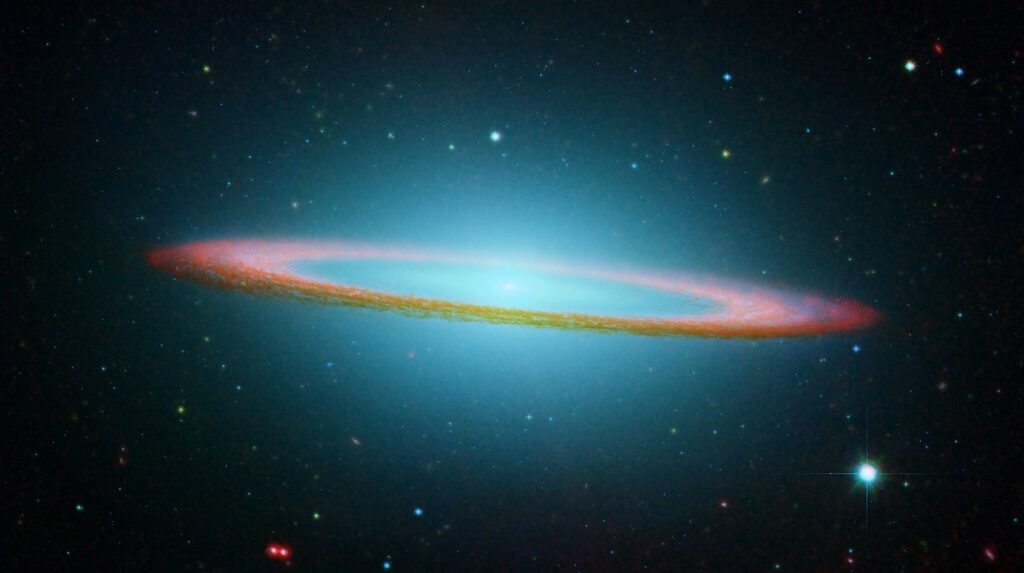
One of the most striking features of the Sombrero Galaxy is its unique morphology. Looking at images of this cosmic wonder, you’ll notice a prominent central bulge surrounded by sweeping spiral arms that stretch out from the center like a grand umbrella. These arms are home to vibrant young stars and are characterized by prominent dust lanes that resemble the delicate patterns on a traditional Mexican sombrero.
In terms of size, the Sombrero Galaxy measures approximately 50,000 light-years in diameter, making it one of the largest galaxies in the local universe. Its mass is estimated to be around 100 billion solar masses, with a total luminosity of about 26 billion times that of our sun. To put these numbers into perspective, consider this: if the Sombrero Galaxy were placed at the center of the Milky Way, its diameter would span from the Sun to the edge of the Oort Cloud, a region of icy bodies and comets that surrounds our solar system.
When viewed through a telescope or binoculars, the Sombrero Galaxy appears as a stunning cosmic sight. Its massive central bulge is a reminder of the galaxy’s complex evolution over billions of years, with stars formed in various stages of their lifecycle embedded within its core.
Star Formation Regions and Stellar Populations
The Sombrero Galaxy’s star formation regions are scattered throughout its vast disk, playing a crucial role in shaping its overall structure and evolution. These regions are areas where new stars are born from dense molecular clouds of gas and dust. One notable example is the central bulge, which houses a high concentration of young, massive stars that have formed relatively recently.
The Sombrero Galaxy also boasts various stellar populations that contribute to its diverse star formation history. Red giants, for instance, are abundant in the galaxy’s older regions, their bright colors and large sizes making them easily distinguishable from more distant stars. Meanwhile, main-sequence stars, which represent the majority of the galaxy’s population, can be found across different regions, including the outer disk where new star formation is active.
As we continue to study the Sombrero Galaxy, astronomers are gaining a deeper understanding of its stellar populations and their impact on its evolution. By examining the types and distributions of stars within these regions, researchers can piece together the galaxy’s history, shedding light on key events that have shaped it over billions of years.
Composition and Evolutionary History
Let’s dive into the sombrero galaxy’s composition, where its iconic spiral arms are woven together by young stars and gas. We’ll also explore how it evolved over billions of years.
Dust and Gas Content
As we continue to explore the intricacies of the Sombrero Galaxy, it’s essential to delve into its dust content. The Sombrero Galaxy, also known as Messier 104 (M104), is a barred spiral galaxy that boasts an impressive amount of interstellar dust. This dusty material plays a crucial role in star formation within the galaxy.
The distribution of dust in the Sombrero Galaxy is quite striking. Dark lanes of dust can be seen stretching across its face, particularly noticeable in the central regions. These dark lanes are a result of dense clouds of gas and dust that block our view of the stars behind them. They also serve as nurseries for new star formation, providing the necessary material for protostars to form.
One of the most notable features related to the Sombrero Galaxy’s dusty regions is its central bulge. This region is home to a vast amount of older, redder stars that are surrounded by a halo of dust. The dust in this area is thought to be the result of mass loss from these aging stars.
The role of dust in the Sombrero Galaxy cannot be overstated. It provides the raw material for star formation and helps regulate the galaxy’s temperature and chemistry. As we continue to study the Sombrero Galaxy, understanding its dust content will remain a crucial aspect of unraveling its secrets.
Galactic Interactions and Mergers
The Sombrero Galaxy’s unique shape and structure have sparked intense debate among astronomers about its evolutionary history. One of the most significant factors that may have contributed to its distinctive appearance is the series of mergers and interactions it has undergone with nearby galaxies.
Numerous studies suggest that the Sombrero Galaxy, also known as Messier 104 (M104), was involved in a massive merger event around 100 million years ago. This collision would have triggered a chain reaction of star formation, gas compression, and subsequent disk distortion. The galaxy’s central bar, thought to be composed of older stars, may be the remnant of a smaller satellite galaxy that merged with Sombrero Galaxy.
Observations also indicate that M104 has interacted with several other galaxies in the past, including the recently discovered satellite galaxy, PGC 36127. These encounters would have stripped away gas and triggered bursts of star formation, further shaping the galaxy’s morphology.
Astronomical Significance and Research Opportunities
As we continue to unravel the mysteries of the Sombrero Galaxy, let’s dive into its astronomical significance and explore the exciting research opportunities that lie ahead for astronomers.
Scientific Importance
The Sombrero Galaxy’s significance extends far beyond its breathtaking appearance. As one of the most extensively studied galaxies in the universe, it has provided invaluable insights into galaxy evolution, star formation, and the role of dark matter in large-scale structures.
Galaxy evolution is a complex process that involves the formation and merger of galaxies over billions of years. The Sombrero Galaxy offers a unique window into this process due to its relatively pristine state, meaning it hasn’t undergone significant mergers or interactions with other galaxies. By studying its disk structure and spiral arms, astronomers have been able to understand how gas and dust are distributed within galaxies, shedding light on the mechanisms that drive star formation.
Research initiatives focused on the Sombrero Galaxy include ongoing surveys to map its detailed stellar population and the distribution of dark matter within its halo. Future studies will continue to leverage this galaxy’s unique properties to explore fundamental questions in astrophysics, making it an exciting area of research for astronomers and cosmologists alike.
Observational Challenges and Future Studies
Studying the Sombrero Galaxy poses several observational challenges due to its vast distance from us. Located approximately 28 million light-years away, it appears as a disk-shaped galaxy that is nearly 50,000 light-years in diameter. This immense size and staggering distance make it difficult for telescopes to capture detailed images of its structures.
The interstellar medium properties within the Sombrero Galaxy also pose a challenge. Its dense gas clouds and dust can absorb or scatter the light we receive from stars and other objects, making it harder to study these components accurately. Furthermore, the strong stellar winds emanating from the galaxy’s central black hole contribute to this obscuration, limiting our ability to observe certain features.
Future studies using advanced telescopes and instruments will greatly aid in overcoming these challenges. Next-generation space-based observatories like the James Webb Space Telescope will allow scientists to study the Sombrero Galaxy’s structure and composition with unprecedented detail.
Conclusion and Final Thoughts
As we conclude our journey through the Sombrero Galaxy, let’s summarize the key takeaways from our exploration of this cosmic wonder and its fascinating features.
Recap of Key Points
In conclusion, our journey through the Sombrero Galaxy has revealed a wealth of fascinating features that make it one of the most captivating celestial bodies in the universe. This majestic spiral galaxy boasts a prominent central bulge and a sweeping disk of stars, gas, and dust, which gives it its distinctive sombrero-like shape.
We’ve discussed how the Sombrero Galaxy’s unique rotation pattern sets it apart from other galaxies, with its stars and gas rotating at different speeds around the galactic center. This peculiarity is a result of the galaxy’s massive central bulge, which exerts a strong gravitational pull on nearby stars and gas.
The Sombrero Galaxy’s significance in astronomy lies in its ability to provide valuable insights into the formation and evolution of galaxies. Its peculiar rotation pattern and prominent central bulge make it an ideal subject for study, offering scientists a unique opportunity to learn more about the mysteries of galaxy formation and evolution.
Future Directions and Exploration
As we conclude our journey through the Sombrero Galaxy, it’s exciting to think about the many mysteries that still await discovery. With its unique ring-like structure and active galactic nucleus, this cosmic wonder continues to captivate astronomers and astrophysicists alike.
Future research directions may focus on unraveling the secrets of the galaxy’s central black hole, which is currently shrouded in mystery. By studying the black hole’s behavior and activity, scientists hope to gain insights into the fundamental laws of physics that govern the universe.
One potential area of exploration is the use of advanced telescopes and observational techniques to study the Sombrero Galaxy’s stars and stellar populations. This could provide valuable information about the galaxy’s formation history and evolution over billions of years.
As new discoveries are made, it’s essential for you, our curious readers, to stay up-to-date on the latest findings. Follow reputable astronomy sources, such as NASA or the European Space Agency, to learn about the most recent research and breakthroughs in the field. Who knows? Perhaps one day, a discovery related to the Sombrero Galaxy will change our understanding of the universe forever!
Frequently Asked Questions
What are some exciting research opportunities associated with the Sombrero Galaxy?
The Sombrero Galaxy offers a wealth of research opportunities, particularly in understanding galaxy evolution and star formation. Scientists can study its massive central bulge, which provides insights into the galaxy’s history, as well as its extensive star-forming regions, where new stars are being born. Additionally, researchers can investigate the interactions between the Sombrero Galaxy and nearby galaxies, shedding light on the processes that shape our universe.
Can I see the Sombrero Galaxy in a backyard telescope?
Yes! With a modest-sized telescope (4-6 inches) and a good observing site with minimal light pollution, you should be able to spot the Sombrero Galaxy. It’s visible in the constellation Virgo and can be identified by its distinctive central bulge and surrounding halo of stars. Be sure to use a star chart or planetarium software to help locate this celestial wonder.
How does the Sombrero Galaxy compare to other spiral galaxies?
The Sombrero Galaxy is one of the most massive and luminous spiral galaxies in the local universe, but it’s also relatively close to us (28 million light-years away). This proximity makes it an excellent target for detailed studies. Unlike some other spiral galaxies, the Sombrero Galaxy has a low level of star formation activity, which allows astronomers to better understand the processes that regulate galaxy evolution.
Can I explore more about the Sombrero Galaxy’s composition and evolutionary history?
Yes! Researchers have used a variety of techniques, including spectroscopy and imaging data from space-based telescopes like Hubble and Chandra. These studies reveal that the Sombrero Galaxy is primarily composed of stars, with significant amounts of interstellar gas and dust. The galaxy’s central bulge is thought to be the result of mergers and interactions with smaller galaxies.
How can I stay up-to-date on new discoveries related to the Sombrero Galaxy?
Stay informed about recent research through scientific publications like The Astrophysical Journal or Astronomy & Astrophysics. You can also follow reputable astronomical organizations, such as NASA or the International Astronomical Union, which often release updates and press releases about significant findings in the field of astronomy.