
Venus, often referred to as Earth’s twin due to its striking similarity in size and composition. However, this bright planet has one major difference: its visibility. As the brightest planet in our night sky, Venus is a treat for stargazers, but when and where can we see it at its most radiant?
If you’re eager to catch a glimpse of Venus shining brightly, you’re not alone. But did you know that there are optimal times and seasons to witness this celestial spectacle? With the right information, you’ll be able to pinpoint the best time to see Venus and make the most of your stargazing adventures.
In this article, we’ll delve into the visibility patterns of Venus, explore the ideal viewing seasons, and provide expert tips on essential equipment for maximum visibility. Whether you’re a seasoned astronomer or an amateur stargazer, get ready to unlock the secrets of spotting Venus at its brightest!
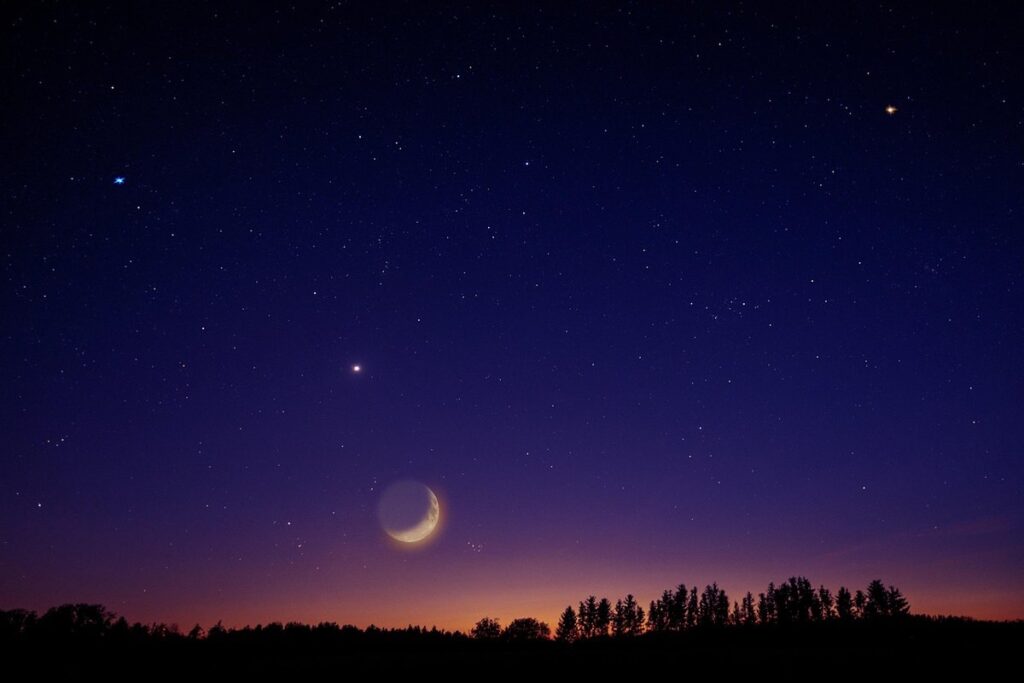
Understanding Venus’ Visibility Patterns
To make the most of your stargazing adventures, it’s essential to understand when and how Venus is visible from Earth. Let’s dive into its visibility patterns and how they affect our view.
Factors Influencing Venus’ Visibility
The visibility of Venus in the sky can be influenced by various factors beyond just its orbit. Atmospheric conditions play a significant role in determining how easily we can spot Venus. Haze, dust, and pollution in the atmosphere can reduce the planet’s brightness, making it harder to see. On clear nights with minimal air pollution, Venus is more likely to shine brightly. For instance, cities like Los Angeles often struggle to spot Venus due to high levels of air pollution.
Lunar phases also impact our ability to see Venus. When the moon is in its waxing or waning crescent phase, it can outshine Venus and make it difficult to detect. However, during the new moon phase, when the sky is darker, Venus becomes more visible. Be aware that if you’re trying to spot Venus near a full moon, be prepared for a challenging viewing experience.
Planetary alignments with other bright objects in the sky also affect visibility. For instance, Venus can be eclipsed by bright stars or other planets during certain periods of its orbit. When planning your stargazing sessions, keep an eye on these factors to maximize your chances of spotting this beautiful planet.
Types of Celestial Events Featuring Venus
Venus is at its most spectacular when it participates in rare celestial events that bring it into close proximity with other planets and stars. One of these events is the conjunction, where Venus appears to merge with another planet or star, creating a striking visual effect.
During an opposition, Venus shines brightly as Earth passes between it and the Sun, making it visible all night long. This is one of the best times to observe Venus, as it reaches its highest point in the sky around midnight.
Occultations occur when Venus appears to pass behind or in front of other celestial objects, such as stars or planets, temporarily hiding them from view. These events are relatively rare and offer a unique opportunity for stargazers to witness something extraordinary.
If you’re planning to observe an occultation, be sure to check the specific timing and location to avoid disappointment. With practice and patience, you can become proficient in identifying these rare celestial events and making the most of your time under the stars.
Choosing the Best Time to Observe Venus
When planning to observe Venus, timing is everything. In this section, we’ll guide you on how to choose the best time to spot our nearest planetary neighbor in the night sky.
Optimal Viewing Seasons for Different Hemispheres
When planning to observe Venus, it’s essential to consider the planet’s position relative to your location on Earth. The optimal viewing seasons for Northern and Southern hemispheres differ due to planetary positions and atmospheric conditions.
For observers in the Northern Hemisphere, the best time to see Venus is during its eastern elongation in late winter or early spring (February to April) and again during western elongation in late summer or early fall (August to October). At these times, Venus rises before the sun and can be seen in the morning sky. Conversely, when Venus is at its peak brightness, usually around March or September, it’s best viewed after sunset.
In contrast, observers in the Southern Hemisphere should look for Venus during its eastern elongation in late winter (June to August) and western elongation in late summer (December to February). Keep in mind that these periods coincide with opposite seasons due to Earth’s axial tilt. When planning your viewing session, consider the planet’s brightness and altitude above the horizon to maximize visibility.
How to Use Planetary Orbits for Better Visibility
When planning your stargazing sessions, consider using Venus’ orbit around the Sun to maximize observation opportunities. Since Venus is an inner planet, its path across the sky is influenced by its proximity to our solar system’s central star. By understanding the planet’s orbital pattern, you can pinpoint the best time to spot it.
Venus orbits the Sun at a relatively fast pace, completing one rotation in approximately 225 Earth days. As it moves through its orbit, Venus appears to shift between the bright evening sky and the dark morning sky. The best time to observe Venus is when it’s visible for extended periods in a single location. This usually occurs when the planet is at its closest point (perihelion) or farthest point (aphelion) from Earth.
To capitalize on these orbital patterns, plan your observations around key dates:
• When Venus is at perihelion (usually in early January), it’s about 0.28 AU away and appears bright in the western sky after sunset.
• Around aphelion (typically in late July), Venus is approximately 1.24 AU from Earth and shines brightly before sunrise.
By scheduling your observations around these orbital milestones, you can catch Venus at its most visible and striking stages.
Identifying Venus in the Sky
To spot Venus, you’ll need to know how to locate it among the stars and planets, which can be tricky, especially for beginners. We’ll show you exactly where to look.
Characteristics and Features to Look For
When it comes to identifying Venus in the sky, there are several key characteristics and features that make it stand out from other celestial objects. One of the most notable is its brightness. On a clear night, Venus can shine with a brilliance that’s hard to ignore. In fact, it’s often visible even in urban areas where light pollution is high.
To distinguish Venus from the Moon or nearby stars, look for its distinctive “twinkling” effect. Unlike the steady glow of the Moon, Venus will appear to wink on and off as it moves through the atmosphere. This is due to a phenomenon called scintillation, which occurs when light passes through different layers of air with varying temperatures and densities.
Another way to identify Venus is by its proximity to Earth. As one of our nearest celestial neighbors, it’s often visible in the western or eastern sky during early morning or late evening hours. If you see a bright planet hovering near the horizon, chances are it’s Venus!
Avoiding Common Mistakes for Amateur Astronomers
As you begin your journey to spot Venus, it’s essential to be aware of common mistakes that can hinder your chances of success. Amateur astronomers often overlook the importance of proper equipment and techniques, which can lead to frustration and disappointment.
One critical mistake is attempting to observe Venus during its brightest phase without adequate light pollution protection. Venus shines brightly in the sky, but its proximity to the sun makes it difficult to see in urban areas. To overcome this challenge, invest in a good pair of binoculars or a telescope with a solar filter to safely view Venus.
Another common error is misidentifying other celestial objects as Venus. Be aware that Venus can be mistaken for bright stars like Sirius or Arcturus, especially during its brightest phases. Take your time to observe and note the planet’s position in relation to nearby constellations to ensure accuracy.
Lastly, don’t underestimate the importance of patience and persistence when searching for Venus. It may take several attempts to spot it due to atmospheric conditions or light pollution. Practice regular observation sessions to develop your skills and increase your chances of success.
Preparing Your Observation Equipment
Before you head out to observe Venus, let’s make sure your equipment is ready for the task. This involves checking and preparing your telescope or binoculars for optimal viewing conditions.
Essential Tools for Stargazing: Telescopes and Binoculars
When it comes to observing Venus, having the right equipment is crucial. You’ll want to invest in a telescope or binoculars that can provide clear and stable images of our nearest planetary neighbor.
For stargazing beginners, a good pair of binoculars with magnification power between 7x50mm and 10x50mm would be an excellent starting point. This range allows for sharp views of Venus without being too cumbersome to carry around. Look for binoculars with ED (Extra-Low Dispersion) or HD (High Definition) glass, which can reduce chromatic aberration and provide a more accurate representation of the planet’s atmosphere.
When it comes to telescopes, you’ll want to consider a refractor or reflector model with an aperture between 60mm and 100mm. These sizes offer an optimal balance between light gathering capabilities and portability. Some popular options for amateur astronomers include the Celestron FirstScope Reflector Telescope and the Meade Instruments Infinity 102mm AZ Refractor Telescope.
Remember, the key to capturing stunning images of Venus is not just about the equipment but also about knowing when to observe it. Stay tuned to our next section for expert advice on timing your stargazing sessions!
Tips for Choosing the Right Location for Observation
When it comes to spotting Venus in the night sky, finding the right location for observation is crucial. Minimal light pollution and atmospheric stability are key factors to consider when selecting a site.
Look for areas far away from city lights, which can make stars harder to see. A dark-sky preserve or a spot with minimal artificial lighting will greatly improve your chances of catching Venus in all its glory. The Atacama Desert in Chile, for instance, is renowned for its incredibly low light pollution levels and offers some of the best stargazing opportunities on the planet.
Atmospheric stability is equally important. Avoid locations prone to temperature fluctuations or atmospheric conditions that can distort your view. Mountainous regions with clear skies tend to be ideal. Remember, Venus’s proximity to Earth means it can appear as a bright, shining disk in the sky – and you want every advantage when trying to spot it.
When possible, choose a location with minimal humidity and cloud cover. This will not only help you see Venus more clearly but also reduce the risk of equipment malfunction or distortion.
Advanced Techniques for Enhancing Visibility
Want to make the most of your stargazing sessions? This section will show you advanced techniques for optimizing Venus visibility, elevating your viewing experience.
Using Technology to Enhance Viewing Experiences
In today’s world of advanced technology, there are numerous tools that can make locating Venus a breeze. Mobile apps such as Sky Map or Stellarium Mobile allow you to hold up your phone and identify constellations, including Venus, in real-time. These apps use the device’s location and time to provide an accurate representation of the night sky.
Planetarium software like Celestron’s SkyPortal or Starry Night can also be a valuable resource for stargazers. These programs enable you to simulate various viewing scenarios, including the position of Venus at different times of the year. This feature is particularly useful for planning your observing sessions and ensuring that you’re in the best location to spot Venus.
Specialized hardware such as binoculars or telescopes can also enhance your viewing experience. For instance, using a tripod-mounted telescope with a good quality eyepiece can reveal the planet’s phases, making it easier to distinguish from other celestial objects.
Expert Strategies for Observing Planetary Details
When observing Venus, even with the best equipment and optimal viewing conditions, capturing its surface features and atmospheric phenomena can be a challenging task. To overcome this hurdle, experienced astronomers employ several advanced techniques that you can incorporate into your stargazing routine.
One such technique is to use adaptive optics, which corrects for the distortions caused by Earth’s atmosphere, allowing for sharper images of Venus’ surface. By integrating an adaptive optics system with a high-resolution telescope or camera, you can achieve unparalleled clarity and detail in your observations.
Another strategy involves observing Venus during its crescent phase, when it is closest to Earth. At this stage, the planet appears larger and brighter, making it easier to discern subtle details such as volcano formations and atmospheric cloud patterns. You can also try capturing images or videos of Venus using specialized software that enhances contrast and reveals hidden features.
When examining Venus’ atmosphere, pay attention to its swirling clouds of sulfuric acid and droplets of water. These phenomena are a result of the planet’s extreme greenhouse effect, which causes temperatures on Venus to soar above 462°C (863°F). By analyzing these atmospheric patterns, you can gain insights into the underlying geological processes shaping our neighboring planet.
Frequently Asked Questions
What are some essential tools I need to observe Venus at its brightest?
To spot Venus, you’ll need a pair of binoculars or a telescope with a decent magnification power (60x-100x). Make sure the equipment is dust-free and properly aligned for optimal viewing. For more precise observations, consider investing in a planisphere or star chart to help locate Venus in the night sky.
Can I observe Venus during the day?
While Venus appears as a bright dot in the daytime sky due to its proximity to Earth, it’s not visible with the naked eye until sunset. The best time to spot Venus is when it’s high in the sky, typically around 9-10 PM in the evening. This allows for optimal viewing conditions and minimizes atmospheric interference.
How do I adjust my observing schedule based on weather conditions?
Since atmospheric factors can affect visibility, it’s essential to monitor local weather forecasts before your stargazing sessions. Clear skies are ideal for spotting Venus, but if clouds or haze prevail, try adjusting your schedule for the next clear night. Keep in mind that planetary orbits and viewing seasons also play a significant role in determining optimal observing times.
What should I do if I’m having trouble finding Venus in the night sky?
If you’re struggling to locate Venus, recheck your star chart or planisphere for accurate coordinates. It’s also possible that atmospheric conditions are affecting visibility. Consider using red light flashlights to preserve night vision and reduce glare from artificial light sources.
Can I observe Venus with a smartphone app, or is it best to use traditional stargazing equipment?
While mobile apps can aid in locating planets and stars, they may not provide the same level of precision as dedicated telescopes or binoculars. For optimal viewing experiences, consider using a combination of both – utilize an app for initial orientation and then switch to your chosen observing equipment for more detailed observations.