
As we venture into our cosmic neighborhood, one fascinating group of celestial bodies catches our attention: the Galilean moons. These four largest satellites of Jupiter have captivated astronomers and space enthusiasts for centuries with their unique characteristics and intriguing histories. From the volcanic surface of Io to the icy expanse of Europa, each moon offers a glimpse into the mysteries of our solar system. But why are these moons so significant? Not only did Galileo Galilei’s discovery of them in 1610 mark a pivotal moment in astronomy, but they also provide valuable insights into planetary formation and potential habitability. In this comprehensive guide, we’ll delve into the fascinating world of Io, Europa, Ganymede, and Callisto, exploring their historical significance, scientific importance, and what makes each one truly remarkable.
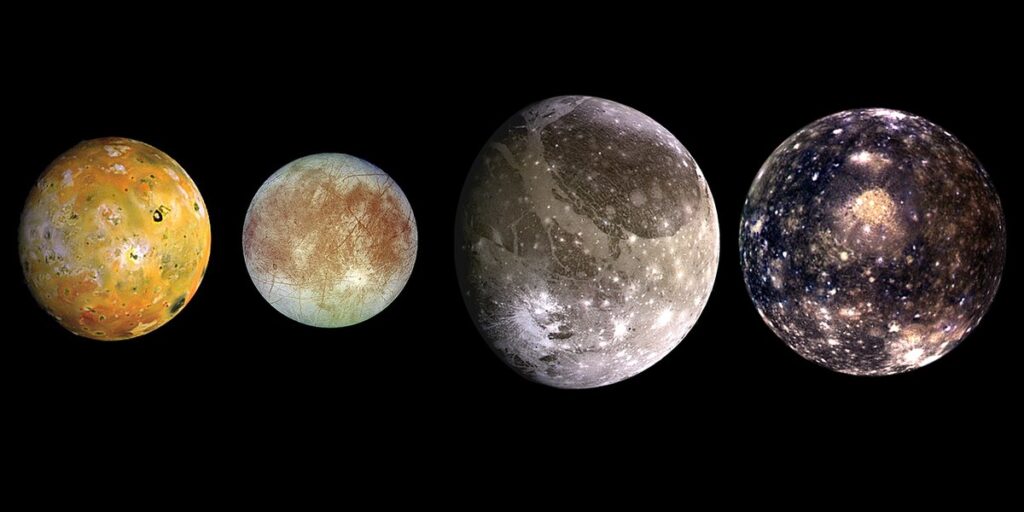
Introduction to the Galilean Moons
Welcome to our journey through the fascinating world of Jupiter’s largest satellites, where we’ll start by exploring the basics of the four Galilean moons. Let’s begin by getting acquainted with Io, Europa, Ganymede, and Callisto.
History of Discovery and Naming
Galileo Galilei’s groundbreaking discovery of the four largest moons of Jupiter in 1610 marked a pivotal moment in astronomical history. On January 7th of that year, Galileo turned his telescope towards the planet and observed three distinct objects orbiting it – Io, Europa, and Ganymede. Just eight days later, he spotted a fourth moon, Callisto. These discoveries not only shed light on Jupiter’s orbital dynamics but also challenged prevailing geocentric models of the universe.
Interestingly, Galileo chose names inspired by Greek mythology to identify his finds. Io was named after the priestess of Hera who was transformed into a cow, Europa was named after Zeus’ lover who was abducted to Crete, Ganymede was named after the handsome youth chosen as Zeus’ cupbearer, and Callisto was named after Zeus’ companion who was turned into a bear.
Galileo’s naming conventions have stood the test of time, with these moons retaining their original names even today. This legacy not only honors ancient mythology but also underscores the profound impact Galileo’s discovery had on our understanding of celestial bodies and the cosmos as a whole.
Importance of the Galilean Moons
The discovery of the Galilean moons was a groundbreaking moment in the field of astronomy that fundamentally changed our understanding of the solar system. Prior to their discovery, it was widely believed that the Earth was at the center of the universe and that celestial bodies orbited around it. However, with the observation of four large moons orbiting Jupiter – Io, Europa, Ganymede, and Callisto – astronomers realized that other planets could have their own satellite systems.
This realization had significant implications for our understanding of planetary formation and the structure of our solar system. The Galilean moons provided a new perspective on the possibility of life beyond Earth, as they demonstrated that larger celestial bodies could harbor smaller, orbiting objects. Furthermore, the discovery of these moons challenged the prevailing geocentric model, paving the way for the development of the heliocentric model and our modern understanding of the solar system’s architecture. Today, continued exploration of the Galilean moons continues to advance our knowledge of planetary science and inspire new discoveries in the field of astronomy.
Characteristics of the Galilean Moons
Let’s take a closer look at what makes each Galilean moon unique, including their size, composition, and surface features that set them apart.
Physical Composition and Size
Each of the Galilean moons has a distinct physical composition and size that sets it apart from the others. Io, the innermost moon, is primarily composed of silicate rocks, with a surface that’s almost entirely volcanic in nature. Its size is relatively small compared to Jupiter, with a diameter of approximately 2,264 miles (3,643 kilometers). Io’s proximity to Jupiter results in intense tidal heating, which leads to frequent volcanic eruptions and a highly energetic geology.
In contrast, Europa, the second innermost moon, has a surface composed mainly of water ice. Its size is slightly larger than Io’s, with a diameter of about 1,940 miles (3,122 kilometers). Europa’s icy composition and its orbital distance from Jupiter make it an ideal candidate for hosting a liquid water ocean beneath its surface.
Ganymede, the largest moon in the solar system, has a mixed composition of silicate rocks and ice. Its size is impressive, with a diameter of around 3,275 miles (5,270 kilometers), making it even larger than Mercury. Callisto’s composition is primarily composed of water ice, and its size is relatively smaller compared to Ganymede.
Jupiter’s gravitational influence on these moons results in unique orbital patterns that affect their physical characteristics. The inner three moons have shorter orbital periods due to Jupiter’s strong gravity, while the outer two have longer orbital periods as they move further away from the planet.
Atmospheres and Surface Features
When it comes to the Galilean moons’ atmospheres and surface features, each moon has its own unique characteristics that set it apart from the others. Let’s take a closer look at what makes each one special.
Io, being the most volcanically active body in our solar system, boasts an atmosphere composed mostly of sulfur dioxide gas. This toxic mixture creates a thin haze around Io’s surface, which is a result of volcanic eruptions spewing gases and particles into space. Geysers on Io shoot plumes of lava up to 200 kilometers high, making it the most geologically active body in the solar system.
Europa, on the other hand, has a surface covered with a thick layer of ice, concealing a global ocean beneath. This moon’s icy crust is pockmarked with craters, including a massive one that stretches over 40 kilometers across. Europa’s subsurface ocean makes it an intriguing candidate for potential life.
Ganymede, the largest moon in the solar system, has its own magnetic field and a surface featuring grooved terrain and numerous craters. The latter is evidence of intense meteorite bombardment early in Ganymede’s history.
Callisto’s cratered surface tells a similar story of heavy meteorite impacts during its formation. However, this moon’s subsurface composition suggests it may have a partially liquid water layer beneath its icy crust, providing a possible habitat for life.
Io: The Volcanic Moon
Io is a fascinating world of volcanic activity, where over 400 active volcanoes erupt with incredible frequency. Let’s dive into what makes this moon so unique among Jupiter’s satellites.
Geysers and Volcanoes
Io’s surface is a geological wonder, with hundreds of volcanoes and a dozen prominent calderas. This extraordinary volcanic activity is primarily caused by Jupiter’s gravitational pull, which generates internal heat through a process known as tidal heating. As Io orbits Jupiter, the planet’s massive gravity causes the moon’s interior to flex and release energy in the form of heat. This heat is what fuels the intense volcanic activity on Io.
The result is a surface covered with volcanoes, many of which are still active today. In fact, it’s estimated that Io has over 400 active volcanoes, making it the most volcanically active body in our solar system. The largest volcano, Tvashtar Paterae, stands over 8 km high and is one of the youngest features on Io’s surface. Its lava flows are so hot they can melt sulfur dioxide ice, creating a unique landscape that’s unlike anything found elsewhere in the solar system.
Io’s volcanoes are not just awe-inspiring; they also provide valuable insights into the moon’s internal structure and composition. By studying these volcanoes, scientists can gain a better understanding of Io’s history and evolution, as well as the role of tidal heating in shaping its surface.
Surface Features and Exploration
When exploring Io, one of Jupiter’s most fascinating Galilean moons, it becomes clear that its surface features are a testament to its volcanic nature. Spacecraft have revealed an array of striking landscapes shaped by intense volcanic activity.
Volcanic lava flows cover significant areas of Io’s surface, often displaying patterns and textures formed from the cooling process. One remarkable example is the Sulfur River, a 110-mile-long flow that has created a characteristic “snakeskin” appearance due to the crystallization of its sulfur-rich content.
Io’s geysers, such as Prometheus and Loki Patera, are another remarkable feature – they shoot up plumes of molten rock into space. NASA’s Galileo spacecraft observed these geysers ejecting massive amounts of material, sometimes covering vast areas with lava flows and depositing volcanic glass particles.
The study of Io’s surface features has provided valuable insights into the moon’s internal dynamics, including its tidal heating mechanism, where Jupiter’s gravitational pull generates heat that fuels the moon’s volcanic activity.
Europa: The Icy Moon with a Hidden Ocean
Let’s dive into Europa, one of Jupiter’s most fascinating moons, where an enormous hidden ocean beneath its icy surface has scientists abuzz. We’ll explore this remarkable moon up close.
Subsurface Ocean
One of the most fascinating aspects of Europa is its subsurface ocean, which scientists believe could potentially harbor life. This hidden ocean is thought to exist beneath a thick icy crust, estimated to be around 10-15 kilometers thick. But how do we know this? The answer lies in a combination of observations and data analysis.
Research suggests that the tidal heating caused by Jupiter’s gravitational pull creates heat and melting within Europa’s interior, leading to the formation of a liquid water ocean. This is supported by NASA’s Hubble Space Telescope observations, which show that Europa’s icy crust is actually flexible, implying that it can move and flex in response to tidal forces.
This hidden ocean is estimated to be around 100 kilometers deep, making it one of the largest known bodies of liquid water in our solar system. The potential for life within this ocean is immense, with scientists suggesting that it could support complex ecosystems similar to those found on Earth.
Surface Features and Exploration
Europa’s surface features have been extensively studied by spacecraft, revealing a complex and dynamic landscape. The moon’s ice crust is its most striking feature, covering a vast ocean beneath that’s thought to be up to 100 km deep. This icy exterior is cracked and fractured, with long, sinuous ridges that suggest tectonic activity has played a significant role in shaping the surface.
Numerous craters can be seen on Europa’s surface, indicating a history of impacts from asteroids and comets. However, these craters are relatively few and far between, suggesting that geological processes have been actively resurfacing the moon over time. In fact, NASA’s Galileo spacecraft observed evidence of tectonic activity in the form of “tensional fractures” – long, linear cracks in the ice crust.
The most intriguing feature on Europa is the possible presence of hydrothermal activity within its subsurface ocean. Scientists believe that if conditions are right, this could support life forms similar to those found around deep-sea vents on Earth. As we continue to explore and study Europa, we’re one step closer to uncovering the secrets of this fascinating moon.
Ganymede: The Largest Moon in the Solar System
Let’s dive into the fascinating world of Ganymede, where we’ll explore its incredible size, unique composition, and what makes it a standout among Jupiter’s many moons. Get ready to be amazed by this icy giant!
Size and Composition
Ganymede is not only the largest moon in our solar system but also boasts a unique composition that sets it apart from other moons. With a diameter of approximately 3,275 miles (5,270 kilometers), Ganymede’s size is staggering, making it even larger than the planet Mercury.
One of the key factors contributing to Ganymede’s distinct composition is its subsurface ocean, which contains more water than all of Earth’s oceans combined. This vast reservoir of liquid water is estimated to be about 100 miles (160 kilometers) thick and is sandwiched between layers of rock. The presence of this ocean has significant implications for the moon’s potential habitability, making Ganymede an intriguing target for astrobiological research.
Ganymede’s composition also features a surface primarily composed of silicate rocks, similar to those found on Earth. However, its subsurface ocean and unique geological processes have led to the formation of distinctive features such as grooved terrain, which is thought to be the result of tectonic activity driven by Jupiter’s gravitational pull. Understanding Ganymede’s composition provides valuable insights into the moon’s history and potential for supporting life beyond Earth.
The Galilean moons’ diverse compositions offer scientists a unique opportunity to study the formation and evolution of our solar system. By examining Ganymede’s subsurface ocean, surface geology, and orbital dynamics, researchers can gain a deeper understanding of these complex processes and their implications for the search for life elsewhere in the universe.
Magnetic Field and Surface Features
Ganymede’s magnetic field is surprisingly similar to that of Jupiter’s, with a strength that’s about 1% of Jupiter’s. This similarity suggests a shared origin story, with Ganymede possibly having formed from the same material as the planet itself. The moon’s magnetic field is also tilted at an angle of about 10 degrees relative to its rotation axis, which is close to Jupiter’s own tilt.
When it comes to surface features, Ganymede is one of the most fascinating moons in our solar system. Its surface is pockmarked with craters, ranging from small dimples to massive impact basins like the famous Ganymede Basin. The largest crater, Tvashtar Paterae, has a diameter of over 300 kilometers and is still active today, with geysers erupting ice particles into space. In addition to these craters, there’s also evidence of water ice on Ganymede’s surface, particularly at the poles. This discovery has significant implications for astrobiologists, who believe that water could have played a crucial role in the moon’s potential habitability.
Callisto: The Outermost Galilean Moon
Let’s dive into Callisto, the largest and outermost of Jupiter’s four iconic moons, a world shrouded in mystery and intrigue. We’ll explore its unique characteristics and fascinating features up close.
Composition and Surface Features
Callisto’s composition is quite distinct from its fellow Galilean moons. Thought to be one of the oldest surfaces in our solar system, it’s made up largely of silicate rocks and water ice. This unique mix has helped scientists determine that Callisto has remained relatively unchanged for billions of years.
Its surface features are a testament to this ancient history. Callisto is pockmarked with craters, with some stretching hundreds of kilometers across its surface. One notable example is the Asgard crater, which is approximately 400 km in diameter and one of the largest impact basins on the moon. In fact, Callisto’s cratered terrain suggests that it has been geologically inactive for a very long time – making it an ideal target for scientists seeking to study its unaltered surface.
Despite being bombarded by asteroids and comets over eons, Callisto’s subsurface is thought to be composed of a layer of liquid water mixed with silicate rocks. This fascinating composition has scientists intrigued about the moon’s potential for hosting life beneath its icy crust – although, it remains purely theoretical at this point.
Exploration and Significance
Callisto’s surface offers a unique window into the early formation and evolution of our solar system. Its surface is characterized by a cratered terrain, indicating that it has been geologically inactive for billions of years. This lack of tectonic activity means that Callisto’s surface has preserved its original features, providing valuable insights into the moon’s composition and history.
One of the most significant aspects of Callisto’s surface is the presence of water ice mixed with rock. This indicates that the moon was likely formed from a mixture of solar nebula material and leftover planetesimals. The distribution of this icy material on Callisto’s surface provides clues about the moon’s early evolution, including its possible interactions with Jupiter’s magnetosphere.
In particular, the polar regions of Callisto exhibit a high concentration of water ice, suggesting that these areas may have been shielded from the intense radiation and charged particles emanating from Jupiter. This has significant implications for our understanding of how the solar system formed and evolved over time. By studying Callisto’s surface in detail, scientists can gain insights into the moon’s unique history and its place within the larger context of the solar system.
The Galilean Moons’ Impact on Science and Society
The discovery of the Galilean moons by Galileo Galilei had a profound impact on our understanding of science, astronomy, and even the way we think about space exploration today. We’ll explore how these four satellites continue to shape our world.
Scientific Contributions
The study of the Galilean moons has significantly advanced our understanding of planetary science and astrophysics. By observing these satellites, scientists have gained valuable insights into the formation and evolution of our solar system. For instance, the orbits and rotation periods of Io, Europa, Ganymede, and Callisto provided crucial evidence for the existence of tidal heating, a process that occurs when the gravitational pull of a planet’s interior causes internal heat.
This discovery has led to a deeper understanding of planetary processes and the potential for life beyond Earth. The subsurface oceans of Europa, in particular, have sparked intense interest as possible habitats for microbial life. Scientists continue to study these moons to better comprehend the conditions necessary for life to emerge elsewhere in the universe. As we explore the Galilean moons, we are reminded that our understanding of the cosmos is constantly evolving and improving, thanks to the contributions of these four remarkable satellites.
Cultural Significance and Representation in Media
The Galilean moons have captivated human imagination for centuries, influencing art, literature, and popular media. Their cultural significance extends beyond their scientific value, reflecting our fascination with the unknown and the beauty of the night sky. In literature, authors like Jules Verne and H.G. Wells featured Jupiter’s moons in science fiction stories, inspiring readers to ponder the possibilities of space exploration.
In art, the Galilean moons have been depicted in various forms, from classical paintings to modern digital illustrations. For instance, the artist James Nasmyth created a series of engravings showcasing the moons’ orbital patterns, while NASA’s Juno mission has produced stunning images of Io and Europa’s volcanic landscapes. These depictions not only showcase human creativity but also serve as visual reminders of our ongoing quest for knowledge about the solar system.
The representation of Galilean moons in popular media is equally significant. Films like “2001: A Space Odyssey” and “Solaris” have used Jupiter’s moons as backdrops or plot devices, reflecting humanity’s existential concerns and desire to explore the cosmos.
Frequently Asked Questions
Can I explore the Galilean moons without specialized equipment or training?
While it’s not possible to physically visit these celestial bodies, you can still engage with them through various online resources and educational materials. Many space agencies and astronomy institutions offer interactive exhibits, virtual tours, and documentaries that bring the Galilean moons to life.
What are some common misconceptions about the Galilean moons?
One common misconception is that all four moons have similar surface features. In reality, each moon has its unique characteristics, such as Io’s volcanic landscape, Europa’s icy crust, Ganymede’s subsurface ocean, and Callisto’s cratered surface.
How can I learn more about the habitability of the Galilean moons?
The potential for life on these moons is a fascinating topic. To delve deeper, explore scientific studies and research papers on the subject, which often discuss factors like radiation protection, water availability, and energy sources that could support microbial life.
Are there any future missions planned to explore the Galilean moons in more detail?
Yes, several space agencies and organizations are planning or proposing missions to explore the Galilean moons. For example, NASA’s Europa Clipper mission aims to study Europa’s subsurface ocean and potential habitability. Stay updated on these developments through scientific publications and news outlets.
Can I observe the Galilean moons in my own telescope?
With a moderate-sized telescope (at least 60mm aperture), you can observe some of the Galilean moons’ orbital patterns and relative brightness. However, keep in mind that Jupiter’s bright disk will dominate your view, making it challenging to distinguish individual moonlight reflections.
How do scientists determine the ages of these celestial bodies?
Astronomers use various methods to estimate the ages of the Galilean moons, including analyzing their cratering patterns, surface features, and orbital characteristics. These techniques provide valuable insights into the geological history and evolution of each moon.