
Emission nebulas are breathtaking sights in our universe, showcasing vibrant colors and swirling patterns that leave astronomers and stargazers alike mesmerized. But have you ever stopped to wonder how these stunning celestial objects come into being? From their birthplaces amidst massive stars and supernovae explosions to the complex science behind their formation, emission nebulas hold secrets waiting to be uncovered. In this article, we’ll delve into the fascinating world of emission nebulas, exploring their types, observational history, and the significance they hold in understanding our vast cosmos. Along the way, you’ll discover the importance of these celestial wonders in shaping our knowledge of space and time.
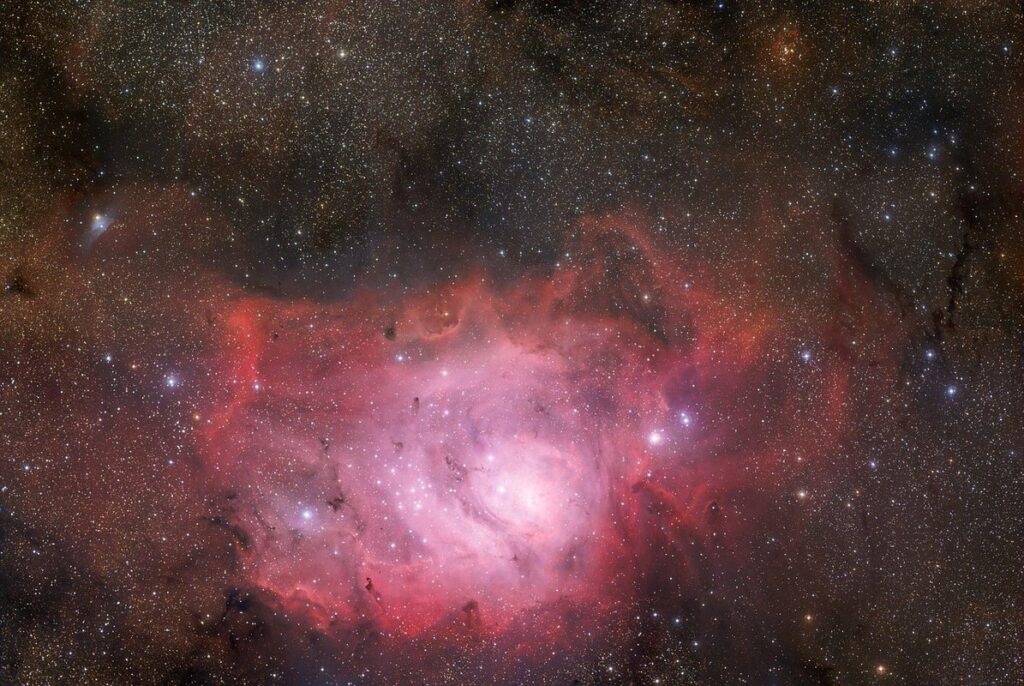
What is an Emission Nebula?
Let’s start by exploring what exactly an emission nebula is, and how it forms in our vast universe. In simple terms, we’ll break down the science behind this breathtaking celestial wonder.
Definition and Formation
An emission nebula is a vast, interstellar cloud of gas and dust that glows due to the intense radiation from nearby stars. It’s a dynamic, ever-changing celestial object that plays a crucial role in the life cycle of stars. The formation of an emission nebula is closely tied to the birth and death of stars.
When a massive star collapses or explodes as a supernova, it can ionize the surrounding gas and dust, creating an emission nebula. This interaction between the star’s radiation and the interstellar medium sets off a chain reaction, causing the nebula to glow with vibrant colors. The colors we see are a result of different elements being excited by the radiation, emitting light at specific wavelengths.
Emission nebulas differ from other types of celestial objects, such as dark nebulas or reflection nebulas, in that they emit their own light rather than simply reflecting it. They can be found near young stars, star-forming regions, and even in the remnants of supernovae explosions. By studying emission nebulas, astronomers gain valuable insights into the processes that shape our galaxy and the life cycles of stars within it.
Types of Emission Nebulae
Emission nebulas are incredibly diverse, and they can be categorized into distinct subtypes based on their formation mechanisms and physical characteristics. One of the most common types is the diffuse nebula. These vast, sprawling clouds of gas and dust are the raw material from which stars are born. They can stretch for millions of light-years across space, giving us a glimpse into the primordial building blocks of our universe.
Planetary nebulas are another fascinating type of emission nebula. These stunning objects form when a star has exhausted its fuel and shed its outer layers, creating a colorful halo around the remaining core. The Orion Nebula is one example of a planetary nebula, showcasing the intricate dance between gas and dust as it takes shape.
Supernova remnants are the final type of emission nebula we’ll discuss. These awe-inspiring events occur when a massive star explodes in a cataclysmic burst, spewing out high-energy radiation that illuminates its surroundings. Supernovae remnants like the Veil Nebula display the explosive power and beauty that lies at the heart of our universe’s most catastrophic events.
Each type of emission nebula offers us a unique window into the ever-changing tapestry of space. By studying these celestial wonders, we can gain insights into the life cycles of stars, the birth and death of galaxies, and the mysteries that lie beyond our cosmic horizon.
The Science Behind Emission Nebulae
Let’s dive into the fascinating world of emission nebulae and explore what’s happening behind their breathtaking colors and shapes, where physics meets art in a beautiful dance.
Radiation and Ionization
When you gaze at an emission nebula, what you’re seeing is the result of a cosmic dance between stars and the surrounding gas and dust. This process begins with radiation, where high-energy photons from nearby stars interact with the interstellar medium (ISM). The ISM consists of mostly hydrogen and helium gas, along with tiny dust particles.
These photons have enough energy to ionize the atoms in the ISM, stripping away their electrons and leaving behind a cloud of negatively charged ions. This phenomenon is known as photoionization. As more stars are born and die within our galaxy, they continuously interact with the surrounding gas, creating an intricate web of radiation and ionization.
For instance, the Orion Nebula, one of the most prominent emission nebulas in our sky, owes its vibrant colors to this very process. The intense radiation from nearby O-type stars ionizes the surrounding gas, which glows in response, producing an breathtaking spectacle. Understanding this process can help us better appreciate the intricate relationships between stars and their surroundings within our galaxy.
Chemical Composition and Abundance
Emission nebulas are composed primarily of hydrogen and helium, with smaller amounts of heavier elements like oxygen, nitrogen, and carbon. These heavy elements play a crucial role in understanding the formation and evolution of stars within these vast interstellar clouds.
The presence of helium is significant because it’s a byproduct of nuclear fusion that occurs within the cores of massive stars. When these stars eventually explode as supernovae, they disperse this helium-rich material into space, enriching the surrounding environment with heavy elements necessary for star formation. Oxygen, on the other hand, is a key component in the creation of complex molecules and organic compounds.
The abundance of these elements within emission nebulas varies greatly depending on factors like distance from the parent star, intensity of radiation, and presence of dust particles. Astronomers studying emission nebulas can gain valuable insights into the chemical makeup of these regions by analyzing the light emitted by specific elements.
Understanding the chemical composition and abundance of emission nebulas helps astronomers piece together the complex history of star formation and evolution within our galaxy and beyond.
Observational History and Notable Emission Nebulae
Let’s take a fascinating journey through observational history, where we’ll explore how astronomers first discovered these cosmic wonders, and shine a light on some of the most notable emission nebulae in our universe.
Past Discoveries and Observations
As we explore the vast expanse of space, it’s fascinating to look back at the discoveries that have shaped our understanding of emission nebulas. One of the earliest recorded observations dates back to 1781 when astronomer William Herschel stumbled upon M42, a bright and sprawling nebula in the constellation Orion. Little did he know that this was just the tip of the iceberg.
Fast-forwarding to the 19th century, astronomers began to classify these celestial wonders into distinct categories based on their characteristics and formation mechanisms. The term “emission nebula” itself was coined by astronomer John Herschel (William’s son) in the 1840s. Over time, we’ve discovered numerous emission nebulas, each with its unique features and properties.
For instance, the majestic Carina Nebula (NGC 3372) has been extensively studied due to its vibrant colors and complex structure. Its intricate details have provided valuable insights into the birth and death of stars. By examining these historical observations, we can appreciate the vast progress made in our understanding of emission nebulas and continue to unravel their secrets.
Iconic Examples: The Orion Nebula and Beyond
One of the most breathtaking sights in the night sky is the Orion Nebula (M42), a vast star-forming region located approximately 1,300 light-years from Earth. This majestic emission nebula is not only a stunning visual spectacle but also a prime example of the complex processes that shape our universe. The Orion Nebula’s distinctive hourglass shape is formed by the collision of gas and dust, which triggers the birth of new stars.
In contrast, the Carina Nebula (NGC 3372) is a more turbulent and dynamic emission nebula, located about 7,500 light-years from Earth. This region is home to numerous hot young stars that illuminate the surrounding interstellar gas, creating an ethereal landscape of swirling clouds and dark dust lanes.
Further out in space lies the Tarantula Nebula (30 Doradus), a massive star-forming complex situated within the Large Magellanic Cloud, about 170,000 light-years from Earth. This gargantuan emission nebula is one of the largest known in the universe, measuring over 1,500 light-years across. Its sheer scale and vibrant colors make it an awe-inspiring sight for astronomers and astrophotographers alike.
These iconic examples not only showcase the beauty and diversity of emission nebulae but also underscore their crucial role in understanding star formation and the evolution of galaxies.
Impact of Emission Nebulae on Our Understanding of Space
Emission nebulae have significantly expanded our knowledge of space, challenging existing theories and shedding light on the mysteries of star formation and galaxy evolution. Let’s explore this fascinating phenomenon further.
Astrophysical Significance
Emission nebulae hold a treasure trove of secrets that have been instrumental in our understanding of astrophysics. By studying these colorful celestial bodies, scientists have gained valuable insights into the mysteries of star formation. For instance, observations of emission nebulas have revealed that they often form around newly born stars, which suggests a direct link between nebulae and the birth process of stars.
Furthermore, research has shown that emission nebulas play a crucial role in planetary system development. As gas and dust are ionized within these nebulae, they contribute to the formation of planets by providing essential materials for their growth. For example, observations of the Orion Nebula have revealed the presence of disk-like structures surrounding newly formed stars, which is thought to be indicative of early planetary system formation.
Galaxy evolution also benefits from the study of emission nebulas. By analyzing the composition and distribution of these nebulae across different galaxies, scientists can infer the history of star formation within those galaxies. This information has been instrumental in understanding how galaxies change over time, shedding light on their lifecycle from birth to death.
Implications for the Search for Life Beyond Earth
As we delve into the mysteries of emission nebulae, it’s impossible not to wonder: could these cosmic clouds harbor conditions suitable for life beyond Earth? The possibility is tantalizing, and one that has captivated astronomers and scientists for decades. If we were to discover extraterrestrial life or biosignatures within an emission nebula, the implications would be nothing short of revolutionary.
The discovery of life in an emission nebula would not only rewrite our understanding of the universe but also raise fundamental questions about the origins of life itself. It could potentially shed light on how life emerged on Earth and whether we’re truly alone in the cosmos. On a more practical level, finding biosignatures within these clouds could help us refine our search for life beyond Earth, focusing our efforts on regions with similar conditions.
The discovery of extraterrestrial life would also have profound implications for humanity’s place in the universe, forcing us to reevaluate our values and priorities. As we continue to explore and study emission nebulae, it’s essential to remain open-minded and keep an eye out for signs that might challenge our current understanding of the universe.
Conclusion: Capturing the Beauty and Complexity
As we conclude our journey through the majestic Emission Nebula, let’s reflect on what we’ve discovered about these breathtaking celestial formations.
Recap of Key Concepts
As we conclude our exploration of emission nebulas, it’s essential to recap the key concepts discussed throughout this article. Understanding these magnificent celestial bodies is crucial for astronomers and space enthusiasts alike. By grasping the intricacies of emission nebulas, we gain a deeper appreciation for the complex processes that shape our universe.
We’ve explored how emission nebulas are formed through the ionization of gas clouds by nearby stars, resulting in vibrant colors and patterns. These regions of intense radiation also give us valuable insights into the life cycles of stars and their interactions with surrounding interstellar space. The study of emission nebulas has led to significant advancements in our understanding of stellar evolution and the formation of new stars.
In addition, we’ve discussed how emission nebulas can be classified based on their morphology and ionization conditions. By recognizing these distinct categories, astronomers can better interpret the data collected from observations and spectroscopic analysis. As you continue to explore the wonders of space, remember that each emission nebula is a unique snapshot of the dynamic processes at work in our universe.
Future Research Directions
As we conclude our journey through the breathtaking world of emission nebulae, it’s essential to look towards the future and explore new avenues for research. By delving into uncharted territories and refining existing methods, scientists can continue to unravel the mysteries surrounding these cosmic wonders.
One promising area of investigation is the discovery of new emission nebulae. With advancements in telescopic technology and observational techniques, astronomers are poised to uncover previously hidden nebulae, shedding light on the diversity of star-forming regions in the universe. For instance, the Spitzer Space Telescope’s infrared surveys have revealed numerous distant nebulae that challenge our current understanding of galactic evolution.
To further enhance our comprehension of emission nebulae, researchers should focus on developing advanced observational techniques. This might involve employing machine learning algorithms to analyze vast datasets or designing novel spectrographic instruments capable of capturing high-resolution spectral signatures. By harnessing these cutting-edge tools, scientists can gain deeper insights into the physical processes governing nebular formation and evolution.
Theoretical models also play a vital role in comprehending emission nebulae. Researchers should strive to develop more sophisticated simulations that account for factors like magnetic fields, turbulence, and radiation pressure. By leveraging supercomputing power and innovative numerical methods, scientists can simulate complex nebular dynamics and make predictions about future discoveries.
Frequently Asked Questions
Can emission nebulas be used as indicators of star formation?
Yes, emission nebulas play a crucial role in the life cycle of stars, making them valuable indicators of ongoing or past star formation. By observing these celestial objects, astronomers can gain insights into the birth and death of stars within our galaxy.
How do I observe emission nebulas for myself?
To observe emission nebulas, you’ll need a telescope with a good quality lens or mirror that can capture the faint light emitted by these celestial objects. You can also use specialized equipment like filters to enhance your viewing experience. Make sure to choose a location with minimal light pollution and stable atmospheric conditions.
Can I see emission nebulas from my backyard?
Unfortunately, most emission nebulas are located far away from Earth and require large telescopes or professional observatories to observe. However, there are some notable exceptions like the Orion Nebula, which can be seen with binoculars or a small telescope under ideal viewing conditions.
How do scientists distinguish between different types of nebulae?
Scientists use various methods to classify nebulae, including their chemical composition, radiation patterns, and spatial structure. By analyzing these characteristics, researchers can determine whether an emission nebula is a result of star birth, death, or other astrophysical processes.
Are emission nebulas relevant for the search for extraterrestrial life?
Yes, the study of emission nebulas provides valuable insights into the conditions necessary for life to emerge and thrive in our universe. By understanding how these celestial objects form and evolve, we can better comprehend the potential for life beyond Earth, which is crucial for astrobiological research.