
The next total lunar eclipse is set to captivate stargazers around the world, casting an otherworldly glow on the night sky. This rare celestial event occurs when the Earth’s shadow completely covers the Moon, revealing a breathtaking sight that has fascinated humans for centuries. As you prepare to witness this spectacle, it’s essential to understand its causes and timing to maximize your viewing experience. In this comprehensive guide, we’ll explore the science behind total lunar eclipses, providing you with expert insights into their rarity, cultural significance, and optimal viewing conditions. We’ll also share valuable tips on how to make the most of this rare event, from selecting a prime viewing location to appreciating its historical and symbolic meanings. By the end of this article, you’ll be well-equipped to appreciate the next total lunar eclipse as more than just a fleeting spectacle – it will be an unforgettable experience that awakens your curiosity about the wonders of our universe.
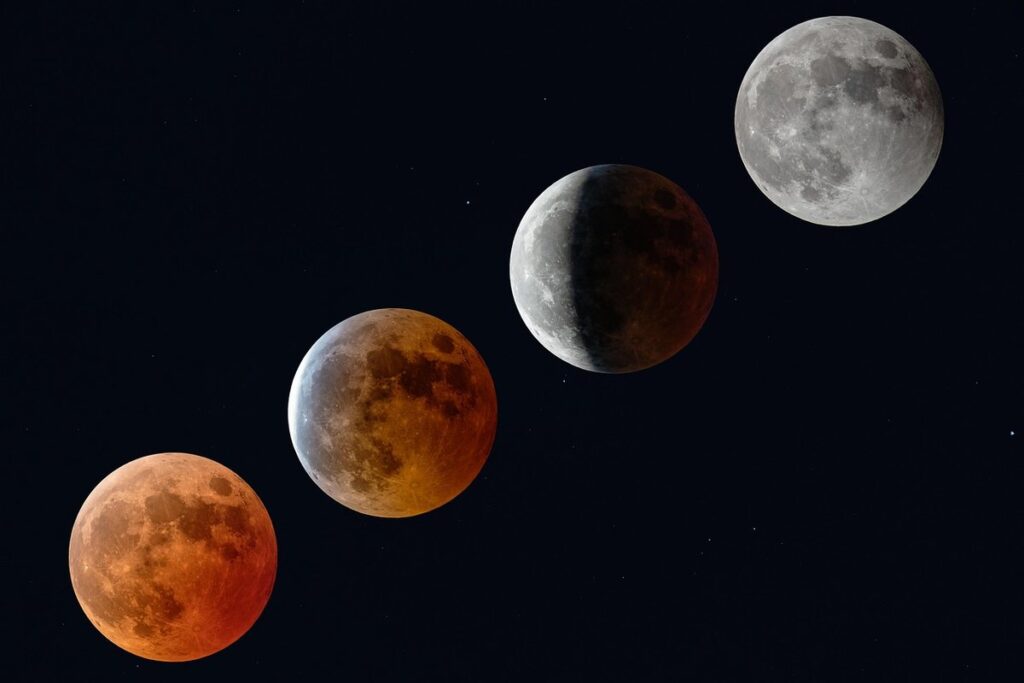
What is a Total Lunar Eclipse?
A total lunar eclipse occurs when Earth passes directly between the sun and the moon, blocking the sunlight that normally reflects off the lunar surface. This phenomenon is relatively rare and requires specific celestial alignment.
Definition and Rarity of Total Lunar Eclipses
A total lunar eclipse occurs when the Earth passes between the Sun and the Moon, casting a shadow on the lunar surface. This phenomenon is relatively rare compared to solar eclipses because the Moon’s orbit is tilted at an angle of about 5 degrees with respect to the Earth’s orbit around the Sun. As a result, the Earth’s shadow usually falls above or below the Moon, causing only partial or penumbral eclipses.
Total lunar eclipses happen when the Moon is in its full phase and passes through the narrow path of the Earth’s umbra, which is about 7,000 kilometers wide. This alignment occurs during specific lunar nodes, where the Moon’s orbit intersects with the Earth’s shadow. The rarity of total lunar eclipses also makes them more spectacular, as they can be visible from anywhere on the Earth where the Moon is above the horizon.
Only a small percentage of lunar orbits bring the Moon into the path of the Earth’s umbra, making total lunar eclipses about twice as rare as solar eclipses. However, when these events do occur, they offer astronomers and sky enthusiasts a unique opportunity to study the Earth’s shadow on the Moon’s surface.
Types of Lunar Eclipses: Penumbral, Partial, and Total
A total lunar eclipse is a specific type of lunar eclipse, but it’s not the only one. There are three main types: penumbral, partial, and total. The difference lies in how much of the Moon passes through the Earth’s shadow.
Penumbral eclipses occur when the Moon passes through the Earth’s penumbra, or partial shadow. This type of eclipse is subtle and can be difficult to notice, as it darkens only a small portion of the Moon’s surface. Penumbral eclipses are more frequent than total lunar eclipses but often go unnoticed due to their faint appearance.
Partial eclipses happen when the Moon passes through the Earth’s partial shadow, resulting in a noticeable darkening of a larger part of the Moon’s surface compared to penumbral eclipses. However, the darkness is still not uniform and can appear as a patchy or irregular shape on the Moon.
The characteristics of these types of lunar eclipses are distinct, but understanding them helps us appreciate the beauty and complexity of lunar eclipses in general.
Causes and Mechanisms Behind a Total Lunar Eclipse
A total lunar eclipse occurs when Earth passes directly between the sun and moon, casting a shadow on the lunar surface. We’ll explore the rare alignment of celestial bodies that makes this phenomenon possible.
Lunar Node and Earth-Moon-Sun Alignment
The Moon’s nodes play a crucial role in creating the conditions for a total lunar eclipse. The nodes are two points where the Moon’s orbit intersects with the Earth’s orbit around the Sun. These points are called the ascending and descending nodes, and they move eastward along the ecliptic due to the procession of the equinoxes.
At new moon or full moon, when the Earth is between the Sun and the Moon or on the opposite side of the Sun, the Moon can pass through the Earth’s shadow. For a total lunar eclipse to occur, the Moon must be near one of its nodes at this time. This alignment allows the Earth’s umbra, which is the darker inner part of the shadow, to fall directly on the Moon’s surface.
The path of totality during a total lunar eclipse is usually a few hundred miles wide and covers a specific region on the Earth’s surface. The duration of totality can vary from a few minutes to over an hour, depending on the alignment of the Earth, Moon, and Sun.
The Earth’s Shadow on the Moon’s Surface
During a total lunar eclipse, the Earth’s shadow falls on the Moon’s surface in two distinct ways: the umbra and the penumbra. The umbra is the darker inner region of the Earth’s shadow, where the light from the Sun is completely blocked by the Earth. This region appears as a small, dark circle on the Moon’s surface, gradually expanding and contracting over time. As the eclipse progresses, the umbra can move across different parts of the Moon, casting an irregularly shaped shadow.
The penumbra, on the other hand, is the lighter outer region of the Earth’s shadow, where the light from the Sun is only partially blocked by the Earth. This region appears as a faint, diffuse circle around the umbra, often creating a subtle gradient effect on the Moon’s surface. As the eclipse reaches its peak, the penumbra can sometimes engulf the entire Moon, casting an eerie glow over the surrounding landscape.
As the Earth’s shadow moves across the Moon, it creates a complex interplay of light and darkness, making each total lunar eclipse unique in terms of its visual appearance.
Viewing and Observing the Next Total Lunar Eclipse
To witness a total lunar eclipse, timing is everything – knowing exactly when to look up at the night sky can make all the difference in viewing this rare phenomenon.
For some eclipses, moonrise occurs while the Earth’s shadow is still covering the Moon, allowing for an extended period of observation and photography opportunities.
Preparation and Safety Precautions
To witness a total lunar eclipse, you’ll need some essential equipment. Start with a pair of binoculars or a telescope, which can provide a closer look at the Moon’s surface during the eclipse. If you’re using a camera, consider investing in a tripod to prevent shaky images. Don’t forget a red light flashlight or headlamp to preserve your night vision while setting up your equipment.
Safety precautions are also crucial. Find a safe viewing location with an unobstructed view of the western horizon where the Moon will be visible. Avoid looking directly at the eclipse through an unfiltered camera lens or telescope, as this can cause eye damage. Wear protective eyewear if you’re observing with the naked eye, but ensure it’s specifically designed for solar viewing.
When choosing your location, consider factors like accessibility, lighting, and potential crowds. Some popular options include national parks, observatories, or designated eclipse viewing areas. Check local weather forecasts to minimize the risk of cloud cover ruining your view. Finally, don’t forget to download a lunar eclipse tracking app on your smartphone to receive timely alerts and updates during the event.
Best Places to Watch the Eclipse
To maximize the viewing experience of the next total lunar eclipse, it’s essential to choose a location with clear skies and minimal light pollution. The path of totality will be visible from parts of North America, which includes major cities like Los Angeles, Chicago, and New York City. However, for optimal viewing, consider traveling to areas within the path where the moon will be completely covered by the Earth’s shadow.
Some recommended locations include national parks in the United States, such as Yellowstone and Grand Teton, which offer dark skies and scenic vistas. In Europe, destinations like the Azores Islands and parts of Scandinavia are also well-positioned for viewing the eclipse. It’s crucial to note that cloud cover can be unpredictable, so having a backup location or plan in place is essential.
To make the most of this rare event, plan your viewing experience around the peak moment of totality, which will occur on specific dates and times depending on your location. Typically, the moon begins to darken about an hour before totality, with the full eclipse lasting only a few minutes.
Cultural Significance and Historical Context of Total Lunar Eclipses
Total lunar eclipses have long been a source of fascination, inspiring myths and legends across cultures. We’ll explore how these rare events have shaped human understanding throughout history.
Ancient Civilizations and Eclipse Observations
Ancient cultures were fascinated by total lunar eclipses, often viewing them as omens or signs from the gods. The ancient Greeks believed a lunar eclipse was caused by the god Selene being devoured by a monster. In contrast, the Chinese saw an eclipse as a dragon eating the moon, while the Mayans thought it was the moon being swallowed by a jaguar. Similarly, the ancient Babylonians associated eclipses with the goddess Ishtar’s journey through the underworld.
Many of these cultures developed elaborate rituals and ceremonies to appease their gods or ward off evil spirits during an eclipse. For example, the ancient Chinese would bang pots and pans to scare away the dragon, while the Mayans performed human sacrifices to prevent the moon from being consumed. These practices highlight the fear and awe with which total lunar eclipses were regarded in ancient times.
These interpretations varied across cultures, but a common thread is the emphasis on the mysterious and unpredictable nature of these events. By examining how ancient civilizations responded to total lunar eclipses, we can gain insight into their worldviews and values.
Symbolism and Omens in Different Cultures
Total lunar eclipses have long been imbued with symbolic meanings across various cultures. In ancient China, a total lunar eclipse was believed to signal the emperor’s demise or the fall of the ruling dynasty. Conversely, a lunar eclipse during the reign of Emperor Wu of Han was seen as an auspicious sign, marking the beginning of his successful military campaigns.
In many indigenous cultures of North America, a total lunar eclipse is thought to be a time for renewal and spiritual growth. The Ojibwe people believe that the eclipse brings about a balance between light and darkness, while the Navajo consider it a moment when the veil between the worlds is at its thinnest.
In some African cultures, a total lunar eclipse is associated with fertility and abundance. For instance, in Ghana, an eclipse is believed to bring forth an era of prosperity and good harvests. In many parts of Asia, particularly in India and Sri Lanka, a lunar eclipse is considered inauspicious and often leads to rituals and ceremonies aimed at warding off evil spirits.
These diverse interpretations highlight the complex and multifaceted nature of human perception surrounding total lunar eclipses.
Scientific Implications of Total Lunar Eclipses
Total lunar eclipses have significant effects on Earth’s atmosphere and magnetic field, with impacts that can be measured by scientists studying the phenomenon. But what exactly happens during these events?
Effects on the Earth’s Atmosphere and Climate
A total lunar eclipse can provide valuable insights into atmospheric conditions and climate patterns. During an eclipse, the Earth’s atmosphere scatters sunlight in a way that affects the amount of light reaching the Moon’s surface. By studying the subtle changes in brightness and color during an eclipse, scientists can gain a better understanding of factors such as aerosol concentration, cloud cover, and water vapor content.
For instance, NASA’s Lunar Reconnaissance Orbiter has used total lunar eclipses to study the Earth’s atmospheric conditions with high precision. The spacecraft’s observations have helped researchers understand how variations in atmospheric composition influence climate patterns. This knowledge can also inform our understanding of past climates and provide a framework for predicting future changes.
Eclipse observations are particularly useful for studying certain aspects of atmospheric conditions, such as the presence of aerosols like pollution particles or volcanic ash. These substances can significantly impact Earth’s radiative balance and contribute to climate change. By analyzing the effects of total lunar eclipses on the atmosphere, scientists can refine their models and make more accurate predictions about future climate trends.
Eclipse Cycles and Long-Term Astronomical Research
Total lunar eclipses play a crucial role in long-term astronomical research, particularly when it comes to understanding celestial mechanics. By analyzing these events, astronomers can gain valuable insights into the Earth’s rotation, the Moon’s orbit, and the Sun’s position in the sky.
One key area of study is the eclipse cycle, which refers to the regular pattern of eclipses that occurs due to the Moon’s orbital path crossing through the Earth’s shadow. This cycle has a period of approximately 173 months (or about 14 years), during which time all types of lunar eclipses occur in a specific order.
By tracking and analyzing these cycles, astronomers can refine their understanding of celestial mechanics and make more accurate predictions for future eclipses. For instance, studying the Saros cycle – an 18-year, 11-day cycle of eclipses that repeats approximately every 6,585.32 days – has allowed scientists to predict lunar eclipse occurrences with remarkable accuracy.
This research not only enhances our understanding of astronomical phenomena but also provides opportunities for testing and refining current models of celestial mechanics. By continuing to study total lunar eclipses, astronomers can further refine their knowledge of the complex relationships between Earth, Moon, and Sun.
Conclusion: The Next Total Lunar Eclipse and Beyond
As we bid farewell to the last total lunar eclipse, let’s take a closer look at what’s next on the celestial calendar. We’ll explore when the next phenomenon is expected to occur.
Recapitulating Key Points
The next total lunar eclipse is a rare and significant event that offers a unique opportunity for scientists, astronomers, and the general public to observe and learn from. In this article, we’ve explored the key points surrounding this phenomenon, emphasizing its importance not only as a scientific curiosity but also as a cultural and historical event.
We began by highlighting the rarity of total lunar eclipses, which occur when the Earth’s shadow falls on the Moon’s surface. This alignment is a result of the Earth-Moon-Sun alignment at the lunar node, creating a brief window for observation. The Earth’s shadow has three distinct phases: penumbral, partial, and total, each with its own characteristics.
The next total lunar eclipse is significant because it offers a chance to study the effects on the Earth’s atmosphere and climate. Eclipse cycles also provide valuable insights into long-term astronomical research, allowing scientists to refine their understanding of celestial mechanics.
In conclusion, the next total lunar eclipse is an event that combines scientific significance with cultural and historical importance. By recapitulating these key points, we hope to have provided a comprehensive understanding of this phenomenon, inspiring readers to observe, learn from, and appreciate this rare occurrence.
Final Thoughts and Future Directions
Total lunar eclipses offer a unique opportunity for astronomers to study the Earth’s atmosphere and its effects on the surrounding space. The interaction between the Earth’s atmosphere and the solar wind during an eclipse can provide valuable insights into the complex dynamics of our planet’s environment. Furthermore, total lunar eclipses serve as a catalyst for long-term astronomical research, allowing scientists to refine their models and predictions about celestial events.
Future research opportunities may lie in studying the effects of multiple eclipses on the Earth’s atmosphere and climate. By analyzing data from past eclipses, researchers can identify patterns and trends that might help predict future climate fluctuations. Additionally, total lunar eclipses could provide a platform for testing new technologies and instruments designed to study the Earth’s atmosphere.
Astronomers may also explore the possibility of using total lunar eclipses as a tool for monitoring space weather and its impact on satellite communications and navigation systems. By leveraging the unique conditions created during an eclipse, scientists can gain a deeper understanding of the complex relationships between our planet and the surrounding universe.
Frequently Asked Questions
How to Determine If I’ll Have Cloud Cover During the Eclipse?
If you’re planning to observe the total lunar eclipse, it’s essential to check the weather forecast for your location. You can use online tools or apps that provide cloud cover forecasts for specific locations and times. Yes, these resources are reliable and often updated in real-time, so make sure to check them regularly before the event.
What If I Missed the Eclipse: Can I Still Observe Its Effects on the Earth’s Atmosphere?
While it’s ideal to observe a total lunar eclipse live, you can still study its effects on the Earth’s atmosphere by analyzing data from astronomical research. These studies often include post-eclipse observations and modeling of atmospheric conditions. You can access this information through scientific journals or online repositories.
Can I Take Photos of the Total Lunar Eclipse Using a Smartphone?
Yes, it’s possible to take impressive photos of the total lunar eclipse using a smartphone, but you’ll need a good camera with manual controls. Use a tripod, and experiment with different exposure settings to capture the unique colors and lighting effects during the eclipse.
What If I Live in an Area with Light Pollution: Can I Still See the Eclipse?
Light pollution can indeed hinder your visibility of the total lunar eclipse. However, you can still observe it by using specialized software or apps that help reduce light pollution’s impact on astronomical observations. These tools often provide enhanced contrast and brightness adjustments to improve visibility.
How Do Total Lunar Eclipses Affect Plant Growth and Wildlife?
There is ongoing research into the potential effects of total lunar eclipses on plant growth and wildlife behavior, but conclusive evidence is still scarce. Some studies suggest that lunar cycles can influence certain species’ migratory patterns or reproductive behaviors, while others argue that these effects are minimal.