
Identifying opals and quartz can be a daunting task, even for seasoned gemstone enthusiasts. The two minerals often exhibit similar characteristics, making it challenging to distinguish between them. This is particularly evident in marketplaces where opal and quartz are frequently mixed or misrepresented. As a result, accurate identification has become increasingly important for collectors, dealers, and jewelers seeking to authenticate their pieces.
This guide aims to equip you with the necessary knowledge and techniques to confidently identify opals and quartz. By exploring key features such as hardness, density, and refractive index, as well as advanced methods like polarized light microscopy and spectroscopy, we’ll break down the differences between these two popular minerals.
Understanding the Basics
Let’s start by covering the fundamental characteristics of both opals and quartz, which are essential for beginners to understand when distinguishing between these two gemstones. This includes their appearance, composition, and unique properties.
Defining Opals and Quartz
Opals are hydrated silica gel minerals composed of water (3-21%) and silicon dioxide. They form when silica-rich solution seeps into a rock crevice, depositing layers of microscopic spheres. This unique structure is responsible for opal’s characteristic iridescence and play-of-color effect. Common types of opals include white opal, fire opal, and black opal.
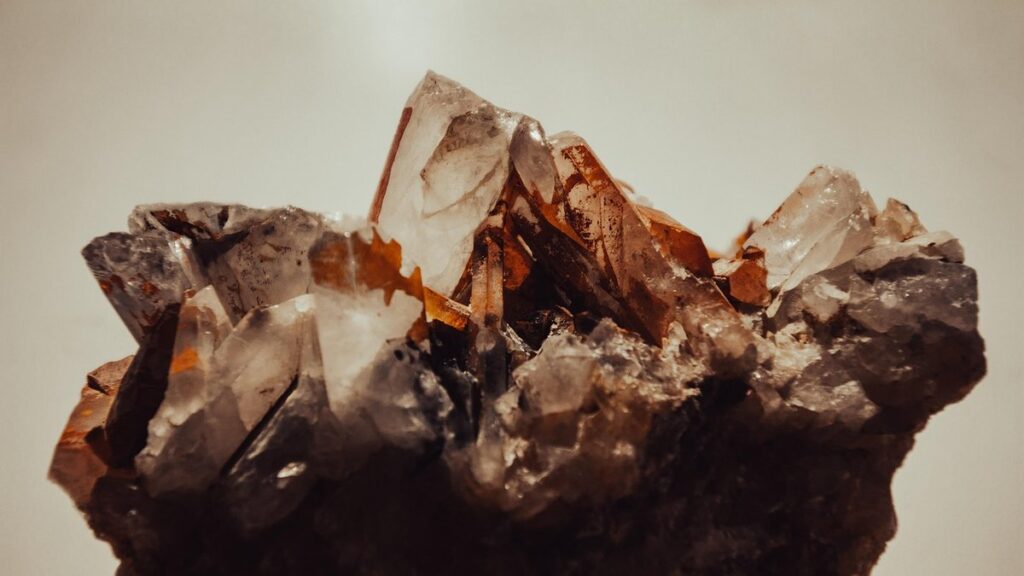
Quartz, on the other hand, is one of the most abundant minerals in the Earth’s crust. It is a crystalline form of silicon dioxide (SiO2) with a trigonal crystal system. Quartz has many varieties, including amethyst, citrine, rose quartz, and smoky quartz, each with distinct coloration and inclusions.
Key differences between opals and quartz lie in their composition and structure. While both minerals are made up of silica, opals contain varying amounts of water, which affects their appearance and durability. Quartz, being a crystalline mineral, exhibits cleavage and can form complex crystals. Understanding the fundamental characteristics of these minerals is essential for accurate identification and appreciation of their unique properties.
Identifying Key Features
When distinguishing opals from quartz, it’s essential to examine their internal structure and optical properties. One key feature is the presence of a “play-of-color” effect in opal, which results from the way light interacts with microscopic silica spheres that are uniformly dispersed throughout the stone. This unique arrangement gives opal its characteristic iridescence.
In contrast, quartz typically lacks this play-of-color effect due to its crystal structure. Quartz has a more ordered internal arrangement of atoms, resulting in a lack of the same level of optical dispersion seen in opals. When examining an unknown specimen, observe whether it exhibits a similar play-of-color effect or if it appears as a solid, opaque material.
Another critical distinction lies in their refractive indices. Opal typically has a lower refractive index than quartz, which can affect how light passes through the stone and is reflected back to the observer’s eye. Be aware that this difference may not be immediately apparent without specialized equipment or expertise.
A small minority of quartz varieties, such as amethyst or citrine, can exhibit internal structural features similar to those found in opal.
Physical Characteristics of Opals and Quartz
One key factor that can help you distinguish between opal and quartz is looking at their physical characteristics, such as color patterns and inclusions. Understanding these differences can be a crucial step in identification.
Opal Appearance and Clarity
White opals typically display a play of colors, known as iridescence, which appears to shift depending on the angle of view. This characteristic is due to the unique composition and structure of the stone. Black opals, on the other hand, have a more subtle appearance, often featuring dark body tone with hints of red or purple. Boulder opals are formed in ironstone and display a striking appearance, with colors that can range from bright red to deep blue.
Opal clarity levels vary significantly, ranging from relatively clear stones with minimal imperfections to those with significant inclusions. Common inclusions include ‘jelly-filled’ cavities, known as ‘jasper’, which are usually dark in color and appear as small pits or pools within the stone. The level of clarity can greatly impact an opal’s overall appearance and value.
When evaluating opals for clarity, it’s essential to consider both the type of inclusion and its size. Larger inclusions may be more noticeable than smaller ones, while specific types of inclusions, like ‘jasper’, can be more desirable in certain stones. Observing the stone under different lighting conditions can also help reveal hidden imperfections or characteristics.
Quartz Varieties and Forms
Quartz is a highly diverse mineral with numerous varieties and forms. While opals are prized for their unique, iridescent appearance, quartz is known for its wide range of colors and crystal structures. Some popular types of quartz include amethyst, citrine, and rose quartz, each with distinct characteristics that set them apart from one another.
Amethyst, a purple variety of quartz, owes its color to the presence of iron impurities. Citrine, on the other hand, is often yellow or orange due to exposure to heat, although some specimens may exhibit a natural orange hue. Rose quartz, a pink-to-red variety, gets its characteristic color from manganese and titanium impurities.
In contrast to opals, which display a shimmering effect known as “opalescence,” most types of quartz lack this property. Some quartz varieties, such as smoky quartz, can appear dark or translucent due to the presence of inclusions or impurities. When identifying quartz specimens, it’s essential to examine their color, crystal structure, and inclusions to determine their specific type. By understanding these differences, collectors and enthusiasts can better distinguish between various types of quartz and avoid misidentifying them as opals.
Optical Properties and Tests
Understanding opal and quartz requires a closer look at their unique optical properties, including how they interact with light. We’ll explore these fascinating effects in more detail below.
Refractive Index and Dispersion
To determine the refractive index and dispersion of opals and quartz, you can use a gemstone tester or a polarized light microscope. A gemstone tester is an affordable tool that measures the refractive index by shining a light through the stone and observing the angle of refraction. The test is relatively quick but may not provide precise measurements.
A polarized light microscope offers more accurate results, particularly for measuring dispersion. This technique involves passing polarized light through the stone and analyzing how it bends. When using a polarized light microscope, look for the “optic axis,” which is where the light passes through with minimal bending. The angle of refraction at this point will indicate the refractive index.
When testing opals, note that their unique structure can cause uneven dispersion, making it challenging to obtain accurate readings. Quartz, on the other hand, typically exhibits a more consistent refractive index and dispersion pattern due to its crystalline structure. Be aware of these differences when interpreting results from your measurements.
Birefringence and Pleochroism
Birefringence occurs when a crystal’s optical properties vary depending on its orientation. This phenomenon is particularly noticeable in quartz due to its hexagonal crystal structure. When light passes through a birefringent material, it splits into two different refractive indices, creating double refraction.
Pleochroism, on the other hand, refers to the change in color intensity or hue when viewed from different angles. Both opal and quartz exhibit pleochroism, but their effects are distinct. Quartz often displays a range of colors due to its complex crystal structure, while opals typically show subtle changes in brightness.
To observe these effects, use a polarizing filter or a dichroscope. The dichroscope is specifically designed for testing crystals and allows you to rotate the sample to observe pleochroism. You can also use a polarized light source, such as a microscope with polarizing capabilities, to examine birefringence.
It’s essential to note that both opals and quartz exhibit some degree of birefringence and pleochroism. However, their magnitudes differ significantly. Quartz generally displays more pronounced effects due to its larger crystal size and more complex structure. By carefully examining these properties, you can gain valuable insights into the identity of your specimen and make a more informed identification between opal and quartz.
Advanced Identification Techniques
To further refine your identification skills, we’ll explore advanced techniques for distinguishing opal from quartz, including analysis of internal structures and optical properties. These methods require a keen eye for detail and practice to master effectively.
Microscopy and Imaging
When examining opals and quartz under a microscope, polarized light can reveal crucial details. Polarized microscopy helps distinguish between the two minerals by highlighting their unique crystal structures. Opal typically exhibits a diffuse, milky appearance due to its amorphous silica structure, whereas quartz shows a more defined, crystalline pattern.
Advanced imaging techniques like Raman spectroscopy offer even greater precision in identification. This non-destructive method involves shining a laser on the mineral and measuring the scattered light’s spectrum. The resulting spectral signature can pinpoint the specific type of opal or quartz, taking into account factors such as its chemical composition and crystal structure.
For example, hydrated silica opals tend to produce distinct Raman peaks corresponding to their hydroxyl (-OH) groups. On the other hand, quartz typically exhibits characteristic peaks associated with its silicon-oxygen tetrahedra. By combining microscopic observations with advanced imaging techniques like Raman spectroscopy, mineralogists can make highly accurate identifications of opal and quartz samples.
Chemical Analysis
Chemical analysis plays a crucial role in identifying the composition of opals and quartz. Techniques such as Energy-Dispersive X-ray (EDX) spectroscopy or X-ray Fluorescence (XRF) help determine the elemental makeup of these gemstones, which can be essential in distinguishing between opal and quartz.
These analytical methods work by bombarding a sample with high-energy electrons or X-rays, causing the atoms to emit characteristic X-rays that are then detected. The resulting spectrum provides a unique fingerprint of the elements present in the sample. For example, EDX analysis might reveal a higher concentration of silicon, aluminum, or iron in quartz compared to opal.
The results of chemical analysis can help identify the presence of impurities or additives that may be present in some quartz varieties, such as tourmaline inclusions or heat treatment residues. This information is vital for collectors and gemstone enthusiasts seeking to accurately identify their specimens. By combining the findings from optical tests with chemical analysis data, experts can make more informed decisions about the authenticity and value of opal and quartz samples.
Common Misidentifications and Mistakes
Many gem enthusiasts struggle to tell opal from quartz, and it’s not uncommon for both stones to be mislabeled. Let’s examine some of the most common mistakes made in this area.
Quartz Lookalikes
Quartz has several lookalikes that can be easily mistaken for it. One of the most common quartz lookalikes is calcite, which often exhibits a similar crystalline structure and transparency to quartz. However, calcite typically has a more vivid color, ranging from white to pink to yellow, whereas quartz tends to be clear or white. Apatite is another mineral that can be mistaken for quartz due to its similar appearance, but it usually has a distinct greenish tint.
Tourmaline is also often confused with quartz because of its similar crystal habit and ability to display a range of colors. However, tourmaline typically exhibits pleochroism – the change in color when viewed from different angles – which can be observed using a polarizing filter or under intense light. To distinguish calcite, apatite, and tourmaline from true quartz, examine their crystal habit, transparency, and pleochroism. If you’re still unsure, consult a gemological microscope or seek the expertise of a professional mineralogist.
Opal Impersonators
Some materials and gemstones can convincingly mimic the appearance of opals. Glass or ceramic inlays, for instance, may exhibit a similar iridescence due to their layered structure. However, these impostors lack the inherent water content that’s characteristic of natural opals.
When examining a specimen suspected of being an opal but displaying a more uniform color or lackluster appearance, it’s essential to inspect it carefully for signs of glazing or lamination. Glass inlays often exhibit sharp boundaries between colors and can appear overly uniform.
Other materials like shell or mother-of-pearl may also be mistaken for opals due to their pearlescent sheen. These materials typically have a more matte appearance than genuine opals and are usually less transparent.
In some cases, the presence of inclusions or imperfections within the material can help distinguish it from an opal. For example, glass inlays often contain tiny bubbles or air pockets that can be visible under magnification.
Best Practices for Collecting and Caring for Opals and Quartz
When it comes to collecting and caring for opal and quartz, proper handling is crucial to preserve their beauty and value. Here are some essential tips on how to collect and care for these gemstones.
Safe Handling and Storage
When handling opals and quartz, it’s essential to exercise caution to prevent damage or alteration of their physical and optical properties. Avoid touching the stones excessively, as the oils from your skin can seep into the stone’s pores and cause discoloration over time. Instead, handle them with a soft cloth or gloves, which will also help protect against scratches.
For storage, it’s crucial to keep opals and quartz away from direct sunlight and harsh chemicals. A dark, dry place with stable temperatures is ideal. Avoid storing them in proximity to other minerals that may cause stress or alteration, such as fluorite or calcite. Store them separately in airtight containers or compartments within a display case.
To prevent thermal shock, avoid sudden temperature changes when handling or storing opals and quartz. This can cause cracking or shattering. If you must store them for extended periods, consider using desiccants to maintain a stable moisture level. When cleaning your opal or quartz collection, use gentle methods and avoid harsh chemicals or abrasive materials that could scratch the stones’ surfaces.
Cleaning and Preservation
Cleaning and preserving opals and quartz requires gentle care to maintain their natural beauty. Avoid exposing these stones to harsh chemicals, as they can damage the surface or cause discoloration. For routine cleaning, use a soft-bristled brush to gently remove dirt and debris from the stone’s surface. A mild soap solution, specifically designed for jewelry or gemstones, can be used on a soft cloth to wipe down the stone. However, rinse thoroughly with lukewarm water to prevent any residue buildup.
When it comes to drying opals and quartz, avoid using heat sources such as ovens, hair dryers, or direct sunlight. Instead, air-dry the stones naturally, either by laying them flat on a soft cloth or hanging them in a cool, well-ventilated area. Some quartz varieties, like agate and jasper, are more porous than opals and may require occasional oiling to maintain their appearance.
For long-term preservation, consider storing your opals and quartz away from direct light sources, as prolonged exposure can cause fading or discoloration. Store them in a cool, dry place, such as a jewelry box or airtight container. Avoid stacking the stones on top of each other, as this can cause scratching or damage to their surfaces.
Frequently Asked Questions
Can I use a jeweler’s loupe to identify opals and quartz?
Yes. A jeweler’s loupe can be useful for initial identification, but it may not provide enough detail to distinguish between similar-looking gemstones. For more accurate results, consider using a polarized light microscope or other advanced tools mentioned in the article.
How do I avoid misidentifying quartz with other minerals that have similar optical properties?
When working with unknown samples, always use multiple identification methods, including refractive index and dispersion testing, birefringence observation, and chemical analysis. This will help you rule out common lookalikes like calcite or apatite.
Can I clean opals and quartz using ultrasonic cleaners or steam cleaning?
No. Avoid using harsh chemicals, high-pressure jets of water, or extreme temperatures when cleaning opals and quartz. Instead, gently wipe them with a soft cloth and mild soap solution, then dry thoroughly to prevent damage or alteration of their optical properties.
What if I’m unsure about the authenticity of an opal or quartz sample?
In cases where you’re uncertain about the identity of a gemstone, consult multiple sources, including experts in the field, and use advanced identification techniques like Raman spectroscopy or EDX analysis to determine its composition.