
Identifying trees can be a daunting task, especially when faced with multiple species that share similar characteristics. As you step into the woods or wander through your neighborhood, you may find yourself unsure about the tree right in front of you. A personalized tree identification guide is just what you need to turn this curiosity into knowledge and appreciation for these natural wonders. With key characteristics such as bark patterns, leaf shapes, and branching styles, learning how to accurately identify trees can be a fun and rewarding experience. This article will cover essential tips and techniques for creating your own customized tree identification guide, allowing you to confidently recognize the many species that surround us. By the time you finish reading, you’ll know just what to look for when identifying trees, making exploration of our natural world even more enjoyable and informative.
Understanding the Basics
To identify a tree, you first need to understand its basic characteristics, including shape, size, and leaf structure, which form the foundation of any identification process. This is where your journey begins.
Characteristics to Observe
Start by examining a tree’s shape and size. Observe whether it has a broad canopy, a narrow crown, or a conical shape. Consider its overall height: is it a towering giant or a smaller shrub? Note the trunk’s diameter and whether it’s straight, curved, or twisted.
Next, inspect the bark texture. Trees can have smooth, scaly, fibrous, or papery bark. Some species display prominent ridges, furrows, or plates. For example, paperbark maple (Acer griseum) features exfoliating copper-colored bark that peels away in thin layers. In contrast, river birch (Betula nitra) has a smooth, white trunk.
Look at the foliage patterns as well. Trees may have simple leaves, compound leaves with multiple leaflets, or needles. Consider the arrangement of leaves on the stem: are they opposite, alternate, or whorled? Some trees display distinctive patterns, like the palmate leaves of sycamore (Platanus occidentalis) or the feathery foliage of ferns.
Take note of these key features when observing a tree. They can provide valuable clues for identification.
Common Misidentifications to Avoid
When identifying trees, it’s easy to get caught up in misidentifications. One common mistake is confusing similar-looking species, such as the Ash and Elm trees. These two deciduous trees have overlapping ranges and can share many physical characteristics, making them challenging to distinguish.
Another critical error is overlooking important distinguishing characteristics. For instance, the Silver Maple has a wide range of variation in leaf shape and size, which can make it difficult to identify. On the other hand, the Sugar Maple’s leaves have seven lobes, whereas the Red Maple’s leaves typically have three.
To avoid these misidentifications, pay close attention to tree features such as leaf margins, branch patterns, and bark texture. For example, the Sweetgum tree has distinctive star-shaped fruits that are often overlooked by novice identifiers. Similarly, the Sycamore tree’s bark is characterized by a peeling mottled pattern.
By being mindful of these common mistakes and taking the time to examine key characteristics, you can improve your chances of accurate identification. Always consult multiple field guides or expert opinions if you’re unsure about a particular species.
Introduction to Tree Families
Let’s start by learning about the main groups of trees, known as families, which will help you narrow down your identification search. You’ll learn about the unique characteristics and tree types within these key families.
Deciduous Trees
Deciduous trees are one of the most diverse and widespread groups within tree families. They can be found on every continent except Antarctica and are known for their ability to shed their leaves seasonally, typically in autumn or fall. Among the most common deciduous tree families are maples (Acer spp.), oaks (Quercus spp.), and elms (Ulmus spp.).
Maple trees are recognized by their distinctive palmate leaves with 3-7 lobes and their stunning displays of color during autumn, ranging from bright red to deep crimson. Oak trees can be identified by their sturdy branches, rough bark, and broad, rounded leaves with pointed tips. Elms, meanwhile, have characteristic irregularities in their leaf margins and often grow in sprawling or vase-shaped forms.
When identifying a deciduous tree, pay attention to its growth habits and any distinctive features such as the shape of its leaves, the color of its fall foliage, and the texture of its bark. Consider the tree’s native habitat and whether it’s adapted to your local climate and soil conditions. Knowing these characteristics can help you pinpoint a specific tree species and provide valuable insights into its needs and potential challenges in cultivation or conservation efforts.
Evergreen Conifers
Evergreen conifers are a diverse group of trees characterized by their needle-like foliage and cone structures. This family includes pine, spruce, and fir, among others. To identify an evergreen conifer, look for long, thin needles that are often bundled together on the twig. The shape, size, and color of these needles can help distinguish between different species.
Pines have sturdy, thick needles with two white bands on the underside, while spruces have shorter, more flexible needles without stomata (the small pores found on most leaves). Firs tend to have flat, narrow needles that are often notched at the tip. When examining a conifer’s cones, consider their shape and size: pinecones are typically round or oval with scales that close when mature, while spruce and fir cones are more cylindrical and often hang downward.
Observe the arrangement of branches on the tree as well; evergreen conifers tend to have a central leader and ascending branches. When combined, these characteristics can help narrow down the identification of an evergreen conifer species. By paying attention to needle morphology and cone structure, you’ll be better equipped to identify these common and widespread trees in your area.
Leaf Identification
Leaf identification can be a daunting task, but it’s a crucial step in accurately identifying a tree species. Let’s start by examining the unique features of leaves that will help you narrow down your search.
Simple Leaves (Alternate and Opposite Arrangement)
Simple leaves come in various shapes and sizes. They are typically broad and flat with a distinct margin. The most common types of simple leaf margins include entire (smooth), toothed, lobed, or deeply incised. For example, the leaves of the maple tree have deeply incised margins, while those of the oak tree have rounded tips and entire margins.
Venation patterns also provide clues for identification. Simple leaves can be classified into three main types based on their venation: net-veined, brochidodromous, or camptodromous. Net-veined leaves have a network of veins that radiate from the midpoint of the leaf to its edges. Brochidodromous leaves have two primary veins that run parallel to each other, while camptodromous leaves have one central vein and two smaller lateral veins.
In terms of size, simple leaves can range from narrow needles to broad palmate shapes. For instance, the leaves of conifer trees like pine or spruce are typically long and needle-like, whereas those of deciduous trees like beech or elm are broader and more flat. When examining a tree’s leaves, it’s essential to pay attention to these characteristics to determine their type and ultimately identify the species.
Compound Leaves (Pinnate and Palmate Arrangements)
Compound leaves are characterized by their complex arrangement of leaflets. Pinnate arrangements feature leaflets attached to a central stem, often resembling a feather. In contrast, palmate arrangements have leaflets radiating from a central point, giving the appearance of an open hand. The American Elm (Ulmus americana) is a notable example of a tree with pinnate compound leaves, its 11-17 leaflets arranged alternately along a central rachis.
Other trees exhibit palmate arrangements, such as the Shagbark Hickory (Carya ovata). Its deeply lobed or palmate leaves feature five to seven pointed segments. When identifying compound leaves, consider the overall shape and arrangement of leaflets. Note whether they are attached by their base to a central stem or radiating from a common point.
Careful observation can also reveal differences in leaflet size, margin characteristics, or venation patterns between pinnate and palmate arrangements. The more familiar you become with these variations, the easier it will be to distinguish between different tree species based on their compound leaves.
Branching Patterns
Tree branching patterns can reveal a lot about a tree’s species and age, so let’s take a closer look at some common patterns to help you narrow down your identification search.
Monopodial and Sympodial Growth Habits
Trees exhibit two primary branching growth habits: monopodial and sympodial. Understanding these patterns is crucial for accurate tree identification, as they influence a tree’s overall shape and structure.
Monopodial trees grow from a single terminal bud, producing new branches at the tip of the current year’s growth. This results in a narrow crown with a prominent leader. Examples include coconut palms and kentia palms, where a single main stem supports a dense cluster of leaves. Monopodial trees tend to have fewer, but often larger, branches.
Sympodial trees, on the other hand, produce new growth from lateral buds along the length of the branch. This leads to a broader crown with multiple leaders. Sympodial trees include species like the dracaena and bamboo, which produce new shoots at regular intervals. Identifying whether a tree is monopodial or sympodial can help narrow down its possible species. For example, if you encounter a palm with a single main stem and a dense cluster of leaves, it’s likely to be a monopodial species.
Examples of Branching Patterns in Different Species
Some of the most distinctive branching patterns can be found in coniferous trees. For example, fir trees typically have horizontal branches that arise from a single main trunk. In contrast, pine trees often grow with ascending branches that form a symmetrical, umbrella-like shape.
Other species exhibit more irregular branching patterns. For instance, the cottonwood tree (Populus trichocarpa) has a broad, spreading canopy formed by long, slender branches that droop towards the ground. This is in part due to its relatively weak branch attachment points. Similarly, willow trees often have pendulous branches with flexible twigs.
When identifying branching patterns, note whether they are ascending (growing upwards), descending (growing downwards), or horizontal (lying flat). Consider how many main branches emerge from the trunk, and observe any notable irregularities in their shape or arrangement. In conifers, you may also want to count the number of needles per fascicle (the leafy bundle at the end of a twig) as this can be an indicator of tree species.
Tree Trunk and Bark Features
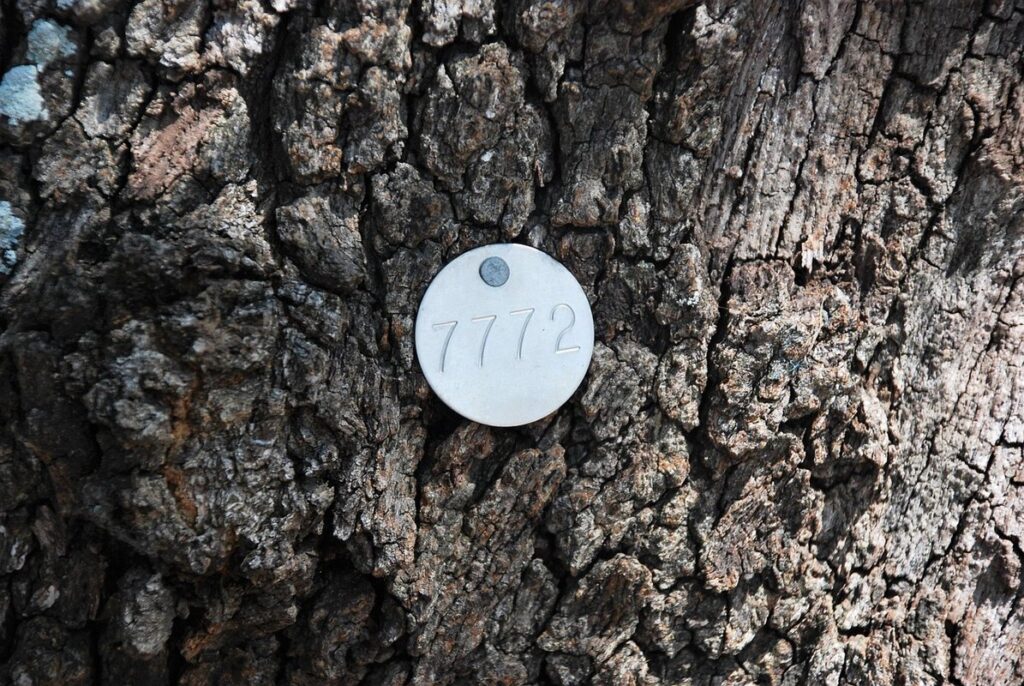
When identifying trees, one of the most distinctive features is often overlooked: the trunk and bark. These characteristics can reveal a tree’s species, age, and even its health.
Types of Bark (Smooth, Scaly, Fissured)
Smooth bark is one of the most recognizable and distinctive features of certain tree species. When you run your hand over a smooth trunk, it should feel slick to the touch, with no visible texture or bumps. Trees like the paperbark maple (Acer griseum) and some birch species display this characteristic. Smooth bark often appears on younger trees but may be lost as the tree matures.
Scaly bark is another common type, characterized by small, overlapping scales that give a rough texture to the trunk. This pattern can be further divided into two subcategories: loose scaly bark and persistent scaly bark. Trees like the shagbark hickory (Carya ovata) and some oak species exhibit loose scaly bark, which tends to flake off as the tree grows older. In contrast, trees with persistent scaly bark, such as the white birch (Betula papyrifera), retain their scales over time.
Fissured or furrowed bark is a more complex pattern featuring deep grooves and ridges that often resemble wrinkles on human skin. This type of bark can be found on many deciduous tree species, including some oak, maple, and elm varieties. Identifying the specific pattern and depth of fissuring can help narrow down the possible tree species and guide further identification efforts.
Significant Features on the Trunk (Burls, Suckers)
Burls are abnormal growths on a tree’s trunk, often resulting from stress, injury, or infection. They can be rounded, oval, or irregularly shaped and may appear smooth or have small cracks. Suckers, also known as water sprouts, are shoots that grow directly from the trunk, often in response to environmental factors like drought or damage.
When identifying a tree with significant features on its trunk, observe the shape, size, and color of these growths. Burls can be light brown, gray, or black, sometimes with visible veins or ridges. Suckers typically grow from nodes on the trunk and may have leaves similar to those of the main branches.
Burls often indicate a tree’s age and history: they usually appear on older trees and can provide clues about environmental conditions at different times. For example, if burls are found only on one side of the trunk, this might suggest that the tree grew in an area with heavy shade or frost.
When examining suckers, pay attention to their location, size, and whether they have any leaves. These shoots often grow rapidly but may eventually die back if they don’t receive adequate light or water.
Advanced Identification Techniques
As you continue to develop your tree identification skills, let’s explore some of the more nuanced and advanced techniques that can help you accurately pinpoint a species. These techniques include analyzing leaf patterns, bud shapes, and other subtle characteristics.
Fruit and Seed Characteristics
When examining fruit and seed characteristics, consider both their size and shape. Berry size can be an identifying feature: small berries are typical of shrubs like blueberries (Vaccinium spp.) or dogwoods (Cornus spp.), while larger berries often indicate a tree like the persimmon (Diospyros virginiana). Fruit color is also crucial – for instance, the bright red fruit of the Chinese hawthorn (Crataegus pinnatifida) typically distinguishes it from other thorny trees.
The shape of berries and seeds can be equally distinctive. Some fruits are characterized by multiple small drupelets, like blackberries (Rubus spp.), while others are single, fleshy structures, such as the pawpaw’s large, green fruit. Seed size and arrangement can also provide clues: for example, trees with pinnately compound leaves often have seeds in clusters of two or three.
When documenting a tree specimen, note the size and shape of its fruits and seeds, as well as any distinctive features like beaks or wings on the seed. This information will help you narrow down the potential identity of your mystery tree – particularly when combined with other field notes about leaf morphology, growth habit, and bark texture.
Unique Features for Specific Species
The key to accurate tree identification lies in understanding the unique characteristics of specific species. The American beech, for instance, features smooth, gray bark with a characteristic “eye” pattern. This is distinct from the paperbark maple, which has exfoliating, reddish-brown bark that sheds in long strips. When identifying trees in your area, it’s essential to familiarize yourself with these species-specific traits.
The northern red oak is notable for its lobed leaves, while the white oak has rounded leaf lobes. These subtle differences can be crucial when distinguishing between these two common eastern deciduous species. To get started, consider examining the tree’s bark, as this can provide immediate clues about its identity. For example, if you notice a smooth, gray trunk with horizontal ridges, it may indicate a paperbark maple.
In some cases, the only way to confirm a tree’s identity is through a combination of factors. Take the eastern white pine, for instance: while its long needles and slender branches are distinctive, they’re not unique to this species. To narrow down your options, look for the presence of short, stout branches that form a “zig-zag” pattern against the trunk. This distinctive characteristic is more typical of the eastern white pine than other conifers in the area.
Putting It All Together: Creating a Personalized Tree Identification Guide
Now that you’ve learned how to identify different tree species, it’s time to put your skills into practice by creating a personalized guide tailored to your specific needs. This section will walk you through the process of making a customized identification guide.
Tips for Developing Observation Skills
Developing observation skills is crucial for creating an accurate and comprehensive tree identification guide. To hone your observational abilities, start by practicing with field guides and online resources. Choose a specific region or ecosystem to focus on, as this will help you become familiar with the unique characteristics of trees in that area.
Begin by studying the illustrations and descriptions in field guides such as the National Audubon Society Field Guide to Trees or the USDA PLANTS Database. Observe how each guide categorizes and describes tree species, paying attention to the distinctive features that set them apart. Online resources like iNaturalist and Leafsnap can also provide valuable insights into tree identification.
In addition to studying guides, take your observations out into the field. Bring a camera or sketchbook with you to record details about the trees you encounter. Note their leaf shape, bark texture, and growth patterns. Consult multiple sources if you’re unsure of a species’ identity. By combining practice with observation, you’ll become more confident in your ability to identify trees accurately and develop a comprehensive tree identification guide that serves as a valuable resource for others.
Conclusion and Future Directions
By now, you’ve accumulated a wealth of knowledge about tree identification. You can use the guide to create personalized notes and sketches for quick reference during fieldwork. Consider compiling photos and descriptions of trees you’ve identified into an album or binder.
A crucial next step is integrating local regulations and management considerations into your guide. Research any protected species in your area, as well as any restrictions on tree removal or pruning. This will help ensure that your identification skills are applied responsibly.
To make the most of your personalized guide, plan to revisit and update it regularly. Observe seasonal changes in leaf color, flower blooming times, and other characteristics to refine your notes. If you notice inconsistencies between your observations and the guide, revise your entries accordingly. This process will not only improve your identification skills but also help you develop a deeper understanding of local ecosystems.
Frequently Asked Questions
What if I’m still unsure about the identity of a tree after observing its key characteristics?
Yes, it’s normal to need additional verification, and consulting multiple field guides or seeking advice from an expert can provide further clarity. Consider taking notes on your observations and researching online resources, such as websites dedicated to tree identification, for more information.
Can I use my own photographs of trees to aid in identification, or is direct observation always best?
Yes, using your own photographs can be helpful, but it’s essential to ensure the images are clear and accurately represent the tree’s features. When possible, combine photographic evidence with direct observation to achieve a more accurate identification.
How do I determine whether a tree’s bark is smooth, scaly, or fissured when it’s not easy to see in person?
Observe the bark texture by gently running your hand over the surface or examining closely taken photographs of the tree. Consider consulting field guides with detailed descriptions and images of different bark types for reference.
Can I use this guide for identifying trees in other parts of the world, or is it specific to a particular region?
While the guide provides general principles applicable worldwide, the specific characteristics mentioned might not be relevant to all regions. Be aware that regional tree species and features may differ significantly, so adapt your approach accordingly when encountering unfamiliar trees.
What if I notice variations in leaf shape or size within the same tree? How does this affect identification?
Yes, variations within a single tree can occur due to factors like climate, soil, or disease. When identifying a tree, look for the most common characteristic of the species and consider taking note of any notable deviations from the typical pattern.
How do I create a digital version of my personalized tree identification guide, making it easy to access on-the-go?
You can use note-taking apps or digital field guides that allow you to organize your observations and notes. Consider saving your guide as a PDF for future reference and printing out a physical copy when needed in the field.