
Halley’s Comet has been a source of fascination for centuries, with ancient civilizations recording its appearance in the night sky. You might be surprised to learn that this comet is one of the most well-documented celestial bodies in history, with over 30 recorded sightings dating back to 240 BCE. From its majestic tail to its relatively short orbital period, Halley’s Comet has captivated astronomers and the general public alike. But what makes it so significant? This article will take you on a journey through the comet’s history, from ancient observations to modern research and space exploration predictions. We’ll explore the key milestones in Halley’s Comet sightings, including its most recent appearance in 1986, and examine the scientific significance of this celestial wonder. By the end of this article, you’ll understand why Halley’s Comet remains an essential topic for astronomers, space enthusiasts, and anyone interested in the wonders of our universe.
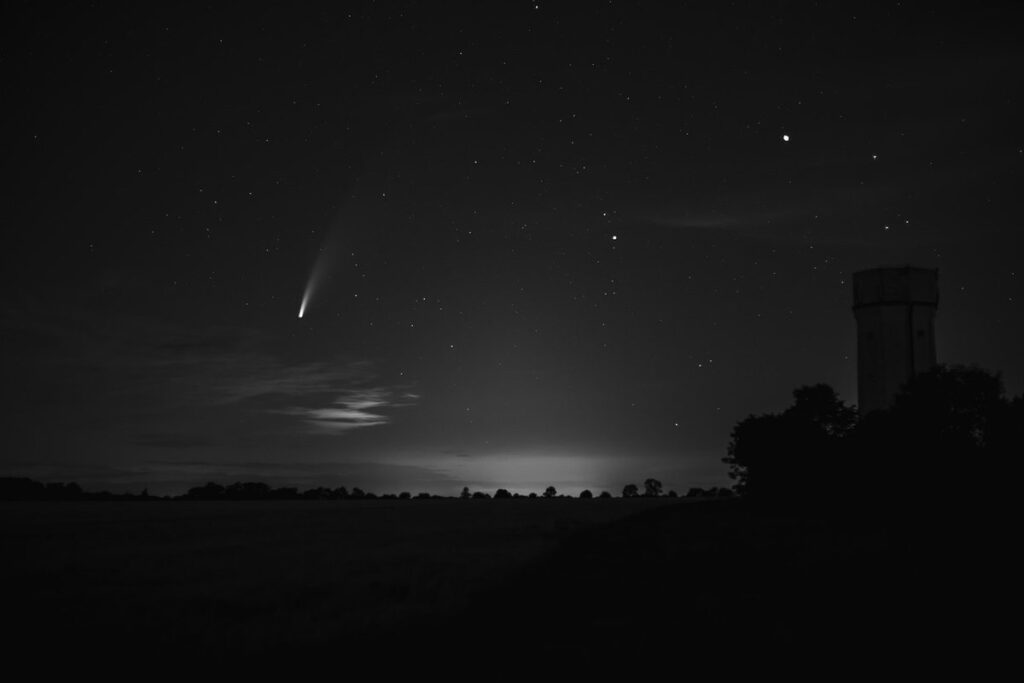
What is Halley’s Comet?
Halley’s Comet has been a topic of fascination for centuries, but have you ever wondered what makes it so special and why it returns to our skies every 76 years. Let’s take a closer look at its unique characteristics.
Discovery and Naming
Chinese astronomers recorded Halley’s Comet as early as 240 BCE. This ancient sighting predates European observations by centuries and highlights the importance of global astronomical collaboration. The comet’s periodicity, which allows it to be predicted with relative accuracy, was not fully understood until Edmond Halley’s work in the 17th century.
Halley, an English astronomer, studied cometary orbits and made a groundbreaking prediction: that a previously observed comet would return in 1758. This prediction proved correct when the comet reappeared on Christmas Day of that year, confirming Halley’s calculations. As a result of his work, the comet was officially named after him.
The naming of celestial bodies often follows a pattern based on their discoverer or key characteristics. In this case, Edmond Halley’s contribution to understanding cometary orbits led to the comet being permanently associated with his name. This example illustrates how scientific discovery can have lasting impacts on our understanding and classification of astronomical phenomena.
Characteristics and Composition
Halley’s Comet is a remarkable celestial body with distinct physical characteristics. Measuring approximately 9 miles (14 kilometers) in diameter, it is a relatively small comet compared to others. Its shape is irregular, with a long, curved tail that can stretch up to 40 million miles (64 million kilometers). This tail is composed of dust and gas, which are ejected from the comet’s nucleus as it approaches the Sun.
The composition of Halley’s Comet is primarily made up of water ice, frozen gases such as carbon dioxide and methane, and darker organic material. The exact ratio of these components varies depending on the comet’s location in its orbit. When Halley’s Comet passes close to the Sun, the ices vaporize, creating a bright tail that can be seen from Earth.
Halley’s Comet is also notable for its high concentration of cometary particles. Its nucleus contains many small dust particles and frozen gases, which are released as it approaches the Sun. This process is crucial in understanding the comet’s behavior and composition.
Halley’s Comet Sightings Throughout History
You’ve likely heard that Halley’s Comet is one of the most observed comets in history, but have you ever wondered when and how it was first spotted by humans? Let’s take a look at some of its notable sightings throughout time.
Early Observations and Record-Keeping
Ancient civilizations demonstrated a keen interest in Halley’s Comet, tracking its appearances with remarkable accuracy. The Babylonians, for instance, recorded the comet’s passage in 164 BC and noted its return in 87 BC. Similarly, Chinese astronomers documented Halley’s Comet in 240 BC and 130 AD. These observations were often linked to significant events such as wars, famines, or floods.
The importance of record-keeping cannot be overstated when it comes to understanding celestial events like Halley’s Comet. By meticulously documenting its movements, ancient civilizations laid the groundwork for modern astronomy. This attention to detail allowed them to identify patterns and cycles that would have otherwise gone unnoticed. Today, astronomers rely on these early records to refine their predictions and understanding of the comet’s behavior.
A key takeaway from this historical record-keeping is the value of meticulous documentation in astronomical research. By adopting a similar approach, modern observers can contribute meaningfully to our understanding of celestial events. This involves not only recording observations but also analyzing data with attention to detail and rigor.
Notable Sightings and Cultural Significance
Throughout history, Halley’s Comet has been a source of fascination and awe for many cultures. One notable sighting occurred in 1066, when the comet was seen by English monks as an omen before the Norman Conquest. Similarly, in 1301, the comet’s appearance coincided with a devastating flood in China.
The comet’s cultural significance extends beyond its association with natural disasters. In ancient Greece and Rome, Halley’s Comet was often linked to the birth of famous leaders, such as Alexander the Great and Julius Caesar. This perception has persisted over time, with some cultures believing that the comet’s return signals a change in leadership or power.
In modern times, Halley’s Comet has also become a symbol of scientific discovery and progress. The 1986 sighting marked a significant milestone in astronomy, as it was the first time humans had directly observed the comet up close using spacecraft. The European Space Agency’s Giotto probe captured stunning images of the comet’s nucleus, revealing its unique composition and structure.
Halley’s Comet has also inspired artistic expression, from medieval woodcuts to modern paintings. Its appearance in 1910 prompted a surge in celestial-themed artwork, cementing its place as a cultural icon.
The Science Behind Halley’s Comet
Halley’s Comet has been a subject of fascination for centuries, and understanding its orbital patterns is key to predicting its return. Its unique elliptical path around the sun has been studied extensively by astronomers.
Composition and Structure
The composition of Halley’s Comet is primarily composed of dust and gas, with a small rocky core at its center. This mixture creates a unique structure, with the comet’s icy surface vaporizing as it approaches the Sun, producing the bright tail we see from Earth. Unlike some other comets, Halley’s has no solid nucleus; instead, its “body” is made up of a loose collection of dust and ice particles held together by their own gravity.
As a result of this composition, Halley’s Comet undergoes significant changes as it approaches perihelion. The comet’s ices sublime, turning directly into gas without going through the liquid phase first, which allows for the formation of its distinctive tail. This process is also responsible for the comet’s varying brightness and color over time.
The structure of Halley’s Comet can be broken down into several distinct layers:
- A dusty outer layer, comprising tiny particles of dust and rock
- A mid-layer of frozen gases, including water vapor and methane
- A rocky core at the center of the comet
Orbit and Periodicity
Halley’s Comet follows a highly elliptical orbit around the Sun, with its closest approach, known as perihelion, occurring at approximately 1.31 astronomical units (AU) from the Sun. The comet’s farthest distance, or aphelion, reaches about 3.27 AU from the Sun. This unique orbital shape is influenced by the gravitational pull of nearby planets, particularly Jupiter and Saturn.
The combination of these planetary interactions and the comet’s own mass distribution results in a periodic orbit with a relatively short period of approximately 76 years. This periodicity means that Halley’s Comet returns to the inner Solar System roughly every three-quarters of a century. The comet’s high eccentricity also leads to significant variations in its brightness and visibility during each perihelion passage.
Several factors contribute to the stability of Halley’s orbit, including the gravitational influence of Jupiter, which has a stabilizing effect on the comet’s motion. Additionally, the comet’s own mass distribution, with most of its material concentrated near the nucleus, helps maintain its orbital shape. These factors work together to ensure that Halley’s Comet remains a regular visitor to our Solar System.
Impact on Astronomy and Space Exploration
Halley’s Comet has left an indelible mark on astronomy, inspiring new discoveries and pushing the boundaries of space exploration. From orbital calculations to deep space missions, its legacy continues to shape our understanding of the cosmos.
Contribution to Astronomical Understanding
Observations of Halley’s Comet have significantly contributed to our understanding of comets and their role in the solar system. The comet’s periodic returns provided astronomers with a unique opportunity to study its behavior, composition, and interactions with the Sun. By analyzing data from these events, scientists discovered that comets are primarily composed of dust and ice, which vaporizes when approaching the Sun, creating the characteristic tail.
One key finding was that comets play a crucial role in delivering organic materials to planetary surfaces, potentially seeding life on Earth. This discovery has implications for understanding the origins of life and the possibility of extraterrestrial life. Additionally, Halley’s Comet’s close proximity to the Sun allowed researchers to study its interaction with the solar wind and coronal mass ejections.
The European Space Agency’s Giotto spacecraft flew by Halley’s Comet in 1986, providing the first close-up images and data on a comet’s composition and structure. These findings have greatly advanced our understanding of comets and their place within the solar system. By studying Halley’s Comet, scientists continue to refine models for predicting comet behavior and improve our understanding of these enigmatic celestial bodies.
Inspirations for Space Exploration
The Giotto mission is just one example of how Halley’s Comet has inspired space exploration. Launched by the European Space Agency in 1986, the Giotto spacecraft flew within 596 miles of the comet’s nucleus on March 13th of that year. This historic encounter provided scientists with a wealth of information about the comet’s composition and structure.
The European Space Agency also sent the Halley Multicolor Camera (HAMCAM) to capture images of the comet from different wavelengths, giving researchers valuable insights into its chemical makeup. The data collected during these missions has helped scientists better understand comets as a whole, including their role in shaping our solar system’s history.
Similar initiatives have followed in recent years, with Japan’s Akatsuki mission and NASA’s Deep Impact spacecraft both conducting close flybys of Halley’s Comet. These projects demonstrate the continued importance of studying comets like Halley’s, which offer unique opportunities for scientists to learn about the early solar system and its evolution.
The study of Halley’s Comet is also driving innovation in space technology, with advancements in navigation and communication systems being developed to support future missions.
Predicting Future Sightings
To accurately predict when Halley’s Comet will next appear, astronomers rely on a combination of mathematical calculations and historical observations. We’ll explore how they make these predictions in detail.
Theoretical Models and Computer Simulations
Theoretical models and computer simulations play a crucial role in predicting when and where future comets will appear. One such model is the orbital mechanics approach, which uses Newton’s laws of motion to calculate the comet’s trajectory. By inputting historical data on the comet’s passage, astronomers can run simulations to predict its future orbits. This method has been refined over time with advancements in computational power and algorithms.
For instance, astronomers used this approach to accurately predict Halley’s Comet’s return in 1986, after a gap of nearly 76 years. The European Space Agency’s Giotto spacecraft even flew within 596 miles of the comet on October 13, 1986, providing valuable data for future predictions.
Computer simulations can also account for various factors such as solar perturbations and gravitational influences from other celestial bodies. These models are continually updated with new observations and discoveries, allowing astronomers to fine-tune their predictions over time. While not a guarantee of accuracy, theoretical models and computer simulations provide a robust framework for anticipating future comet sightings.
Observational Evidence and Confirmation
Astronomers rely on a combination of theoretical models and observational evidence to confirm predicted sightings. To validate predictions, astronomers use a variety of methods to analyze data collected from observations. These methods often involve comparing observations with known orbital parameters and periodicity patterns.
One key aspect of confirmation is the identification of characteristic features that distinguish Halley’s Comet from other celestial bodies. Astronomers look for distinctive shapes, colors, or brightness levels that are consistent with past sightings. For example, during its 1986 perihelion passage, astronomers observed a bright coma and a distinct nucleus shape.
Data analysis also plays a crucial role in confirmation. By comparing observations to theoretical models, astronomers can determine the accuracy of their predictions. They examine factors such as orbital parameters, velocity, and trajectory to confirm that the comet’s path aligns with predicted patterns. This process often involves using sophisticated software and algorithms to interpret large datasets.
Astronomers typically require multiple lines of evidence to confirm a sighting. If observations from different locations or with varying instruments produce consistent results, it increases confidence in the prediction.
Halley’s Comet in Modern Times
Halley’s Comet has been a recurring visitor to our skies for centuries, and its recent appearances have left astronomers and enthusiasts alike wondering what the future holds. We’ll explore its impact on modern society.
Current Research and Studies
Researchers continue to study Halley’s Comet using advanced technologies and techniques. Scientists are working to refine their understanding of the comet’s composition, particularly its dust and gas components. For example, NASA’s Deep Impact mission in 2005 provided valuable insights into the comet’s internal structure by colliding a probe with the comet’s surface.
The European Space Agency’s Rosetta mission, which orbited Halley’s Comet from 2014 to 2015, collected extensive data on its magnetic field and dust environment. This research has helped scientists better understand the comet’s interactions with the solar wind and the effects of these interactions on its surroundings.
Researchers are also exploring the potential threats that Halley’s Comet poses to Earth. While it is still too early to predict a catastrophic impact, scientists are working to develop more accurate models for predicting the comet’s orbit and periodicity. This includes analyzing historical data from past sightings and incorporating new observations from ongoing research efforts.
Public Engagement and Education Initiatives
Efforts to educate the public about Halley’s Comet have taken various forms over the years. For instance, NASA has developed interactive exhibits and educational materials for schools and museums, providing accurate and engaging information about the comet’s history and science. Similarly, astronomers and educators have organized public viewing events, allowing people to witness the comet’s passage through our solar system.
These initiatives are crucial in conveying the significance of Halley’s Comet in modern times. By making complex astronomical concepts accessible to a broader audience, these efforts can foster a deeper appreciation for the natural world and inspire interest in STEM education. Some notable examples include the European Space Agency’s (ESA) “Comet Halley” website and the American Museum of Natural History’s interactive displays on comet science.
To get involved, consider visiting websites like NASA’s Jet Propulsion Laboratory or the International Astronomical Union, which offer resources for educators and the general public. These organizations often provide lesson plans, activity ideas, and tips for hosting a successful public viewing event or educational program centered around Halley’s Comet.
Frequently Asked Questions
Can I see Halley’s Comet in the sky without special equipment?
Yes, it is possible to observe Halley’s Comet with binoculars or a small telescope, but you’ll need to know its exact position and timing of its appearance. Plan ahead by consulting astronomical charts or apps that track celestial events.
How do scientists predict when Halley’s Comet will return?
Astronomers use a combination of historical records, mathematical models, and computer simulations to predict the comet’s orbital path and timing of its return. These predictions are continually refined as new data becomes available from space missions and ground-based observations.
What would happen if Halley’s Comet were to collide with Earth?
No credible evidence suggests that Halley’s Comet poses an immediate threat to our planet. However, comets like Halley’s can potentially carry small amounts of organic material that could affect the atmospheric composition if they were to enter the Earth’s atmosphere in large numbers.
Can I try to capture or collect pieces of Halley’s Comet?
No, it is not recommended to attempt to capture or collect pieces of a comet. Comets are composed of loose, fragile materials that can break apart easily, and attempting to capture them could result in contamination or damage to the surrounding environment.
Are there any ongoing space missions focused on studying Halley’s Comet in detail?
Yes, several space agencies have planned or are currently conducting missions to study comets like Halley’s up close. These missions aim to provide a wealth of new data about comet composition, structure, and behavior, which will help scientists better understand these enigmatic celestial objects.