
Halley’s Comet has been one of astronomy’s most enduring and fascinating events, captivating human imagination for centuries. With its predictable orbital pattern, Halley’s Comet has become synonymous with celestial spectacle, appearing in the skies approximately every 76 years to remind us of the universe’s vastness and mystery. Its appearances have not only influenced art, literature, and culture but also contributed significantly to our understanding of astronomy. By studying Halley’s Comet, scientists have gained valuable insights into the solar system’s dynamics and the behavior of comets in general. This comprehensive guide will explore Halley’s Comet’s history, orbital patterns, and scientific significance, shedding light on its impact on human culture and our understanding of the universe.
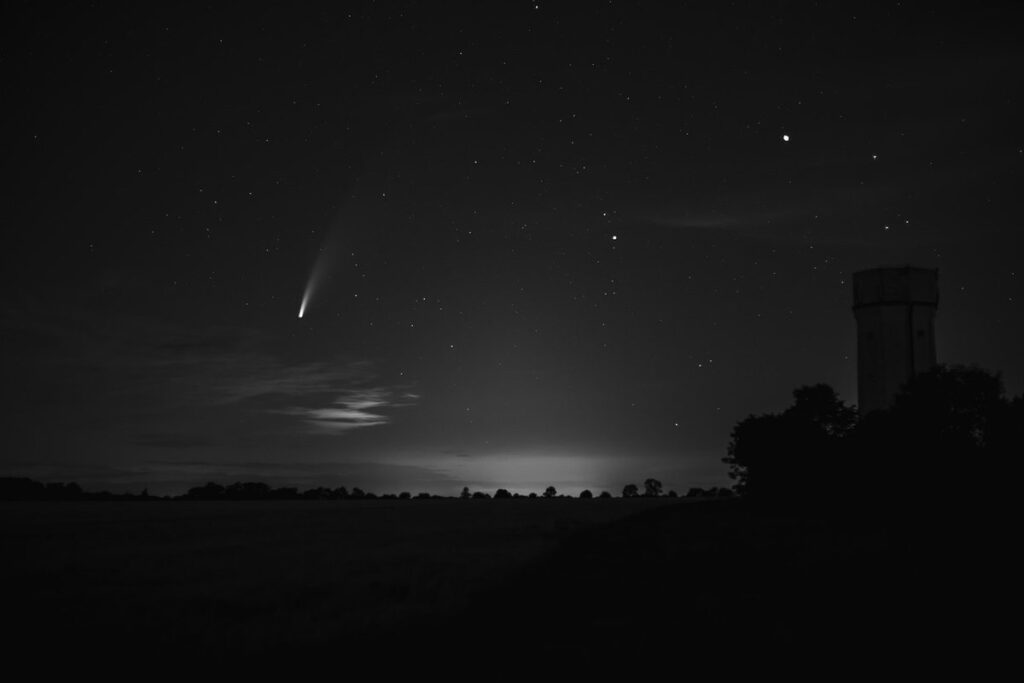
History and Discovery
Let’s take a journey through time and uncover the fascinating history behind Halley’s Comet, from its earliest recorded appearances to modern-day discoveries. This section explores the key milestones in our understanding of this celestial phenomenon.
The Ancient Sightings
The earliest recorded sightings of Halley’s Comet date back to ancient civilizations in China, Babylon, and Egypt. In 240 BCE, Chinese astronomers observed a comet that would later be confirmed as Halley’s, noting its appearance with great detail. The comet was seen to have a long tail stretching across the sky, which they described as “a celestial dragon.” Similarly, in Babylon, a clay tablet from around 164 BCE describes a comet that matches the characteristics of Halley’s, including its bright appearance and curved path.
In ancient Egypt, Halley’s Comet is believed to have been seen by the pharaoh Ramses II around 1290 BCE. Egyptian records describe the comet as “a star that rose in the east,” which was associated with the god Set. These early observations not only demonstrate a keen understanding of astronomy but also highlight the cultural significance placed on comets during this time period. By studying these ancient sightings, we can gain insight into the historical context and societal impact of Halley’s Comet, which would later become an integral part of its enduring legacy.
Edmond Halley’s Prediction
Edmond Halley’s prediction of the comet’s return in 1758 marked a significant achievement in the field of astronomy. By analyzing observations from past sightings, including those made by Chinese astronomers in 240 BC and by Isaac Newton and Giovanni Cassini in the 17th century, Halley recognized that these events were connected.
Halley used his knowledge of astronomical calculations to determine the comet’s orbit, taking into account the elliptical path it followed around the sun. He published his findings in a paper titled “A Theory of the Comet” in 1705, where he correctly predicted that the comet would return within a specific time frame. Halley’s prediction was based on the idea that comets follow predictable paths, and by using his calculations, he was able to pinpoint the comet’s expected return date.
This achievement showcased Halley’s skill as an astronomer and set a new standard for celestial predictions. His work laid the foundation for modern astronomy, demonstrating the importance of precise calculations in understanding celestial phenomena.
Orbital Characteristics and Return Patterns
As we continue our journey through the fascinating world of Halley’s Comet, let’s take a closer look at its orbital characteristics and return patterns, which play a crucial role in its periodic appearances. Its unique orbit has captivated astronomers and space enthusiasts for centuries.
Understanding the Comet’s Orbit
The comet’s elliptical orbit is a critical factor in determining its visibility from Earth. Halley’s Comet has an eccentric orbit, meaning it is not a perfect circle. Its closest approach to the Sun, known as perihelion, occurs at about 46 million kilometers away, while its farthest point, aphelion, reaches approximately 3.2 billion kilometers. This significant variation in distance from the Sun causes the comet’s brightness and visibility to change dramatically.
The elliptical shape of Halley’s orbit is due to the gravitational influence of Jupiter and other planets in our solar system. As the comet approaches its perihelion, it experiences a strong gravitational pull from the Sun, which accelerates its speed and brings it closer to Earth. Conversely, as it moves towards aphelion, the comet slows down under the Sun’s gravity, resulting in a longer period of invisibility.
To understand the comet’s orbit better, astronomers divide it into three distinct phases: approach, perihelion passage, and recession. During its approach phase, Halley’s Comet can be observed with binoculars or small telescopes as it begins to brighten up. By the time it reaches perihelion, it becomes visible to the naked eye, and its brightness peaks. After passing perihelion, the comet slowly fades away during the recession phase, becoming increasingly difficult to spot until its next approach.
The Return Period
Halley’s comet has been observed and recorded by humans for over 2,000 years, with a rich history of notable sightings. The average interval between appearances is approximately 76 years, although it can vary slightly due to the comet’s elliptical orbit. One of the most significant past sightings was in 1066, when Halley’s comet was seen as an ill omen by English chroniclers before the Battle of Hastings.
In terms of predictions for future returns, astronomers have been able to accurately forecast the comet’s path and timing with increasing precision over the centuries. The next expected appearance is set for 2061, although it will not be visible from all parts of the world due to its position in the sky. In preparation for this event, amateur astronomers and scientists are already planning observations and research projects.
Several key dates mark Halley’s comet return periods:
- 1531: German artist Albrecht Dürer recorded a sighting
- 1607: English astronomer Thomas Harriot observed the comet independently of Kepler’s discovery in 1602
- 1682: Edmond Halley predicted the next appearance, which was confirmed in 1758 by Johann Palitzsch
Scientific Significance and Impacts
Halley’s Comet has been a subject of fascination for centuries, but its significance goes beyond just being a spectacular celestial event. Let’s examine the profound scientific implications it has on our understanding of astronomy and space exploration.
Cometary Composition and Structure
The comet’s composition and structure offer valuable insights into the early solar system. At its core, Halley’s Comet has a large icy nucleus composed of water ice, dust particles, and frozen gases such as methane and ammonia. This icy core is surrounded by a cloud of gas and dust that streams behind the comet as it approaches the Sun.
The gas emissions from Halley’s Comet include carbon dioxide, carbon monoxide, and hydrogen cyanide, which are released when the comet’s ices vaporize due to solar heating. These gases provide important clues about the comet’s origins and the conditions of the early solar system.
Halley’s Comet also has a distinct tail structure that forms as the gas and dust particles escape from the nucleus and are swept back by solar radiation pressure. This tail can be thousands of kilometers long and is composed of two main parts: a bright, ionized gas tail and a fainter, neutral gas tail.
Understanding Halley’s Comet’s composition and structure helps scientists learn about the formation and evolution of our solar system, including the role of comets in delivering organic molecules to early Earth.
Halley’s Comet and Climate Change
Comets like Halley’s have been observed to bring significant amounts of dust and gas into Earth’s atmosphere. This influx can lead to spectacular displays of meteors and even affect global climate patterns. The impact on the atmosphere is often short-lived, but repeated events over thousands of years could contribute to long-term changes.
Theories suggest that large comets may have played a role in shaping our planet’s climate history. For instance, some scientists propose that the mass extinction event at the end of the Cretaceous period was triggered by a massive comet impact. However, this theory remains speculative and requires further research.
Halley’s Comet is relatively small compared to other celestial bodies, so its direct influence on Earth’s atmosphere might be limited. Nevertheless, studying Halley’s passage through our solar system provides valuable insights into how comets interact with planetary systems. By observing the effects of smaller comets like Halley’s, scientists can better understand the potential risks associated with larger, more destructive impacts.
The connection between comets and climate change remains an area of ongoing research and debate. While there is no conclusive evidence that comets directly cause significant climate fluctuations, their study contributes to our broader understanding of Earth’s history and potential future threats.
Cultural Impact and Legacy
Throughout history, Halley’s Comet has been a source of wonder, awe, and cultural significance, leaving an indelible mark on art, literature, and human imagination.
From paintings to poetry, its appearances have inspired countless creative works that continue to captivate us today.
Historical Significance and Artistic Depictions
Throughout history, Halley’s Comet has been a source of fascination and inspiration for artists, writers, and filmmakers. In ancient civilizations, such as Egypt and Greece, comets were often depicted in murals and artwork as symbols of divine power and omens of change. For example, the Tomb of Senenmut in Egypt features a mural showing a comet with a long tail, believed to be Halley’s Comet, which is thought to have been seen in 1066 BCE.
In literature, Halley’s Comet has been immortalized by authors such as Chaucer and Dickens, who wrote about its appearances in their works. The comet’s most famous literary appearance is perhaps in Chaucer’s “Parlement of Foules,” where it is described as a harbinger of love and fertility. In modern times, Halley’s Comet has been featured in films like “2001: A Space Odyssey” and “Apollo 13,” often symbolizing the awe-inspiring power of space exploration.
Artists have also been drawn to the comet’s majestic appearance, with depictions ranging from classical paintings to contemporary digital artwork. Some notable examples include William Blake’s watercolor illustrations and a series of prints by artist David Roberts.
Symbolism and Superstition
Throughout history, Halley’s Comet has been shrouded in mystery and superstition. In many cultures, its appearance is seen as an omen, a sign of impending doom or great change. The ancient Greeks believed that the comet was a harbinger of war, while the Chinese saw it as a symbol of good fortune. In medieval Europe, Halley’s Comet was often associated with the apocalypse, and its appearances were said to signal the end times.
In some cultures, the comet is also seen as a divine intervention, a sign from the gods or a celestial messenger. For example, during the 1066 appearance of Halley’s Comet, King Harold II of England saw it as a bad omen, while William the Conqueror took it as a sign that he would conquer England. This dichotomy highlights the subjective nature of superstition and symbolism.
When observing Halley’s Comet, it’s worth noting that its cultural significance can vary greatly from one region to another. While some see it as an omen or a divine sign, others view it as a natural phenomenon worthy of scientific study. Regardless of interpretation, Halley’s Comet remains a powerful symbol of the human experience and our place in the universe.
Observation and Study Techniques
To effectively observe and study Halley’s Comet, it’s essential to employ specific techniques that allow you to maximize your viewing experience and gather valuable insights into its celestial behavior. Let’s explore some of these methods in detail.
Modern Telescopes and Instruments
The study of Halley’s Comet has greatly benefited from the development of advanced telescopic and observational tools. In recent years, spacecraft have been sent to intercept the comet, providing invaluable data on its composition and structure. The European Space Agency’s Giotto probe, for example, flew within 596 kilometers of the comet’s nucleus in 1986, returning detailed images and measurements of the comet’s surface. Ground-based observatories have also played a crucial role, with large telescopes like the Very Large Telescope (VLT) in Chile and the Keck Observatory in Hawaii capable of capturing high-resolution images and spectra of the comet.
These advanced instruments have allowed scientists to study Halley’s Comet in unprecedented detail, revealing insights into its composition, size, and orbital dynamics. The data collected by these spacecraft and ground-based observatories has been used to refine our understanding of the comet’s return periods and orbits, as well as its potential impact on Earth. Furthermore, the use of advanced telescopes and instruments has enabled scientists to monitor Halley’s Comet in real-time during its perihelion passage, providing a wealth of new data for scientific analysis.
Amateur Astronomy and Citizen Science Projects
Amateur astronomers can contribute significantly to our understanding of Halley’s Comet through citizen science projects and online initiatives. One such project is the European Space Agency’s (ESA) Giotto mission, which provided valuable data on the comet’s composition and structure during its 1986 flyby. Today, enthusiasts can participate in similar endeavors, like the Comet Hale-Bopp Campaign of 1997 or the ongoing Halley’s Comet Observation Project.
These initiatives often rely on volunteers to collect observations, process data, and assist with research tasks. For instance, the Zooniverse platform offers various projects focused on comet observation, including the “Comet Watch” project, which allows users to analyze images and provide insights on comet morphology. To get involved, individuals can start by exploring online forums, such as the NASA Jet Propulsion Laboratory’s Comet Hale-Bopp Observing Campaign forum.
When participating in these projects, it’s essential to follow established protocols for data submission and analysis. This ensures that contributions are accurate and useful for scientists. By collaborating with professionals and leveraging technology, amateur astronomers can make meaningful contributions to our understanding of Halley’s Comet and its return cycles.
Frequently Asked Questions
Can I see Halley’s Comet in person every time it returns?
Yes, with the right equipment and planning, you can observe Halley’s Comet from anywhere on Earth. However, note that its visibility is affected by atmospheric conditions and light pollution. It’s essential to check for optimal viewing times and locations during its return periods.
What if I miss Halley’s Comet’s next appearance? Will there be another opportunity?
Yes, Halley’s Comet has a periodic return of approximately 76 years, making it one of the most reliable celestial events for astronomers. While missing the current appearance is unfortunate, you can plan to observe it during its next scheduled return.
Can I use my smartphone or binoculars to spot Halley’s Comet?
While your smartphone or binoculars may help you locate the comet, they are not sufficient for observing its details. For a more in-depth view, consider investing in a telescope or joining an amateur astronomy group that offers access to more advanced equipment.
How can I contribute to scientific research on Halley’s Comet without being a professional astronomer?
You can participate in citizen science projects, such as tracking the comet’s position and brightness using mobile apps like Sky & Telescope. Many organizations also offer remote observation opportunities for non-experts, allowing you to contribute to ongoing research efforts.