
As you step outside on a clear night, have you ever wondered if Mars is visible in the sky above? For many astronomy enthusiasts, spotting the Red Planet is a thrilling experience that combines adventure with scientific curiosity. Unfortunately, Mars’ visibility can be affected by several factors, including its distance from Earth and the time of year. On certain nights, it’s possible to see Mars shining brightly against the dark canvas of the night sky, while on others, it may be all but invisible. In this article, we’ll explore how to spot Mars in the night sky, including the best viewing times and tips for observation with both the naked eye and a telescope. Whether you’re a seasoned astronomer or just starting out, learning when and how to spot Mars can enhance your understanding of our solar system and leave you in awe of its beauty.
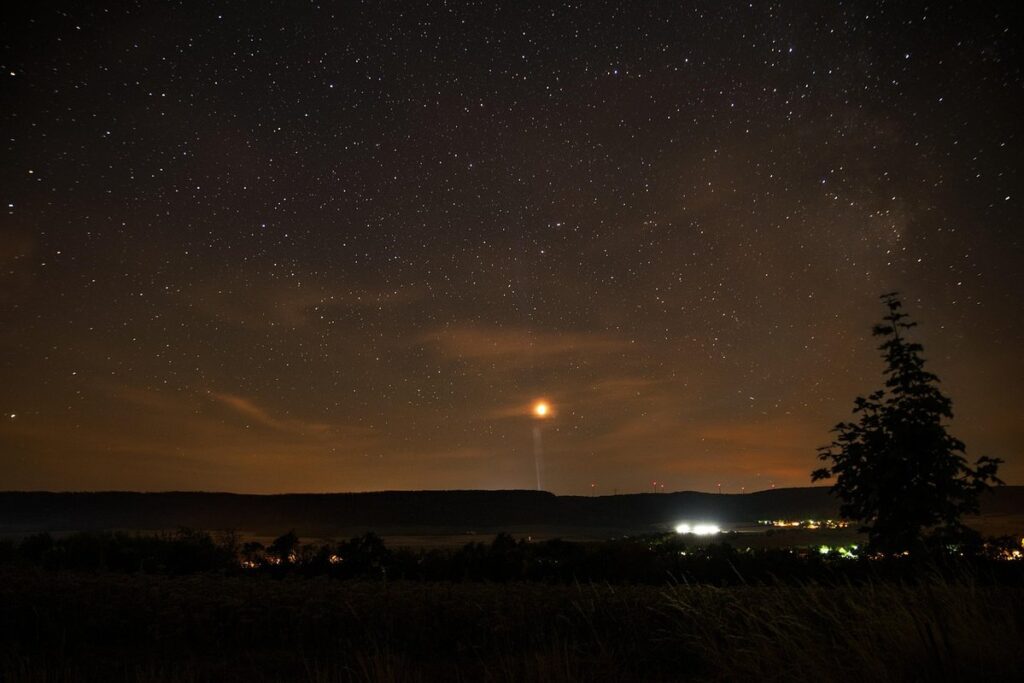
Understanding Mars Visibility
To see if Mars is visible tonight, you need to know when it’s at its best visibility and how to spot it in the night sky. Let’s take a closer look at what affects our view of the Red Planet.
Factors Affecting Visibility
Mars’ visibility is influenced by several key factors. Earth’s position plays a significant role, as the Red Planet is only visible when it lies on the opposite side of the sun from our planet. This occurs approximately every 26 months, during what astronomers call opposition. At this time, Mars appears bright and close to its highest point in the sky.
Atmospheric conditions also impact visibility. Haze, dust, and pollution can scatter light and reduce the planet’s brightness, making it harder to spot. Clear skies and low humidity are essential for viewing Mars with the naked eye or through a telescope. During periods of high atmospheric pressure, Mars may appear slightly larger and brighter.
The time of year also affects visibility. Mars is best viewed when it’s highest in the sky, typically around midnight or 1 am, depending on your location. This occurs during its opposition, but the exact timing varies due to Earth’s elliptical orbit and Mars’ own orbital eccentricity. A small telescope can help you locate Mars even if it’s not at opposition, but for casual viewing, it’s best to wait until the planet is high in the sky and the atmosphere is calm.
Best Time for Viewing
Mars is typically at its brightest and most visible from Earth when it’s opposition. This occurs every 26 months, when Mars is on the opposite side of the Earth from the Sun. During opposition, the planet appears larger and brighter in the night sky due to its proximity to our planet.
For optimal viewing, consider these dates and times: around mid-September and mid-March. These periods offer the best conditions for spotting Mars with the naked eye. As an example, if you’re observing from the Northern Hemisphere, try to catch Mars during opposition in September when it’s highest in the eastern sky at midnight.
When selecting specific viewing nights, note that the exact timing of opposition varies from year to year due to Earth’s elliptical orbit around the Sun. However, you can use online astronomical resources or mobile apps to calculate Mars’ position and brightness for any given date and time. This will give you a more accurate prediction of when to expect Mars at its brightest in your specific location.
How to Find Mars in the Night Sky
To spot Mars, you’ll need to know when and where to look for it in the night sky. This involves understanding its orbit and how to locate it among the stars.
Identifying Mars with a Planisphere or Star Chart
When using a planisphere or star chart to locate Mars, start by identifying the current date and time on the chart. Align the chart with your local horizon, considering the latitude and longitude of your observing location. Rotate the chart to match the sky’s orientation for your specific date and time. Look for the constellation Scorpius, as Mars often passes through this region.
Mars is usually depicted as a small red dot or symbol on the planisphere, typically marked with its name or an “M.” Be aware that some charts may not explicitly label Mars, so it’s essential to consult a key or legend to identify the planet. Once you’ve located Mars on the chart, refer to a planetary almanac or astronomy app for its exact position and brightness.
When using a star chart, also consider the chart’s scale and grid system. Some charts may use a polar alignment or equatorial coordinate system, which can help you accurately locate Mars in the night sky. By combining the planisphere with additional resources, such as a red light flashlight to preserve your night vision, you’ll increase your chances of spotting Mars.
Using Mobile Apps for Navigation
Several mobile apps can aid in locating Mars in the night sky. Sky Map and Star Walk 2 allow for location-based viewing times, ensuring you’re aware of when to expect Mars’ visibility in your area. These apps also feature celestial object tracking, making it easier to identify Mars among other stars and planets.
Another useful app is Stellarium Mobile, which provides an interactive star chart that can be viewed in real-time. This allows for precise location-based navigation and the ability to track Mars’ movement throughout the night. The app’s augmented reality mode enables you to see a virtual representation of the sky above your current location, further simplifying the process of finding Mars.
In addition to these features, some apps offer alerts when Mars is at its brightest or most visible. For example, the NASA App sends notifications when Mars reaches opposition, making it an excellent choice for those who want to catch the planet at its best. When choosing a mobile app for navigation, consider your device’s compatibility and any additional features that might enhance your viewing experience.
Observing Mars with the Naked Eye
Mars is a fleeting sight, visible only under certain conditions, and knowing how to spot it can be a challenge. Let’s explore how to observe our neighboring planet with just your naked eye.
Conditions for Clear Viewing
To observe Mars clearly with the naked eye, you need to be in an environment with ideal viewing conditions. Darkness is essential for spotting Mars, as it’s a relatively faint object even at its brightest. Find a spot away from streetlights and other sources of artificial light pollution, which can make it difficult to see the planet. An atmosphere free of haze or fog is also crucial, as these can scatter light and obscure your view.
In terms of time, try to observe Mars when the sky is at its darkest, typically between 10 PM and 2 AM, depending on your location and the season. Avoid observing during periods of high moonlight, as this will make it harder to spot the planet against a bright background. Finally, dress warmly and choose a spot with minimal wind, which can disrupt your view or cause you to lose focus.
When it comes to atmospheric conditions, try to observe Mars on a night when there’s little to no cloud cover in your area. If possible, wait for a clear day to pass before attempting to observe the planet, as this will allow any atmospheric disturbances to settle out.
Tips for Enhancing Visibility
Using binoculars can make a significant difference in observing Mars, allowing you to see more detail and texture on its surface. This is especially true when Mars is at opposition, making it appear larger and brighter. A good pair of 7×50 or 10×50 binoculars will provide a clear view of the planet’s disk and help you spot any notable features such as polar ice caps or dark albedo markings.
Another way to enhance visibility is by using a telescope. While more expensive than binoculars, a telescope can offer even greater magnification and resolution. A 60mm to 80mm aperture will provide a good balance between portability and image quality. When selecting a telescope for observing Mars, look for one with a short focal length and a wide field of view.
To further enhance contrast and detail, try using techniques such as lunar phase observation or using a solar filter. By observing Mars when it’s at a high altitude in the sky, you can reduce atmospheric interference and improve visibility. It’s also essential to choose a location with minimal light pollution, which can make the planet appear dimmer than it should be.
Using Telescopes and Binoculars for a Closer Look
To get a closer look at Mars, you’ll want to learn how to use telescopes and binoculars effectively, whether they’re high-end models or more affordable options. This is where these tools come in handy for your stargazing adventure.
Choosing the Right Equipment
When using telescopes and binoculars to observe Mars, it’s essential to choose equipment with the right magnification power, aperture size, and optical quality. A higher magnification can make details on Mars appear more distinct, but be cautious not to overdo it – too much magnification can lead to image distortion.
For telescope users, a 100-150mm aperture is usually sufficient for observing Mars’ surface features. Larger apertures provide better resolution, but may also increase weight and price. Consider a refractor or reflector telescope with a good optical quality rating (e.g., a Ritchey-Chretien design) to minimize distortion.
Binocular users should opt for 7×50 or 10×42 models, which offer a balance between magnification and stability. These binoculars can provide a decent view of Mars’ polar ice caps or dark albedo features without being too heavy or expensive.
When selecting equipment, also consider the type of Martian observation you want to make. For instance, observing Olympus Mons requires higher magnification than spotting Valles Marineris.
Tips for Viewing with Telescopes or Binoculars
When viewing Mars through a telescope or binoculars, it’s essential to adjust the focus carefully. Start by setting the initial focus on the brightest star in the field of view and then gradually fine-tune the adjustment while observing Mars. This technique helps ensure that both near and far objects are in sharp focus.
If you’re tracking Mars’ motion across the sky, use a slow-motion control or an equatorial mount to follow its path smoothly. A tripod is also crucial for stabilizing your instrument and preventing blurring caused by hand movement.
To enhance image quality, consider the following techniques: use a Barlow lens to increase magnification without sacrificing light transmission; employ a moon filter to reduce glare when Mars is full; or try using a digital camera adapter to capture high-resolution images of the planet. When adjusting the focus with a telescope, use a focus aid like a Bahtinov mask or a focusing tool to help you achieve precise adjustments.
Remember that even with optimal setup and technique, image quality can degrade due to atmospheric conditions or instrument limitations. Be patient and prepared to adjust your approach as needed.
Special Considerations and Challenges
While spotting Mars can be exciting, there are some situations where it might not be visible at all. We’ll discuss these special circumstances that could affect your viewing experience tonight.
Effects of Moon Phase on Visibility
When the moon is full, its brightness can outshine Mars, making it difficult to spot. This is especially true for smaller telescopes and binoculars, which may struggle to make out the planet’s faint light against the lunar glow. However, there are times when the moon’s phase actually helps with visibility.
The best viewing opportunities often occur when the moon is in its new or crescent phase. During these periods, the moon’s gentle illumination can cast a subtle glow on Mars, making it slightly easier to spot. A new moon phase occurs when the moon is between Earth and the sun, minimizing its brightness in the night sky.
In contrast, a crescent moon adds a soft light that doesn’t overpower Mars’ visibility. This is particularly beneficial for observing the planet’s reddish hue and subtle details. To make the most of these viewing opportunities, try to schedule your observation sessions during the few days following a new moon or when the crescent moon is low in the sky.
Atmospheric Interference and Light Pollution
Atmospheric conditions play a significant role in determining how clearly you can see Mars. Humidity and temperature fluctuations can distort light waves, making it more challenging to spot the planet. High humidity, for instance, can cause atmospheric refraction, bending light around obstacles like buildings or hills, potentially hiding Mars from view. Similarly, extreme temperatures can alter the air’s density, affecting how light travels through the atmosphere.
Light pollution is another significant factor to consider when attempting to observe Mars. Artificial lighting from nearby cities or towns can overwhelm the faint light emitted by the planet, making it nearly impossible to spot. To minimize this effect, try observing from a location with minimal artificial lighting, ideally far away from urban areas. You can also use a red light flashlight or cover your white light sources to reduce their blue spectrum emission, which contributes significantly to light pollution.
In locations with severe light pollution, consider using specialized software that can simulate the night sky under ideal conditions, helping you locate Mars more easily.
Frequently Asked Questions
Can I spot Mars during daylight hours?
No, it is generally not possible to see Mars in the daytime sky due to its relatively faint appearance and the bright sunlight. Mars becomes visible only after sunset or before sunrise when the sky is dark enough for celestial objects to be seen. If you’re looking to observe Mars, plan your viewing session for a clear evening or morning.
How do I know if the moon phase affects my chances of spotting Mars?
Yes, the moon’s phase can impact visibility. The best times to spot Mars are typically when the moon is in its new or crescent phase, as a full moon can outshine Mars and make it harder to observe. Check a lunar calendar or use a mobile app that displays moon phase information to plan your viewing sessions accordingly.
What if I have limited stargazing experience? Can I still spot Mars with binoculars?
Yes, spotting Mars with binoculars is definitely possible, even for those new to stargazing. Start by familiarizing yourself with the night sky using a planisphere or star chart, and then use a mobile app to help locate Mars in the sky. Adjust your binoculars’ focus and magnification accordingly to get a clear view of the planet.
Can I observe Mars through a telescope if it’s not a high-quality one?
Yes, you can still observe Mars with a lower-end telescope, but be aware that image quality may vary. Use a telescope with a decent aperture size (at least 60mm) and a good optical quality to get a clear view of the planet. Also, make sure to adjust your telescope’s focus correctly for optimal viewing results.
What if it’s cloudy or there’s heavy light pollution in my area? Can I still spot Mars?
Yes, Mars can be visible even on partially cloudy nights or with some light pollution. Use a mobile app that provides cloud cover forecasts and try to observe Mars during periods of clear skies. Also, consider using binoculars or a telescope with good optical quality to enhance your viewing experience despite the challenges posed by clouds or light pollution.