
As you gaze up at the night sky, have you ever stopped to think about the timing of the full moon? The lunar cycle is a fascinating phenomenon that has captivated humans for centuries. From ancient astronomers tracking the phases of the moon to modern-day enthusiasts observing its beauty in nature, understanding when the full moon occurs can be a rewarding experience. But what exactly determines this celestial event, and how can you best observe it in your own life? In this article, we’ll explore the intricacies of lunar cycles and provide practical tips for tracking the full moon. We’ll also delve into some of the cultural significance surrounding this phenomenon, from folklore to astronomical observations. By the end of this article, you’ll be able to predict when the next full moon is due to occur and appreciate its impact on your surroundings.
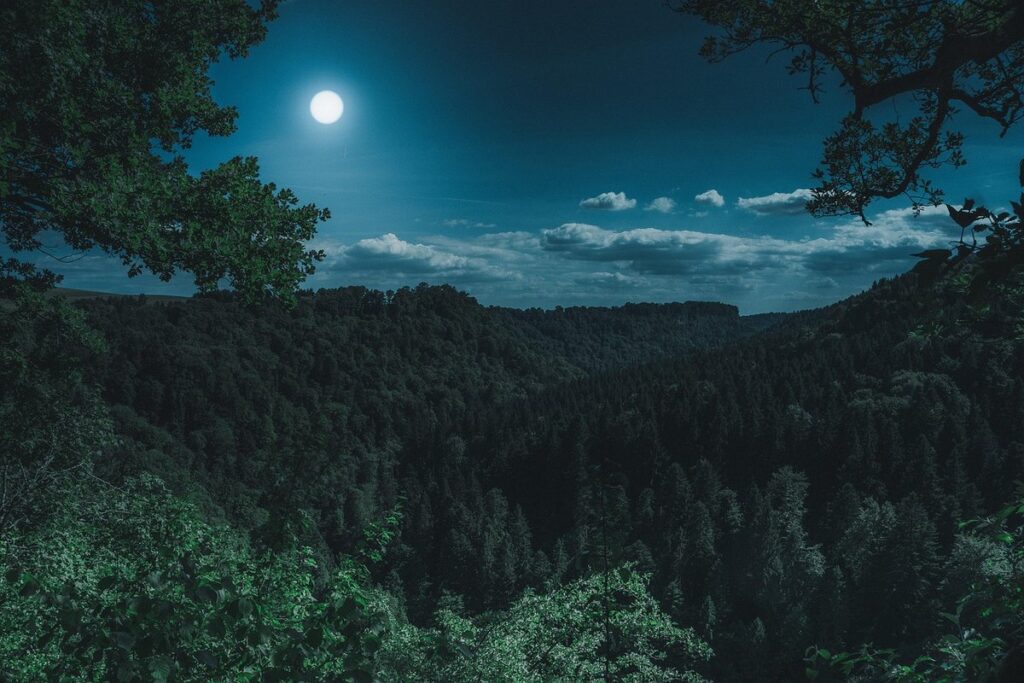
Understanding Lunar Cycles and Phases
The lunar cycle is made up of eight distinct phases, each with its own unique characteristics that help determine when we’ll see a full moon in the sky. By understanding these phases, you can better predict when the next full moon will occur.
What are the Different Phases of the Moon?
The lunar cycle consists of eight distinct phases, each a result of the Earth’s rotation relative to the Sun and the Moon. The new moon phase occurs when the side of the Moon facing the Earth is not illuminated by the Sun. As the Moon orbits the Earth, we start to see a small sliver of light on the right side, marking the beginning of the waxing crescent phase.
The first quarter phase is reached when the Moon has completed one-quarter of its orbit around the Earth and is half-illuminated. The waxing gibbous phase follows, where the Moon continues to appear larger as more of its illuminated surface becomes visible from our planet. Eventually, we reach the full moon phase, where the entire face of the Moon is lit by the Sun.
The waning phases begin with the waning gibbous, followed by the last quarter and finally, the waning crescent. It’s worth noting that the exact timing of these phases can vary slightly due to the elliptical shape of the Moon’s orbit around Earth.
Why is the Full Moon Important in Astronomy
Astronomers study the full moon extensively due to its unique position, which facilitates various celestial observations. During a full moon, the Earth is positioned between the Sun and the Moon, making it easier for astronomers to observe the Moon’s phases and its effects on planetary alignment.
This positioning also allows for more precise measurements of the Moon’s distance from the Earth and its orbit around our planet. The full moon’s gravitational pull has a minor impact on tidal patterns and ocean currents, which can be studied during this phase. Additionally, the bright illumination of the full moon enables astronomers to observe the Moon’s surface features in greater detail.
Astronomers often utilize the full moon as an opportunity to conduct observations and experiments that would otherwise require precise timing and positioning. For example, they may use lunar eclipses, which occur during a full moon, to study the Earth’s atmosphere and its effects on solar radiation.
Calculating the Full Moon Date
To accurately plan for the full moon, you’ll need to calculate its exact date and timing, which can be a bit tricky without the right tools and knowledge. Let’s explore how to do just that using simple math and astronomy principles.
How to Determine the Next Full Moon Date
To determine the next full moon date, you can rely on online resources or lunar calendars. Many websites and apps provide accurate calculations of lunar phases, including the exact dates and times of full moons. You can visit websites like NASA’s Moon Phase Calculator, TimeAndDate.com, or the United States Naval Observatory’s Data Services for this information.
These websites typically allow you to input your location to get the most accurate results, as the timing of full moons varies slightly depending on your time zone. Some also offer features such as lunar calendars or printable charts that show upcoming full moon dates and times.
Another option is to use a dedicated lunar calendar app on your smartphone or tablet. These apps often include interactive charts and graphs to help you visualize the lunar cycle and plan around full moons. Many apps also send notifications when the next full moon occurs, making it easy to stay informed without having to manually check for updates.
When selecting an online resource or app, ensure that it provides reliable and up-to-date information.
Understanding Lunar Cycle Lengths and Patterns
The lunar cycle’s length of approximately 29.5 days plays a significant role in determining when full moons occur. This duration is slightly shorter than the solar year’s 365.25 days, which means that the lunar cycle and the calendar year are not perfectly synchronized. As a result, an extra day appears every few years to keep our calendars aligned with the seasons.
To put this into perspective, consider the following example: If a full moon falls on January 1st one year, it will occur about 3-4 days later in the following year due to the lunar cycle’s length. This discrepancy might not seem significant, but it adds up over time and affects the timing of future full moons. Understanding this relationship can help you predict when full moons will occur with greater accuracy.
The lunar cycle’s length has a predictable pattern, making it possible to anticipate its effects on future full moon dates. By taking into account the lunar cycle’s 29.5-day duration and its relation to the solar year, you can make more informed predictions about when full moons will appear.
Effects of Full Moon on Human Behavior and Environment
While we’ve explored when the full moon occurs, it’s also worth examining how its effects ripple out into our daily lives and beyond. The full moon can indeed have a significant impact on human behavior and the environment around us.
Folklore and Mythology Surrounding the Full Moon
Ancient cultures believed the full moon had a profound impact on human behavior, often associating it with chaos, violence, and irrationality. This notion is exemplified by the werewolf legend, where humans transform into wolves under the full moon’s influence. Similarly, in ancient Greece, the full moon was linked to the myth of Lycaon, who was transformed into a wolf as punishment for his hubris.
The full moon’s supposed influence on human behavior has also been tied to increased crime rates and erratic behavior. In some cultures, this phenomenon is attributed to the “lunacy” that supposedly afflicts individuals during the full moon. However, it’s essential to note that there’s no scientific evidence supporting these claims. The idea of a direct link between the full moon and human behavior has been largely debunked by modern studies.
While the folklore surrounding the full moon’s influence on human behavior is intriguing, it serves as an interesting historical footnote rather than a practical guide for understanding its effects. To better understand the full moon’s significance in today’s world, we must look to more empirical evidence and scientific research.
Scientific Studies on Full Moon Effects
Many studies have been conducted to investigate whether the full moon has a significant impact on human behavior and natural phenomena. A 2016 study published in the journal Sleep found no correlation between full moon phases and emergency room admissions, which is often cited as an indicator of increased violent or erratic behavior. Similarly, research by psychologists at the University of Adelaide discovered that there was no difference in the number of reported crimes during full moon versus new moon phases.
Other studies have focused on specific areas, such as emergency services responses and mental health hospital admissions. A 2018 study published in the Journal of Forensic Sciences found no increase in police activity during full moon nights compared to other lunar phases. These findings are echoed by a review of 46 studies on lunar effects, which concluded that there is no reliable evidence for any significant impact on human behavior.
While some claims about full moon effects are anecdotal and based on individual experiences, the scientific consensus is clear: there is currently no empirical support for the idea that the full moon has a direct influence on human behavior or natural phenomena.
History and Cultural Significance of the Full Moon
The full moon has captivated human imagination for centuries, with many cultures assigning deep meaning to its appearance. Let’s take a closer look at how our ancestors perceived this spectacular lunar event.
Ancient Lunar Calendars and Their Legacy
Ancient cultures revered the full moon as a benchmark for tracking time. Many civilizations employed lunar-based calendars to measure months and years. The Babylonians, for instance, divided the year into 12 lunar cycles, with each cycle beginning on the first sighting of the new moon. Similarly, the ancient Greeks used a lunisolar calendar that accounted for both lunar phases and solar year lengths.
The influence of these lunar calendars can be seen in modern systems. Many Islamic countries still follow a lunar-based Hijri calendar, which determines important dates such as Ramadan and Eid al-Fitr. The Hebrew calendar also uses lunar cycles to determine holidays like Passover and Rosh Hashanah. These ancient cultures’ emphasis on lunar observation has contributed to the complexity of modern calendars, with many still using lunisolar or purely lunar systems to track time.
In fact, a small number of communities around the world continue to use traditional lunar calendars for everyday planning and organization. For instance, some indigenous Australian groups use the Dreamtime calendar, which is based on the full moon’s cycles.
Modern Celebrations and Traditions Associated with the Full Moon
Modern celebrations and traditions associated with the full moon are diverse and widespread across cultures. Many indigenous communities observe a lunar ceremony to honor the full moon’s completion of its cycle. For example, some Native American tribes hold rituals to acknowledge the moon’s role in their daily lives, such as planting and harvesting. These ceremonies often involve singing, dancing, and storytelling.
In modern Western culture, the full moon has become synonymous with creative expression and emotional release. Many artists, musicians, and writers draw inspiration from the lunar cycle, often creating during the night of the full moon. Some individuals also use this time for meditation, yoga, or other spiritual practices to connect with the natural world.
Other contemporary traditions include organizing full moon gatherings, where people come together to share meals, stories, and experiences related to the moon’s significance. These events can range from intimate family gatherings to large-scale festivals celebrating the lunar cycle’s impact on our lives.
Observing and Experiencing the Full Moon
As you prepare to witness the full moon, it’s essential to understand how to make the most of this celestial event, from planning your viewing experience to capturing its beauty. Here are some tips for observing and experiencing the full moon at its fullest glory.
Best Times to Observe the Full Moon
The timing of your viewing session can greatly impact your experience of the full moon. In general, the best time to observe the full moon is when it’s highest in the sky, which typically occurs around midnight or 1 am. This positioning allows for optimal viewing conditions, as the moon’s light won’t be obstructed by trees or buildings.
Avoid observing the full moon during peak daylight hours (usually between 10 am and 4 pm), as the sun’s glare can make it difficult to see any details on the lunar surface. Weather also plays a significant role in optimizing your viewing experience. A clear, cloudless sky is ideal for stargazing and moon gazing.
To increase your chances of spotting the full moon during optimal conditions, head to a location with minimal light pollution. This might be a rural area or a spot with a low population density. Some popular locations for stargazing include national parks, remote beaches, or designated dark-sky preserves. By choosing the right time and location, you can enhance your appreciation of this celestial event.
Creative Ways to Engage with the Full Moon
Capture the full moon’s majesty through photography by taking advantage of its optimal viewing hours. The best time to photograph a full moon is just after sunset, when it’s low on the horizon and surrounded by a rim of golden light. This creates an ideal contrast between the bright moon and the warm colors of the setting sun.
For astronomy enthusiasts, many observatories host public viewing events during full moons. These events often feature expert-led tours of celestial objects visible in the night sky, from planets to star clusters. Attend one of these events to gain a deeper understanding of the moon’s place within our solar system.
Other activities that encourage appreciation for the full moon include moonlight hiking and stargazing parties. The gentle illumination provided by a full moon can illuminate trails, making it easier to navigate through nature at night. Host or attend a group stargazing event to connect with others who share your interest in astronomy and the beauty of the night sky.
Advanced Topics in Lunar Cycle Study
If you’re eager to dive deeper into lunar cycle study, you’ll find our advanced topics discussion particularly insightful. It covers lesser-known aspects of moon phases and their effects on daily life.
Elongation and Conjunction: Understanding Lunar Geometry
The elongation and conjunction of celestial bodies have a significant impact on the appearance of the full moon. When the Earth passes between the sun and the moon, it creates an opposition, causing the moon to appear full from our vantage point. This can occur when the moon is actually slightly ahead or behind its perigee, the closest point in its elliptical orbit.
Conversely, during conjunctions, the sun’s brightness overwhelms the reflected light of the moon, making it invisible. However, this doesn’t always result in a new moon – sometimes, the full moon can still be visible due to scattering effects from atmospheric particles. For instance, when the moon is near its perigee and experiences an opposition with the Earth at the same time as a solar eclipse, the moon can become visible despite being in conjunction.
To better understand these phenomena, astronomers often track lunar geometry by observing the moon’s elongation – how far it appears from the sun or other reference points. This data helps predict when conjunctions will occur and how they’ll affect the full moon’s visibility.
Impact of Solar Eclipse on Lunar Cycles
During a rare event known as an occultation, the shadow of the moon falls directly on Earth’s surface, blocking sunlight and causing a solar eclipse. This phenomenon often occurs when a new moon coincides with a total solar eclipse, but it can also happen near a full moon if the alignment is precise enough. When a solar eclipse occurs close to a full moon, astronomers must be cautious in their observations.
The bright light of the full moon can interfere with the precise measurements required during a solar eclipse, making it challenging for scientists to collect accurate data. To mitigate this issue, researchers often rely on specialized instruments that can detect subtle changes in the sun’s corona during an occultation. Additionally, astronomers may choose to observe the event from locations with reduced lunar illumination, such as during the night or using telescopes that can filter out moonlight.
The combination of a solar eclipse and full moon is relatively rare, occurring only about once every few years.
Frequently Asked Questions
Can I See the Full Moon from Anywhere in the World?
Yes, you can see the full moon from anywhere on Earth, but the best viewing conditions depend on your location. A clear horizon and minimal light pollution are essential for optimal visibility. Additionally, the full moon is often visible during the early morning hours when it’s at its highest point in the sky.
How Do I Track Future Full Moon Dates with a Lunar Calendar?
To track future full moon dates using a lunar calendar, consult online resources or download a lunar calendar app that takes into account your location and time zone. These tools will help you plan your observations and engage with the full moon’s significance in various cultures around the world.
What if I Miss the Full Moon? Can I Still Observe Its Effects?
While it’s best to observe the full moon during its peak, you can still experience its effects on human behavior and natural phenomena. Study the folklore and mythology surrounding the full moon to understand how people have interpreted its influence throughout history. You may also explore scientific research on the topic for a more in-depth understanding.
How Does the Full Moon Affect Photography?
The full moon offers unique photography opportunities, especially during the blue hour or golden hour when the soft light enhances its beauty. Use a tripod and adjust your camera settings to capture stunning images of the full moon. Experiment with different angles and compositions to showcase its grandeur and majesty.
Can I Observe the Full Moon During a Solar Eclipse?
While it’s rare for a solar eclipse to occur near a full moon, you can still observe both events separately. However, be aware that a solar eclipse may affect your ability to see the full moon due to the alignment of celestial bodies. Plan ahead and research optimal viewing locations for each event to maximize your astronomical experience.