
Lunar eclipses are one of the most spectacular events in astronomy, where Earth passes between the sun and the moon, casting an eerie glow over our night skies. You’re probably eager to know when is the next lunar eclipse, but do you also wonder about their frequency and significance? While they may seem rare, lunar eclipses occur relatively often, with several taking place every year.
In fact, there are three types of lunar eclipses: penumbral, partial, and total. Total lunar eclipses are the most dramatic, with the moon sometimes taking on a reddish hue due to the way Earth’s atmosphere scatters sunlight. As an avid astronomer or simply someone fascinated by the night sky, understanding when is the next lunar eclipse and how it fits into the celestial calendar can enhance your appreciation of these rare events.
This article will provide you with information about upcoming lunar eclipse events, their frequency, and significance in astronomy, along with tips for safe viewing and debunking myths surrounding these celestial occurrences.
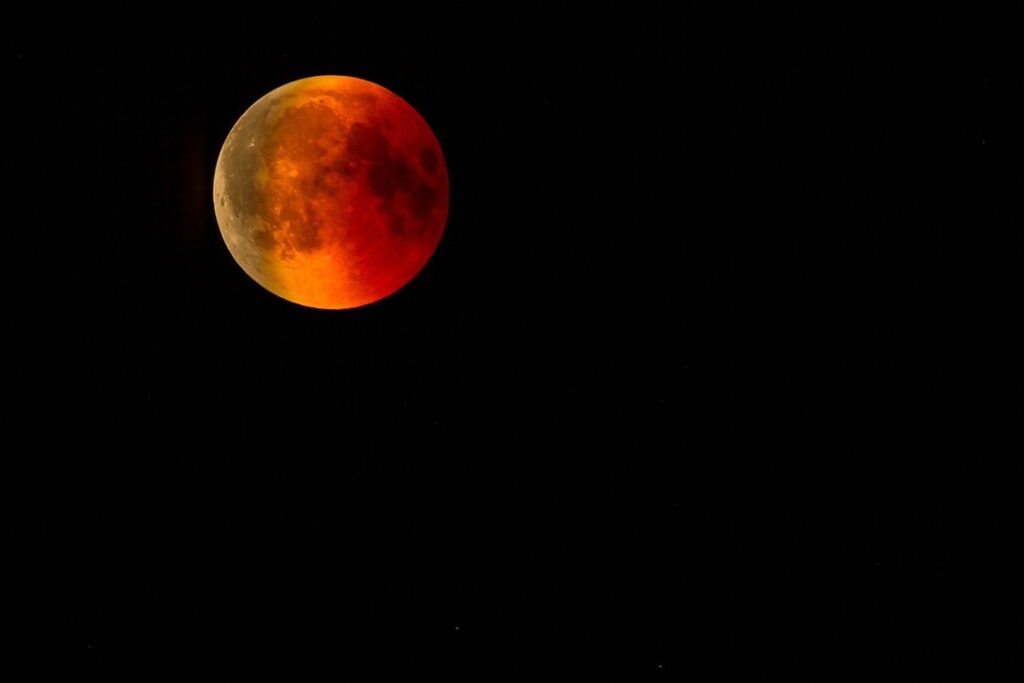
What is a Lunar Eclipse?
A lunar eclipse occurs when Earth passes between the sun and the moon, blocking the sunlight that normally reflects off the moon’s surface. This rare alignment of celestial bodies creates a spectacular sight in the night sky.
Defining a Lunar Eclipse
A lunar eclipse occurs when the Earth passes between the Sun and the Moon, blocking the sunlight that normally reflects off the Moon’s surface. This rare alignment can result in three distinct types of eclipses: penumbral, partial, and total.
Penumbral eclipses are subtle, with the Earth’s shadow falling on only a small part of the Moon’s surface, resulting in a slight darkening of its brightness. Partial eclipses, on the other hand, occur when the Moon passes through only a portion of the Earth’s shadow, creating a darker and lighter band across the lunar surface.
Total eclipses are the most spectacular type, occurring when the entire Moon slips into the Earth’s umbra – the darkest part of the shadow. During this brief moment, the Moon takes on a reddish hue due to the scattering of sunlight by atmospheric particles.
Understanding these types is essential for predicting and timing future lunar eclipses accurately. By recognizing the distinct characteristics of each type, astronomers can pinpoint the specific date and time when an eclipse will occur, making it possible for observers around the world to witness this celestial spectacle.
Importance of Lunar Eclipses in Astronomy
Lunar eclipses are not just spectacular visual events but also significant milestones for astronomers studying celestial mechanics. One of the key importance of lunar eclipses lies in their ability to showcase planetary alignment, which is a critical aspect of our solar system’s dynamics. During an eclipse, the Earth passes between the Sun and the Moon, temporarily blocking the sunlight that normally reflects off the Moon’s surface. This alignment provides astronomers with valuable data on the Earth-Moon-Sun relationship.
Studying lunar eclipses also helps scientists understand the Earth’s shadow on the Moon. The shape and size of the Earth’s shadow vary depending on the Moon’s distance from the Earth, which can be measured during an eclipse. This information is crucial for refining our understanding of the Earth’s rotation and orbit around the Sun.
Astronomers use lunar eclipses to test their predictions about celestial mechanics and planetary alignment. By analyzing the data collected during these events, scientists can refine their models and make more accurate predictions about future lunar eclipses and other celestial phenomena.
How Often Do Lunar Eclipses Occur?
Lunar eclipses are relatively rare events, but how often do they actually occur? We’ll break down their frequency and patterns to give you a better understanding of when these celestial events happen.
Frequency and Patterns of Lunar Eclipses
Lunar eclipses are not random events, but rather follow a predictable pattern. They occur approximately every 18 years, 11 days, due to the Earth, Moon, and Sun aligning in a straight line. This alignment is known as syzygy. However, this period is not fixed, and the actual frequency of lunar eclipses can vary from one Saros cycle to another.
A Saros cycle is approximately 6,585.32 days long and consists of 69 lunations. During each Saros cycle, a series of eclipses occur in a specific sequence, including both lunar and solar eclipses. The last eclipse in a Saros cycle is known as the “saros partner” of the first eclipse. Because the Earth’s rotation slows down over time due to tidal interactions with the Moon, the Saros cycle length increases by about 1 minute every year.
Understanding the Saros cycle can help you anticipate when lunar eclipses are likely to occur in the future. By tracking this pattern, astronomers and sky enthusiasts can make predictions about upcoming eclipses with high accuracy. Keep in mind that the Saros cycle is not a fixed interval, and its length may vary slightly due to these tiny changes in Earth’s rotation.
Predicting Lunar Eclipse Events
Astronomers use a combination of astronomical calculations, algorithms, and data analysis to predict lunar eclipse events. These predictions are based on the Earth, Moon, and Sun’s precise positions in their orbits around each other. The main factors involved are the Moon’s elliptical orbit, which causes it to pass through the Earth’s shadow at new moon phases, and the Earth’s slightly tilted axis, which affects the frequency of lunar eclipses.
To predict these events, astronomers employ complex algorithms that account for the Moon’s orbital eccentricity, the Earth’s rotational velocity, and other celestial mechanics. They also analyze historical data on lunar eclipse cycles to identify patterns and trends. For example, a lunar eclipse is more likely to occur when the Moon is at or near its closest approach to Earth in its elliptical orbit.
The accuracy of these predictions relies on the precision of astronomical calculations and data analysis. Astronomers use sophisticated software and algorithms to make accurate forecasts of lunar eclipse events.
Understanding Lunar Eclipse Scheduling
You might be wondering how lunar eclipses are scheduled, and what makes them visible from specific locations on Earth. We’ll explore these factors in more detail here.
Factors Influencing Lunar Eclipse Timing
Lunar eclipses occur when the Earth passes between the sun and the moon, casting a shadow on the lunar surface. However, not all full moons are eclipsed, as the moon’s orbit is tilted at an angle of about 5 degrees relative to the Earth’s orbit around the sun. This means that for an eclipse to happen, the moon must be near one of two points in its orbit where it passes through the Earth’s shadow: the ascending or descending node.
The alignment of the lunar nodes plays a crucial role in determining when a lunar eclipse occurs. The nodes are points on the moon’s orbit where it intersects with the plane of the Earth’s orbit around the sun. Most often, one of these nodes is aligned with the center of the Earth, causing an eclipse to happen about twice a year. Additionally, the tilt of the lunar orbit causes the shadow cast by the Earth to be elliptical in shape, resulting in partial eclipses when the moon passes through only part of this shadow.
A small minority of eclipses are total because the moon is at the right distance from the Earth and its orbital path happens to take it directly into the center of the Earth’s shadow.
The Role of NASA and Other Space Agencies in Predicting Eclipses
NASA and other space agencies play a crucial role in predicting lunar eclipses by utilizing advanced astronomical software and data analysis tools. These agencies have access to vast amounts of astronomical data, including observations from satellites, telescopes, and spacecraft. They use this data to identify patterns and anomalies that can indicate the likelihood of an eclipse.
For instance, NASA’s Solar Dynamics Observatory uses high-resolution images to track sunspot activity, which is a key factor in predicting lunar eclipses. The agency also employs sophisticated algorithms to analyze data from other satellites, such as those monitoring the Earth’s rotation rate and the Moon’s orbit. This information allows scientists to calculate the probability of an eclipse with remarkable accuracy.
In addition to data analysis, space agencies use computer simulations to model complex astronomical phenomena, including lunar orbits and solar eclipses. These simulations enable scientists to test various scenarios and make predictions about future eclipses. By combining these approaches, space agencies can accurately forecast lunar eclipses months or even years in advance.
Upcoming Lunar Eclipse Events
Mark your calendars for these extraordinary celestial events, as we guide you through the next lunar eclipses scheduled to occur over the coming months. From partial to total eclipses, don’t miss a single spectacle!
Notable Upcoming Lunar Eclipse Dates
A total lunar eclipse on April 4, 2024, is expected to be visible from much of North and South America. This event will coincide with a partial solar eclipse seen over parts of Europe and Africa. A penumbral lunar eclipse on October 28, 2023, can be observed from Eastern Europe and Asia.
For the total lunar eclipse on April 8, 2025, the best viewing locations will likely be in South America, Australia, and New Zealand. The Moon will pass through the Earth’s shadow at about 1:15 AM UTC. This event will also be visible over the southern tip of Africa and Antarctica.
It’s essential to note that lunar eclipses are relatively rare, as they require specific alignments between the Sun, Earth, and Moon. A partial lunar eclipse on March 14, 2025, can be seen from Western Europe, North America, and parts of South America. These events serve as a reminder of the celestial ballet that occurs in our solar system, offering opportunities for stargazers to observe the Moon’s shadow dance across the Earth’s surface.
Viewing Tips and Safety Precautions for Watching Eclipses
For optimal viewing of a lunar eclipse, it’s crucial to plan ahead. The key is to position yourself in an area with minimal light pollution and unobstructed views of the horizon where the Moon will be visible. A pair of binoculars or a telescope can enhance your experience but are not necessary for observing the eclipse.
Timing is also essential; the lunar eclipse occurs when the Earth’s shadow falls on the Moon, typically during the late evening hours. To ensure you catch the entire event, plan to view it at least 30 minutes before and after the predicted peak time.
When photographing a lunar eclipse, be mindful of your camera settings. You’ll want to use a slower shutter speed to capture the subtle color changes on the Moon’s surface, but this may require additional support or a tripod to prevent camera shake. It’s also essential to experiment with different ISO and aperture settings to achieve the desired exposure.
Lastly, don’t forget to dress warmly, as lunar eclipses often occur in the cooler parts of the night.
Lunar Eclipse Myths and Misconceptions
Many believe that lunar eclipses are bad omens, but what’s fact and what’s fiction? Let’s debunk some common myths surrounding these rare celestial events.
Separating Fact from Fiction in Lunar Eclipse Legends
The term “blood moon” has become increasingly popular in recent years due to a series of lunar eclipses that coincided with significant events. However, its origins are often misattributed to biblical prophecies. The phrase itself is derived from the reddish hue that appears on the Moon’s surface during a total lunar eclipse.
This phenomenon occurs when the Earth passes between the Sun and the Moon, casting a shadow on the lunar surface. The shorter wavelengths of light, such as blue and violet, are scattered by the Earth’s atmosphere, leaving primarily longer wavelengths like red and orange to reach the Moon. This is why the Moon takes on a reddish appearance.
It’s essential to note that this occurrence has no actual connection to any biblical events or prophecies. The association likely stems from its perceived significance and rare occurrence. In reality, lunar eclipses are quite common, happening approximately twice a year. By understanding their cause and natural process, we can separate fact from fiction surrounding these spectacular celestial events.
Cultural Significance of Lunar Eclipses Across History and Continents
Lunar eclipses have been a source of fascination for cultures around the world throughout history. In ancient China, eclipses were seen as omens, signaling the emperor’s downfall or the onset of war. Conversely, in many indigenous American cultures, lunar eclipses were believed to be the result of a wolf or serpent devouring the moon.
In Asia, the Hindu and Buddhist traditions have long associated lunar eclipses with the demon Rahu, who consumes the moon as revenge for being decapitated by the god Vishnu. This mythological significance is still celebrated during the eclipse itself, where prayers are offered to appease Rahu and restore balance to the universe.
In contrast, many ancient cultures saw lunar eclipses as a time of great spiritual power. The ancient Greeks, for example, believed that an eclipse was a sign from the gods, while in some African cultures, it’s seen as a time when spirits can communicate with the living.
The cultural significance of lunar eclipses serves as a reminder of their enduring mystique and importance across different civilizations. By understanding these diverse perspectives, we can better appreciate the awe-inspiring spectacle that a lunar eclipse presents.
The Science Behind Lunar Eclipse Prediction
Lunar eclipses occur when Earth, moon, and sun align, but what triggers these alignments? Understanding astronomy principles is key to predicting lunar eclipse events.
Advanced Astronomical Calculations and Algorithms
Astronomers rely on advanced mathematical models to predict lunar eclipse events with high accuracy. These calculations involve complex algorithms that take into account various celestial parameters, including the Moon’s elliptical orbit around the Earth and the Earth’s slightly ellipsoidal shape.
The Saros cycle, which repeats every 18 years and 11 days, is a key component in predicting lunar eclipses. By understanding this periodic pattern, astronomers can accurately forecast when the Moon will pass through the Earth’s umbra, casting a shadow on the Earth’s surface. The Saros cycle is based on the synchronization of three celestial events: the Sun’s position, the Moon’s orbit, and the Earth’s rotation.
To achieve high accuracy, astronomers use numerical methods to solve differential equations that describe the motion of the Earth, Moon, and Sun. These calculations involve sophisticated algorithms that account for various perturbations, such as the gravitational influence of other planets and the tilt of the Earth’s axis. By combining these mathematical models with computational simulations, astronomers can make precise predictions about lunar eclipse events, including their timing, duration, and frequency.
The Role of Computational Models in Predicting Eclipses
Computer models developed by organizations like NASA’s Jet Propulsion Laboratory play a crucial role in simulating and predicting lunar eclipses. These models take into account various celestial mechanics, including the Earth’s elliptical orbit around the Sun, the Moon’s slightly irregular shape, and its tidal locking with Earth. By accounting for these factors, the models can accurately predict the timing and frequency of lunar eclipses.
The models use complex algorithms to simulate the positions of the Earth, Moon, and Sun over a given period, typically years or even decades in advance. This allows scientists to identify potential eclipse events and calculate their exact timing with high precision. For example, NASA’s Planetary Data System uses these models to generate detailed charts and tables that astronomers can use for planning observations.
The accuracy of these predictions is remarkable. In many cases, computer models have predicted lunar eclipses months or even years in advance, allowing scientists to prepare for observations and gather valuable data on the Earth-Moon-Sun system. By relying on these models, astronomers can better understand the complexities of celestial mechanics and improve their ability to predict future eclipse events.
Conclusion: Appreciating the Beauty and Significance of Lunar Eclipses
As we conclude our exploration of lunar eclipses, let’s take a moment to appreciate their unique beauty and significance in the night sky, and reflect on what we’ve learned about this celestial event.
Recap of Key Takeaways
Lunar eclipses come in two main types: partial and total. Partial eclipses occur when only a part of the Earth’s shadow covers the Moon, resulting in a subtle change to its brightness. Total eclipses, on the other hand, take place when the entire Earth’s shadow falls upon the Moon, causing it to darken and sometimes even turn a reddish hue. While lunar eclipses are relatively rare, occurring about twice a year, they can be more frequent than solar eclipses.
We discussed how the scheduling of these events is tied to the alignment of celestial bodies, particularly the Moon, Earth, and Sun. This alignment creates a narrow window for lunar eclipses to occur, which is why their frequency may vary. The cultural significance of lunar eclipses should not be overlooked; many ancient cultures believed that these events held spiritual or mystical powers.
For those who want to witness a lunar eclipse, it’s essential to note the importance of location and timing. Not all regions on Earth experience total eclipses, so planning ahead is crucial. In addition, knowing when to expect a partial or total eclipse can help you prepare your equipment for optimal viewing.
Final Thoughts on the Wonder of Lunar Eclipses
Lunar eclipses have captivated human imagination for centuries, transcending their scientific significance to become a phenomenon of beauty and wonder. For astronomy enthusiasts, scientists, and anyone curious about our celestial surroundings, lunar eclipses remain an essential topic. Their occurrence is a rare event that reminds us of the awe-inspiring scale and complexity of the universe.
Observing a lunar eclipse is an experience like no other – watching the Earth’s shadow creep across the Moon’s surface, seeing its light gradually dim, and witnessing the ethereal beauty of a Blood Moon. The fascination with lunar eclipses extends beyond aesthetics; they also offer valuable insights into the workings of our solar system. By studying these events, scientists can gain a deeper understanding of the relationships between Earth, Sun, and Moon.
The allure of lunar eclipses lies in their combination of scientific importance and accessibility. Anyone can observe a lunar eclipse with minimal equipment – no need for expensive telescopes or specialized training. The next time a lunar eclipse occurs, take advantage of this rare opportunity to appreciate its beauty and significance.
Frequently Asked Questions
How Can I Track Upcoming Lunar Eclipse Events Beyond What’s Listed in the Article?
Yes, you can use online astronomy platforms and mobile apps that track celestial events, such as NASA’s website or Sky & Telescope’s app. These resources provide detailed schedules for lunar eclipses, including those not mentioned in this article.
Is it Safe to Observe a Lunar Eclipse with Binoculars or Telescopes?
Yes, binoculars or telescopes are safe to use during a lunar eclipse, but always ensure they are securely positioned and won’t fall over. When viewing through optical instruments, be aware of any potential light pollution and try to position yourself in an area with minimal obstruction.
Can I Predict Lunar Eclipses Myself Using Basic Astronomical Calculations or Algorithms?
While you can learn basic astronomical concepts to understand lunar eclipses, predicting them requires advanced mathematical knowledge and specialized software. If you’re interested in developing your skills, consider taking online courses or tutorials on astronomy and programming.
How Do I Share My Own Lunar Eclipse Photos or Videos with the Public or Scientific Community?
To share your photos or videos, upload them to platforms like Flickr, Instagram, or YouTube, using relevant hashtags (e.g., #lunaireclipse #astrophoto). If you’re interested in submitting your work for scientific analysis, consider contacting astronomy organizations or research institutions that specialize in lunar eclipse studies.
Can I Attend a Lunar Eclipse Event as a Part of a Scientific Expedition or Citizen Science Project?
Yes, several organizations offer opportunities to participate in citizen science projects during lunar eclipses. These initiatives often involve data collection, observation, and educational activities. Look for programs through space agencies like NASA, the European Space Agency (ESA), or non-profit astronomy groups that organize such events.