
The next lunar eclipse is just around the corner, offering stargazers a rare opportunity to witness the moon’s transformation. A lunar eclipse occurs when the Earth passes between the sun and the full moon, casting an otherworldly glow over our nighttime companion. This phenomenon is a thrilling spectacle for astronomy enthusiasts, but it requires some planning to observe effectively. In this comprehensive guide, we’ll cover everything you need to know about the next lunar eclipse, including its types (penumbral, partial, and total), prediction methods, and tips for optimal visibility. We’ll also provide expert advice on how to enhance your experience with proper equipment and viewing techniques. By the time you finish reading this article, you’ll be well-equipped to make the most of this celestial event, from predicting its occurrence to capturing stunning images of the eclipse.
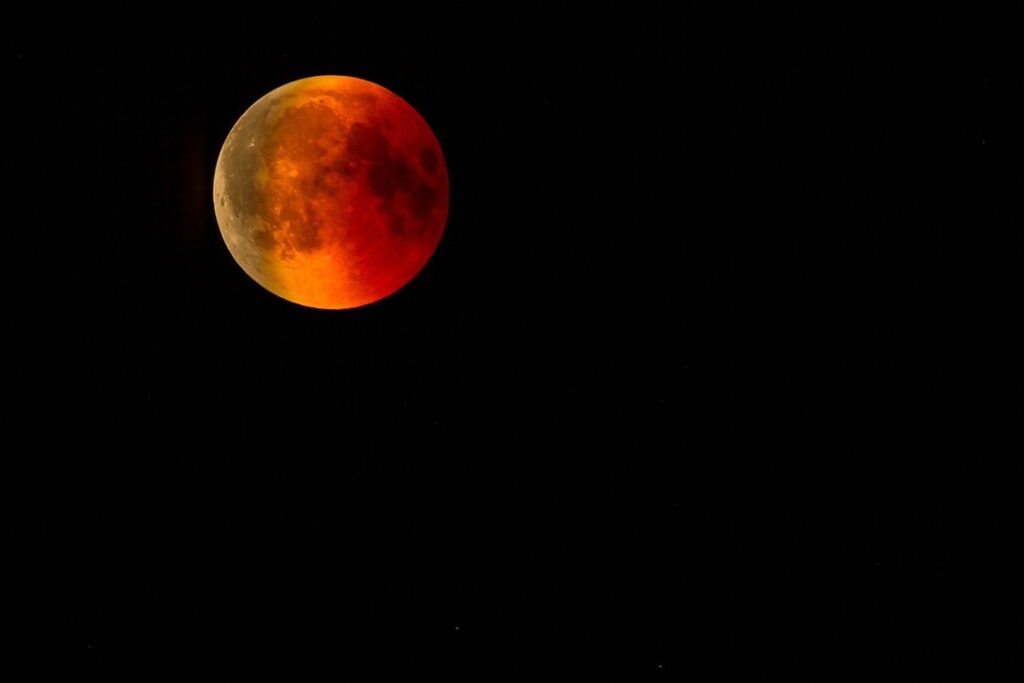
Understanding Lunar Eclipses
Lunar eclipses are fascinating events that have captivated humans for centuries, but what exactly happens during these rare occurrences? Let’s take a closer look at the science behind them.
What Causes a Lunar Eclipse?
A lunar eclipse occurs when the Earth’s shadow falls on the Moon. This happens when the Moon is positioned at a specific angle relative to the Earth and Sun, allowing our planet’s shadow to extend into space and cover the Moon’s surface. The type of eclipse that occurs depends on the alignment of these celestial bodies.
There are three main types of lunar eclipses: Penumbral, Partial, and Total. A Penumbral eclipse occurs when the Moon passes through the Earth’s partial shadow, resulting in a subtle darkening of the Moon’s surface. This type of eclipse is often difficult to notice and requires clear skies for observation. In contrast, a Partial eclipse happens when only a portion of the Moon enters the Earth’s umbra, creating a noticeable but incomplete shadow on the lunar surface.
A Total lunar eclipse, also known as a Blood Moon, occurs when the entire Moon passes through the Earth’s umbra, causing the Moon to take on a reddish hue. This type of eclipse is both visually striking and relatively rare, making it a sought-after event for astronomers and sky gazers alike.
Phases of a Lunar Eclipse
A lunar eclipse has distinct phases that mark its progression. The first phase is known as the P1, or penumbral contact, when the Earth’s atmosphere begins to darken the Moon. During this phase, you might notice a subtle darkening of the Moon’s surface, but it may not be immediately noticeable.
As the Earth’s shadow deepens, the eclipse enters its partial phases: P2 (partial), where the Moon starts to take on a distinctive curvature; and the maximum eclipse, when the penumbra reaches its peak. The lunar surface becomes increasingly darkened during this phase, taking on an orange or reddish hue due to the Earth’s atmosphere scattering sunlight.
The final two phases are called fourth contact (E4) and fifth contact (E5), also known as umbral exit. During E4, the Moon starts to re-emerge from the Earth’s shadow, gradually brightening until it is fully illuminated at E5. Note that the entire eclipse event can last several hours, with each phase occurring at different times depending on your location and the specific eclipse path.
Prediction and Timing
To accurately plan for the next lunar eclipse, let’s examine how to predict its timing, including the exact dates and durations of visibility. Understanding these factors will help you make the most of this celestial event.
How Lunar Eclipses are Calculated
Astronomers use specialized software and mathematical algorithms to predict lunar eclipses with remarkable accuracy. One such tool is called a “lunar eclipse predictor,” which considers several key factors when calculating the timing and duration of an eclipse. The primary factor is the alignment of the Earth, Moon, and Sun, known as syzygy.
The Moon’s orbital path must intersect with the node where its orbit crosses the ecliptic plane, which includes five specific points in the sky: the ascending and descending nodes. Astronomers also consider the Moon’s elliptical shape and its proximity to perigee or apogee. These parameters influence the eclipse’s duration, type (partial, penumbral, or total), and timing.
The software takes into account various celestial mechanics, including the Earth’s slightly ellipsoidal shape, which affects the lunar orbit. The algorithms also consider any potential variations in the Moon’s orbital path due to tidal interactions with the Sun. By inputting precise astronomical data and accounting for these factors, astronomers can accurately predict the timing and duration of an upcoming lunar eclipse, ensuring that observers know exactly when to witness this rare celestial event.
Understanding Lunar Eclipse Cycles
A lunar eclipse cycle, also known as a Saros cycle, has a significant impact on the frequency and visibility of lunar eclipses. This 18-year, 11-day pattern determines when and how often lunar eclipses occur. The Saros cycle is named after the ancient Greek astronomer Hipparchus of Rhodes, who discovered this repeating phenomenon.
Within each Saros cycle, there are three to five lunar eclipses. Over time, these cycles affect the frequency and visibility of lunar eclipses due to changes in Earth’s orbit around the Sun. As a result, some years experience more frequent lunar eclipses than others. For instance, during an eclipse season, which typically spans 35 days, multiple eclipses can occur.
Understanding Saros cycles helps predict when lunar eclipses are likely to happen and how often they will appear over time. It also gives astronomers and sky gazers a sense of what to expect in terms of the number and visibility of these celestial events. By tracking Saros cycles, observers can anticipate and prepare for upcoming lunar eclipses, making the most of their viewing opportunities.
Visible from Your Location
Are you eager to witness the lunar eclipse with your own eyes? This section will help you determine if the next lunar eclipse is visible from your exact location, so grab a map and let’s check.
When and Where to Observe
To determine if a lunar eclipse is visible from your location, consider the factors that influence visibility. Latitude plays a significant role, as lunar eclipses are only visible from locations where the Moon is above the horizon at the time of maximum eclipse. If you live between latitudes 80°N and 80°S, you’ll miss this particular lunar eclipse.
Longitude also affects visibility. The path of totality for a partial lunar eclipse typically spans several thousand miles, but it’s still possible to observe from locations outside this narrow corridor. If you’re within the Americas or Western Europe, you might be able to see the partial phases of the next lunar eclipse.
Atmospheric conditions can significantly impact your viewing experience. Thin clouds or high altitude can reduce visibility, while heavy haze or smog can obscure the Moon entirely. Check local weather forecasts and astronomical websites for updates on potential viewing conditions during the lunar eclipse event.
Tips for Observing a Lunar Eclipse
For safe and effective observation, find a location with an unobstructed view of the eastern horizon. This typically means getting to high ground or moving to an open area far from buildings and trees. Bring binoculars or a telescope to get a closer look at the Moon’s surface as it transitions into shadow. A tripod is also essential for stabilizing your equipment, reducing camera shake, and ensuring a clear view.
When choosing a viewing location, consider the time of day and the surrounding environment. Avoid areas with artificial lighting, which can wash out the faint light from the Earth’s shadow on the Moon. Instead, opt for a spot with minimal ambient illumination, allowing you to capture the full range of colors in the lunar eclipse spectrum. Some parks or observatories may offer special viewing events or telescopes for public use – check local listings or join astronomy clubs to find out more. With proper preparation and equipment, you’ll be well-equipped to witness this rare celestial event up close.
History of Lunar Eclipses in Mythology and Culture
Lunar eclipses have captivated human imagination for centuries, inspiring a rich tapestry of myths and legends across cultures. Let’s explore how ancient civilizations interpreted these rare celestial events.
Ancient Civilizations and Lunar Eclipses
Ancient cultures viewed lunar eclipses as a sign of divine intervention, often interpreting them as omens for good or ill. In ancient China, lunar eclipses were seen as a dragon eating the moon, while in many Native American cultures, they believed the sun and moon were fighting. In Hindu mythology, the eclipse was caused by Rahu, a serpent-like demon who consumed the moon.
Folklore from various cultures reveals a mix of fear and reverence for these events. For example, some African tribes believed lunar eclipses brought disease and death, while others saw them as a sign of fertility and prosperity. In Japan, the eclipse was associated with the goddess Tsuki-yomi, who was said to be angry when her brother Amaterasu hid the sun.
When observing an upcoming lunar eclipse, remember that these events were often considered sacred or taboo in ancient times. However, we can learn from their interpretations by recognizing the awe and wonder they inspired. Take a moment to appreciate the science behind this celestial event: the moon passing through Earth’s shadow creates a temporary phenomenon with deep cultural significance.
Modern Cultural Significance
Lunar eclipses have maintained their cultural significance in modern times. In recent years, they’ve often coincided with significant events, such as solar flares, volcanic eruptions, and global economic shifts. These occurrences are not merely coincidental; scientists suggest that lunar eclipses might influence seismic activity.
For instance, the 2015 total lunar eclipse coincided with a surge in earthquakes across the globe, leading some to speculate about possible connections between the celestial event and tectonic activity. Similarly, during the 2018 lunar eclipse, several major stock markets experienced significant fluctuations, sparking debate about potential correlations between economic trends and lunar cycles.
A growing interest in astronomy and space exploration has also contributed to the continued relevance of lunar eclipses in modern culture. With social media platforms offering unprecedented access to real-time astronomical events, people worldwide can now witness and participate in discussions surrounding these rare occurrences. As we await the next lunar eclipse, it’s essential for observers to understand the science behind these events and be aware of any potential risks or considerations associated with viewing them.
Astronomy and Science Behind the Eclipse
As we wait for the next lunar eclipse, it’s time to explore what makes these celestial events possible: the unique alignment of Earth, Moon, and Sun.
The science behind this phenomenon is fascinating, and understanding its mechanics can add depth to your experience.
Moon’s Orbit and Elliptical Shape
The Moon’s elliptical orbit has a profound impact on the Earth-Sun-Moon alignment during an eclipse. As the Moon orbits the Earth, its distance from our planet varies between 221,500 and 252,088 miles (356,000 to 405,500 kilometers). This elliptical shape is caused by the gravitational pull of the Sun and the other planets in our solar system.
As a result, the frequency and visibility of eclipses change throughout the year. During the new moon phase, when the Moon is at its closest point to Earth (perigee), it appears larger in the sky and can completely cover the Sun’s disk, creating a total solar eclipse. Conversely, when the Moon is at its farthest point from Earth (apogee), it appears smaller and can only partially cover the Sun, resulting in a partial solar eclipse.
Understanding the Moon’s elliptical orbit helps astronomers predict which areas of the world are likely to experience an eclipse. By taking into account the Moon’s distance and position in its orbit, scientists can calculate the precise timing and duration of an eclipse, allowing for accurate predictions and planning for astronomical events.
Atmospheric and Geophysical Effects
During a lunar eclipse, the Earth passes between the sun and the moon, blocking direct sunlight from reaching our satellite. This has a profound impact on atmospheric conditions, particularly temperature and pressure changes. Typically, temperatures drop by 1-3°C (2-5°F) as the Moon moves into the Earth’s shadow, due to reduced solar radiation. This cooling effect is more pronounced near the surface, where it can be felt in cities and rural areas alike.
In addition to temperature fluctuations, lunar eclipses also cause a slight increase in atmospheric pressure. This might seem counterintuitive, given the reduced sunlight, but it’s actually caused by the Earth’s atmosphere reacting to the changed solar radiation patterns. The increased pressure is usually imperceptible, but it can be measured using specialized instruments.
For skywatchers and photographers, understanding these changes is crucial for planning the best vantage points and capturing high-quality images during an eclipse. To make the most of this phenomenon, consider heading outdoors to areas with minimal light pollution, where you’ll have a better view of the lunar surface’s subtle color shifts.
Next Steps: Planning Your Lunar Eclipse Experience
Now that you’ve learned what a lunar eclipse is and how to safely observe one, it’s time to plan your experience. Consider factors like location, timing, and equipment needs for an unforgettable viewing.
How to Prepare for the Event
When you’re preparing for a lunar eclipse experience, it’s essential to understand what to expect during the event. A lunar eclipse occurs when the Earth passes between the Sun and the Moon, casting a shadow on the lunar surface. This can cause the Moon to darken or even turn a reddish hue.
To prepare your equipment, make sure you have a stable tripod for your telescope or camera. A sturdy mount will help you avoid shaky images and ensure that you capture sharp photos of the eclipse. You’ll also want to use a moon filter to reduce the brightness of the lunar surface, which can help prevent overexposure in your photos.
Safety guidelines are crucial when observing a lunar eclipse. Avoid looking directly at the eclipse through an unfiltered telescope or binoculars, as this can cause damage to your eyes. Instead, use a solar viewing device or proper eye protection that meets international safety standards. Additionally, be mindful of your surroundings and ensure you’re in a safe location with minimal obstructions for optimal viewing.
Tips for Capturing Exceptional Photos or Videos
To capture exceptional photos or videos of the lunar eclipse, start by planning ahead. Familiarize yourself with the eclipse’s timing and duration to ensure you’re prepared for the right moment. Consider investing in a tripod, as it will help stabilize your camera and prevent shaky footage.
Choose a location with an unobstructed view of the moon, ideally at a high vantage point or with minimal light pollution. For photography, use a wide-angle lens (10-22mm) to capture the entire moon in frame. If you’re using a smartphone, consider using a camera adapter or external lens for improved image quality.
In terms of equipment, a DSLR or mirrorless camera is ideal, but a good-quality smartphone will also produce exceptional results with the right settings. Experiment with different shutter speeds and ISO settings to achieve the best exposure. For video, keep your shots short (2-3 minutes max) to avoid overexposure and maintain viewer interest. Also, remember to bring spare batteries and memory cards to ensure you don’t run out of power during the eclipse.
Frequently Asked Questions
Can I Observe a Lunar Eclipse with My Binoculars?
Yes, you can observe a lunar eclipse with binoculars, but the image may appear blurry or washed out due to the Moon’s brightness. Consider using a Moon filter to enhance the visibility of details.
How Do Atmospheric Conditions Affect Visibility During a Lunar Eclipse?
Atmospheric conditions such as dust, pollution, and water vapor can scatter light and reduce visibility during a lunar eclipse. Locations with poor atmospheric quality may experience reduced contrast or hazy images. Clear skies are essential for optimal viewing.
What if the Lunar Eclipse is Cloudy in My Area?
If the lunar eclipse is cloudy in your area, try to observe it from a location with clearer skies or wait for the clouds to pass. Be patient and prepared to adjust your plans according to weather conditions.
Can I Capture Exceptional Photos of a Lunar Eclipse Using My Smartphone?
Yes, you can capture exceptional photos of a lunar eclipse using your smartphone, but consider investing in a tripod and a good camera lens to reduce image shake and improve quality. Use the camera’s manual mode to adjust settings for optimal results.
How Long Does it Take for the Effects of a Lunar Eclipse on Atmospheric Conditions to Wear Off?
The effects of a lunar eclipse on atmospheric conditions can take several days or even weeks to wear off, depending on the location and type of eclipse. This is because the Moon’s gravitational pull affects the Earth’s tides and atmosphere in subtle ways that persist after the eclipse has passed.