
Watching a comet is one of life’s most unforgettable experiences. You’ve likely heard tales of comets streaking across the night sky, their ethereal beauty captivating astronomers and amateur stargazers alike. But timing is everything when it comes to spotting these celestial wonders – missing the optimal viewing period can mean going home empty-handed. The best time to see a comet depends on its orbital path and trajectory relative to our planet, making preparation crucial for success. In this article, we’ll explore how to prepare for a comet’s passage, including advanced techniques for maximizing your chances of spotting these fleeting phenomena. By the end of it, you’ll know when to look up and what to do to ensure an unforgettable experience.
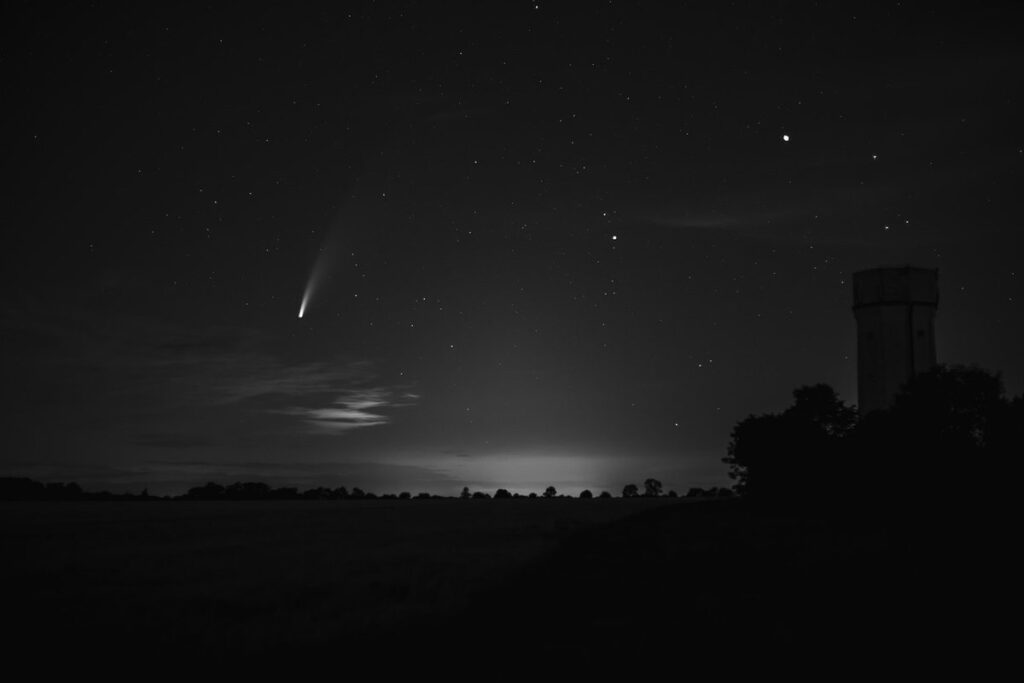
Understanding Comets and Their Behavior
To truly appreciate a comet sighting, it’s essential to understand what these celestial bodies are and how they behave during their orbits around the sun. Let’s start by examining the basics of comets and their unique characteristics.
What are Comets?
Comets are formed from icy material and rocky debris left over from the solar system’s formation. As they approach the Sun, the heat causes these frozen particles to vaporize, releasing gas and dust into space. This process is known as outgassing, and it’s what makes comets visible from Earth. The released gas and dust create a bright tail that can be seen extending behind the comet, making them appear like a celestial wonder in the night sky.
The composition of comets varies widely, with some being primarily composed of water ice, while others have higher concentrations of methane or ammonia. This diversity is reflected in their appearance, with some comets displaying vibrant colors due to the presence of certain gases. Understanding the nature of comets helps astronomers predict their behavior and visibility, which is essential for planning a successful viewing event.
When observing a comet, it’s worth noting that the amount of gas and dust released can change over time, affecting its brightness and tail formation. By studying these variations, scientists can gain insights into the comet’s composition and activity levels.
Types of Comets
Comets can be broadly categorized into three types based on their orbital periods. Short-period comets, also known as Halley-type comets, are those with an orbital period of less than 200 years. These comets originate from the inner Oort Cloud and have elliptical orbits that bring them close to the Sun. Comet Hale-Bopp is a notable example of a short-period comet.
Long-period comets, on the other hand, have orbital periods exceeding 200 years. They are thought to originate from the outer Oort Cloud and have highly inclined orbits that take them far beyond Neptune’s orbit. Long-period comets like C/2013 A1 (Siding Spring) and C/2020 F3 (NEOWISE) are examples of this type.
Periodic comets, also known as recurrent comets, are those with orbital periods less than 20 years. These comets have stable orbits that bring them close to the Sun at regular intervals. Comet Halley is a well-known periodic comet that appears every 76 years. It’s essential to note that long-period comets can become periodic comets if their orbits change due to gravitational interactions with the giant planets.
Understanding the types of comets helps astronomers predict their behavior and visibility. Knowing whether a comet is short-period, long-period, or periodic informs observers about when and where they are likely to appear in the sky.
Factors Affecting Comet Visibility
Comet distance is one of the primary factors affecting visibility. As comets approach Earth, they appear larger and brighter in the sky. However, if a comet is too close, it can be overwhelmed by sunlight, making it difficult to observe. Conversely, if it’s too far away, its light will be dispersed across a wider area, reducing its apparent brightness. The average distance of a comet from Earth varies greatly depending on its orbital path.
A comet’s size also plays a significant role in determining visibility. Larger comets tend to be brighter and more noticeable due to their increased surface area. However, even small comets can still produce impressive tails and appear bright if they are close enough to Earth. The shape of the comet’s nucleus is another factor; irregular shapes can make it harder for astronomers to predict brightness levels.
The orbital path of a comet also influences its visibility. Comets that pass through regions with high levels of interstellar dust or gas may experience increased brightness due to reflection. Additionally, comets with highly eccentric orbits tend to be more visible than those with circular paths, as their distances from Earth vary significantly during the year.
Preparing for a Comet Viewing Event
To make the most of your comet viewing experience, you’ll want to be prepared with the right equipment and knowledge on how to safely view these celestial events. We’ll walk you through what to bring along.
Choosing the Right Equipment
When choosing equipment for comet viewing, it’s essential to select gear that can handle low light levels and provide a clear view of the comet. Binoculars are an excellent starting point, as they’re portable and relatively affordable. For optimal results, look for binoculars with 7x or higher magnification and objective lenses at least 30mm in diameter.
A telescope is another valuable tool for comet viewing. Refractor telescopes are ideal due to their ability to produce clear images without distortion. Aperture size is also crucial; a minimum of 60mm (2.4 inches) is recommended, but larger apertures will provide better results.
If you want to capture high-quality images or videos, consider investing in a camera specifically designed for astrophotography. These cameras typically have longer exposures and better low-light sensitivity than standard cameras. Some popular options include DSLRs with interchangeable lenses and specialized astronomical cameras like the QHY600.
Finding the Best Viewing Spots
To increase your chances of spotting a comet, it’s essential to find optimal locations for observation. Comets are best viewed in areas with dark skies and minimal light pollution, which can significantly hinder visibility. Remote locations, far from cities and towns, often provide the best conditions.
Some popular destinations for stargazing include national parks, remote wilderness areas, and designated Dark Sky Sanctuaries. These places typically have strict lighting regulations, reducing artificial light interference. For example, Death Valley National Park in California is renowned for its incredibly dark skies, making it an ideal spot to observe comets.
When selecting a location, consider the time of year and the comet’s trajectory. If the comet will be passing close to the southern horizon, find a spot with an unobstructed view of that area. A low-lying area or hill can also provide a better vantage point for observing the comet’s tail and coma.
Avoid areas with streetlights, building lights, or other sources of artificial illumination, as these can wash out the faint light of the comet.
Tips for Successful Observation
When observing a comet, it’s essential to maximize your observation time and capture clear images. To do so, consider the following tips:
- Be prepared for variable viewing conditions: Comets are often brightest when they’re closest to Earth, but this can also make them more challenging to observe due to increased light pollution or atmospheric distortion. Check forecasts before heading out and be flexible with your schedule.
- Use averted vision to enhance contrast: This technique involves looking slightly away from the comet’s position to reduce glare and increase detail visibility in the surrounding area. Practice averted vision by observing a bright star, then apply it to the comet.
- Adjust your exposure times for optimal image capture: If you’re photographing the comet, experiment with different exposure settings to balance brightness and detail. A shorter exposure may reveal more texture, while a longer one can capture fainter features.
- Take breaks to rest your eyes and maintain focus: Staring at a bright object like a comet can lead to eye strain. Give yourself regular breaks to rest and refocus your gaze. This will help you observe the comet with greater clarity and accuracy.
Identifying the Best Time to See a Comet
To make the most of your comet-watching experience, it’s crucial to know when is the best time to spot one in the night sky. We’ll walk you through the key factors that determine the optimal viewing times for comets.
Perihelion: The Closest Approach
Perihelion is the point at which a comet reaches its closest distance from the Sun. This event holds significant importance for comet viewing as it marks the moment when the comet’s ices begin to vaporize, creating a bright and visible tail. As a result, perihelion often coincides with the best time to see a comet.
During this period, the comet is typically at its brightest due to increased solar heating of the ice and dust particles. The closer proximity to the Sun also makes it easier for observers to spot the comet against the starry background. In many cases, perihelion occurs when the comet is in opposition with the Earth and Sun, further increasing its visibility.
To make the most of this opportunity, consider consulting astronomical calendars or websites that provide predictions for upcoming comets and their perihelion dates. This will help you plan your viewing sessions around the time when the comet is at its brightest and most accessible. By doing so, you’ll be well-positioned to observe some of the most spectacular views in the night sky.
Opposition: When the Sun, Earth, and Comet Align
Opposition occurs when the Earth passes between the Sun and the comet. At this point, the comet is on the opposite side of the sky from the Sun, making it visible for most of the night. This alignment significantly enhances the comet’s visibility due to two main factors: the reduced glare from the Sun and the increased opportunity for observation.
As the Earth moves between the Sun and the comet, the light from the Sun no longer overpowers the reflected light from the comet’s surface. This reduction in solar glare allows the fainter details of the comet to become visible to the naked eye or with binoculars. Moreover, during opposition, comets are often at their brightest due to increased exposure to sunlight, making them more accessible for observation.
Keep in mind that opposition occurs when a comet is on the opposite side of the sky from the Sun, not when it’s directly overhead. This means you may need to wait until evening or early morning to observe the comet. It’s essential to check the comet’s path and timing with online resources to plan your viewing session accordingly.
Averted Vision and the Power of Patience
Averted vision is a technique used by astronomers to spot faint objects like comets. It involves shifting your gaze slightly off-center from the object, allowing your peripheral vision to pick up on faint light emissions that might be invisible when looking directly at it. This method is particularly useful for comet hunting because it can help you detect subtle features and brightness variations in the comet’s tail.
The power of patience is equally important in comet hunting. Comets are often faint and require a steady gaze to appreciate their full beauty. It’s not uncommon for observers to spend hours gazing at a comet, waiting for it to brighten or become more visible. This patience can be rewarded with breathtaking views that make the wait worthwhile.
To practice averted vision, try looking at a faint star through your telescope and then shifting your gaze slightly off-center. You may notice that the star appears brighter when you’re not looking directly at it. Apply this technique to comet hunting by focusing on the comet’s tail rather than its nucleus. With patience and persistence, even the faintest comets can become visible.
Advanced Techniques for Comet Observation
To take your comet observation skills to the next level, we’ll share expert techniques for maximizing visibility and capturing stunning images of these celestial wonders. This includes tips on optimal viewing conditions and specialized equipment use.
Using Software to Track Comets
Comets are notoriously unpredictable, but software tools have revolutionized the field of comet tracking. By harnessing the power of artificial intelligence and machine learning algorithms, these programs can accurately predict a comet’s path and optimize viewing opportunities for amateur astronomers.
One popular tool is Stellarium, an open-source planetarium software that allows users to simulate the night sky and track celestial objects in real-time. With Stellarium, you can input the comet’s orbital elements and receive updates on its predicted position, velocity, and brightness. Another option is SkySafari, a mobile app that provides detailed information on comets, including their orbits, trajectories, and viewing conditions.
To get the most out of these tools, it’s essential to understand how to use them effectively. For instance, you should regularly update your software with the latest orbital data and astronomical ephemerides. Additionally, familiarize yourself with the program’s interface and features, such as asteroid or comet tracking modes, to ensure smooth navigation.
By leveraging software like Stellarium or SkySafari, you can significantly enhance your chances of spotting a comet and make the most of this rare opportunity.
Long-Exposure Photography for Comet Capture
When it comes to capturing high-quality images of comets, long-exposure photography is a technique worth exploring. This method involves keeping the camera shutter open for an extended period, typically between 30 seconds and several minutes, to allow more light to enter and create sharper images.
To achieve successful long-exposure photos of comets, you’ll need a sturdy tripod to support your camera and prevent any movement during the exposure time. A wide-angle lens with a low f-stop value (around f/2.8 or lower) is ideal for capturing the comet’s tail and surrounding sky. Additionally, use an intervalometer or remote shutter release to minimize vibrations caused by pressing the shutter button.
A dark location away from city lights is essential for minimizing light pollution and capturing the comet’s faint details. If you’re using a DSLR camera, consider setting the ISO to its lowest value (around 800-1600) to reduce digital noise and enhance image quality. You can also experiment with different exposure times and f-stop values to find the optimal settings for your specific equipment and viewing conditions.
Experimenting with long-exposure photography can be a fun and rewarding experience, allowing you to capture unique images of comets that might not be visible through traditional observation methods.
Advanced Telescopes and Their Applications
Advanced telescopes are designed specifically for comet observation and offer several advantages over standard instruments. One such specialized telescope is the Schmidt-Cassegrain Telescope (SCT), which features a curved primary mirror and a corrector plate to produce sharp, high-resolution images of comets. SCTs are particularly useful for observing comets in the outer solar system, where their wide fields of view allow astronomers to capture more of the comet’s tail.
Another advanced telescope is the Ritchey-Chrétien Telescope (RCT), which boasts exceptional optical quality and minimal distortion. RCTs are ideal for detailed studies of comets, such as observing subtle changes in their gas and dust composition. For instance, the Hubble Space Telescope, an RCT-based instrument, has made numerous groundbreaking discoveries about comet composition.
Some popular advanced telescopes include the Meade LX200 and the Celestron EdgeHD. These instruments often come equipped with specialized software and accessories that enhance comet observation capabilities. When selecting an advanced telescope for comet observation, consider factors such as aperture size, focal length, and optical quality to ensure optimal performance.
Notable Comets Throughout History
Comets have fascinated humans for centuries, and some of the most notable ones have left an indelible mark on history. From Halley’s Comet to Hale-Bopp, we’ll take a closer look at these celestial wonders.
Famous Comets in Human History
Halley’s Comet has been one of the most iconic comets in human history, visible to the naked eye every 75 years. Its appearance in 1066 was documented by English chronicler Byrhtferth, and its return in 1301 was recorded by Italian poet Giovanni Villani. The comet’s most famous appearance was in 1758, when it became one of the first objects to be predicted using mathematical calculations. This feat marked a major milestone in astronomy.
The Great Comet of 1811, also known as C/1811 F1, is another notable example. It was visible for 260 days and reached a magnitude of -2, making it easily observable with the naked eye. The comet’s passage was closely followed by astronomers and the general public alike, with many witnessing its spectacular appearance in the sky.
The impact of comets on human culture cannot be overstated. Halley’s Comet has been depicted in numerous works of art throughout history, from medieval illuminated manuscripts to modern paintings. Its periodic returns have often coincided with significant events in human history, such as wars and natural disasters.
Impact of Comets on Culture and Society
Comets have captivated human imagination for centuries, leaving an indelible mark on art, literature, and science across various civilizations. In ancient Greece, Halley’s Comet was believed to signal the birth of great leaders or the demise of kings. Similarly, in China, comets were associated with omens and portents, often predicting changes in fortune or power.
In Western culture, comets have inspired some of the most iconic works of art. For example, J.M.W. Turner’s painting “The Comet” (1833) depicts a celestial body streaking across the sky, while Gustav Holst’s “The Planets” suite features a movement dedicated to the comet-like qualities of Saturn.
Comets have also had a profound impact on scientific discovery. The observation of Halley’s Comet in 1066 led to a more accurate understanding of astronomical cycles, while the study of comets has contributed significantly to our knowledge of planetary formation and the solar system’s evolution.
As we continue to observe comets, we can draw inspiration from their historical significance. By studying these celestial bodies, we not only gain a deeper appreciation for their beauty but also expand our understanding of the universe and its mysteries.
Recent Notable Comet Sightings
Recent notable comet sightings have significantly contributed to our understanding of these celestial bodies. The 2013 discovery of Comet ISON’s breakup provided valuable insights into cometary fragmentation and the effects of solar radiation pressure on comet tails.
The 2020 apparition of Comet Neowise offered astronomers a unique opportunity to study a bright, active comet up close. Its high-resolution images revealed intricate details about the comet’s tail structure and dust emissions. The event also sparked public interest in astronomy, with millions of people worldwide capturing stunning images and videos of the comet.
Another notable sighting is that of Comet Hale-Bopp in 1997, which was one of the brightest comets of the 20th century. Its prolonged visibility allowed scientists to collect extensive data on its coma and tail dynamics. The comet’s close approach to Earth also led to studies on the effects of solar wind on cometary atmospheres.
These recent sightings demonstrate the importance of continued monitoring and observation of comets. By analyzing their behavior, astronomers can refine predictions about future appearances and improve our understanding of these enigmatic bodies.
Conclusion: Maximizing Your Chances for a Successful Comet Viewing Experience
To maximize your chances of a successful comet viewing experience, it’s crucial to combine careful planning with flexibility. Be prepared to spend several nights monitoring the sky, as comets can be unpredictable and may change their position rapidly. Start by familiarizing yourself with the comet’s predicted trajectory and brightness, which will give you an idea of its visibility in your area.
Check local weather forecasts to ensure clear skies, as even a slight haze or cloud cover can significantly impact viewing conditions. Bring binoculars or a telescope, but also keep a pair of naked-eye observers handy to confirm what you’re seeing. Lastly, be prepared for the possibility that the comet may not appear as predicted – and have fun trying again on another night if it doesn’t materialize.
Frequently Asked Questions
Can I spot comets during the day?
Yes, it is possible to spot comets during the day, but it requires a lot of patience and knowledge of the comet’s position. Comets can be visible in daylight when they are at their brightest and have passed perihelion. However, this can also make them difficult to spot due to the bright sky.
What if I’m observing a comet and I notice it’s fading rapidly? Is something wrong with my equipment?
No, a comet’s brightness can fluctuate significantly as it approaches or recedes from Earth. If you’re concerned about your equipment, check that it’s properly calibrated and clean. However, if the comet is indeed fading, it may be due to its natural behavior, and you should consult astronomical software for updates on its position and brightness.
How do I know when a comet will pass close enough to Earth for me to see with my binoculars?
To determine when a comet will be visible in your binoculars, use astronomical software to track the comet’s path and proximity to Earth. You can also consult online resources that provide visibility charts for comets. Remember to consider factors like light pollution, atmospheric conditions, and the comet’s brightness.
Can I use long-exposure photography with a smartphone?
While smartphones have improved significantly in image quality, they may not be ideal for long-exposure photography due to limitations in camera software and sensor size. However, there are apps that can help you achieve decent results, such as using manual mode and experimenting with different exposure settings.
What if I’m planning a comet-viewing event and the weather forecast is poor? How do I ensure everyone has a good experience?
To minimize disappointment, consider having a backup plan in place, such as indoor activities or observing another celestial object. You can also communicate with your guests beforehand to set realistic expectations about visibility conditions.