
If you’ve ever gazed up at a clear night sky, you might have wondered about that faint, fuzzy patch in the northern hemisphere – the Andromeda galaxy. Visible to the naked eye on a very dark night, it’s a stunning sight for astronomers and stargazers alike. But seeing it clearly requires more than just good eyesight: you need to know where to look and how to observe this distant beauty. Fortunately, finding the Andromeda galaxy is easier than you think, even with beginner-friendly equipment like binoculars or a smartphone app. With some simple techniques and knowledge of astronomy basics, you can locate and observe the Andromeda galaxy in no time. In this article, we’ll show you how to find and observe this celestial wonder using telescopes, binoculars, and smartphone apps – perfect for anyone looking to explore the universe from their own backyard.
Understanding the Basics of the Andromeda Galaxy
The Andromeda Galaxy is a fascinating celestial body, but before you can spot it, you need to understand its basic characteristics and location in the night sky. Let’s start by learning about its shape, size, and distance from Earth.
What is the Andromeda Galaxy?
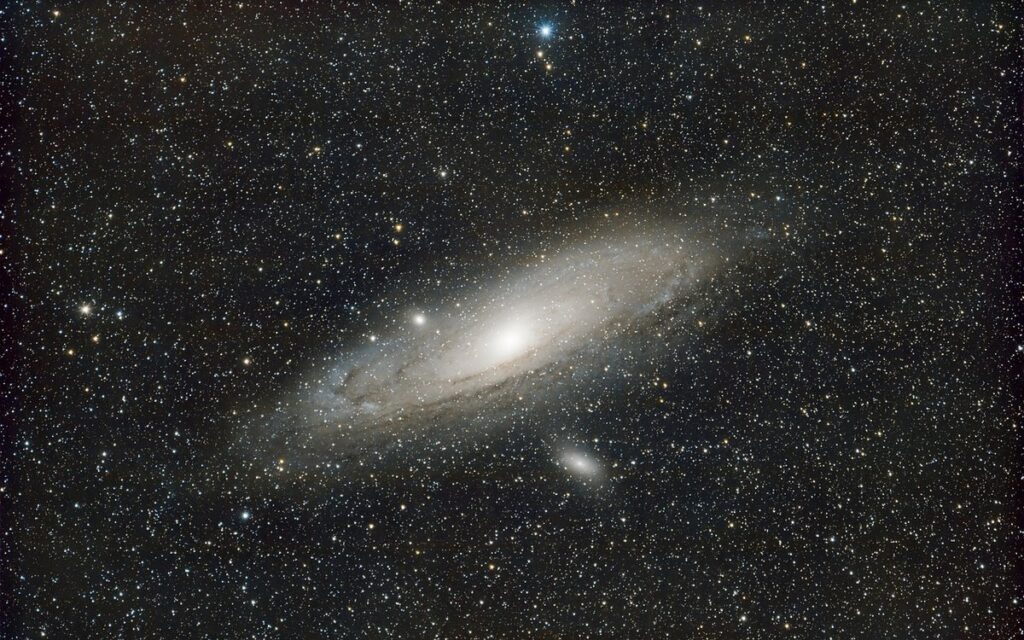
The Andromeda galaxy is a spiral galaxy that has captivated astronomers and stargazers for centuries. Specifically, it’s designated as Messier 31 (M31) or NGC 224. This distinction might seem like mere cataloging to some, but each label provides valuable context about the galaxy’s nature.
When we refer to M31, we’re using a designation from Charles Messier’s catalog of deep-sky objects in the late 18th century. Messier was searching for comets and documented many notable celestial bodies in his efforts. The Andromeda galaxy’s entry in this list underscores its visibility and significance even back then.
The NGC (New General Catalogue) designation, on the other hand, is a more modern system created by John Louis Emil Dreyer in 1888. It groups objects based on their relative brightness and position within our galaxy. As NGC 224, the Andromeda galaxy fits into this classification due to its impressive size and luminosity.
Understanding these designations can help you better appreciate the history behind astronomical observations.
Importance and Notable Features
The Andromeda galaxy is significant to astronomers because it’s the closest major galaxy to our own Milky Way, located about 2.5 million light-years away. Its proximity makes it an ideal subject for study, allowing scientists to gain valuable insights into the structure and evolution of galaxies. One notable feature of the Andromeda galaxy is its spiral arms, which are home to new star formation. The galaxy’s central bulge is also of interest, as it contains a supermassive black hole at its center.
Astronomers study the Andromeda galaxy to better understand the life cycle of galaxies and how they interact with each other. For example, observations suggest that our own Milky Way and the Andromeda galaxy are on a collision course, expected to collide in about 4.5 billion years. This event will likely trigger a burst of star formation as gas and dust are compressed.
Several key features make the Andromeda galaxy stand out among other galaxies. Its large size, with over 1 trillion stars, is one notable characteristic. Additionally, the galaxy’s distinctive X-shaped central bulge is thought to be the result of multiple mergers with smaller galaxies in its past.
Preparing for Observation: Essential Equipment and Techniques
To find the Andromeda Galaxy, you’ll need a pair of binoculars or a telescope to magnify its faint light in the night sky. Let’s cover the essential equipment and techniques for observation.
Choosing the Right Telescopes for Viewing
When it comes to viewing the Andromeda galaxy, having the right telescope is crucial. You’ll want a telescope with sufficient aperture and magnification power to bring out the faint details of the galaxy’s central bulge and surrounding halo.
Amateur-friendly options include reflector telescopes, such as Newtonian or Dobsonian designs, which offer good light gathering capabilities at an affordable price point. Refractor telescopes are also suitable for beginners, providing sharp images with minimal distortion. However, they can be more expensive due to the cost of high-quality optics.
Professional-grade equipment typically features larger apertures (6-10 inches or more) and advanced optics, such as Ritchey-Chretien designs. These telescopes offer exceptional resolution and detail but come at a significantly higher price point, making them less accessible for casual observers.
When choosing a telescope, consider your budget, observing location, and the type of viewing you want to do. If you’re just starting out, a good-quality reflector or refractor with an aperture of 4-6 inches should suffice for viewing the Andromeda galaxy.
Understanding Telescope Settings and Adjustments
When setting up your telescope for optimal viewing conditions, it’s essential to focus on three key areas: focusing, magnification, and image stabilization. Start by adjusting the focus knob until you achieve a sharp image of nearby stars or objects. This will help you fine-tune the focus for the Andromeda Galaxy.
For magnification, consider starting with lower powers (around 50-100x) to get a sense of the galaxy’s overall shape and structure. You can then gradually increase the power to higher settings (200-300x or more) for a closer look at specific details. Be aware that excessive magnification can introduce distortion and make it harder to observe.
To stabilize your image, engage your telescope’s image stabilization feature or use a tripod with a sturdy base. This will help you capture sharp images even when observing through thin clouds or in breezy conditions. Avoid using high-magnification settings in windy or unstable environments, as this can exacerbate image blur. By mastering these basic techniques, you’ll be well-prepared to observe the Andromeda Galaxy and appreciate its stunning beauty. Use a short exposure time (around 10-30 seconds) for initial observations, and adjust as needed based on your telescope’s performance.
Locating the Andromeda Galaxy in the Night Sky
To locate the Andromeda Galaxy, you’ll want to head towards the constellation of Cassiopeia on a clear night between September and February. This section will guide you through the steps to spot this stunning celestial wonder.
Identifying Constellations and Star Patterns
To locate the Andromeda galaxy, it’s essential to understand the surrounding constellations. Two prominent ones near its location are Pegasus and Triangulum. Start by identifying Pegasus, which is easily recognizable by its distinctive square shape formed by four bright stars. Note that Pegasus lies south of the Andromeda galaxy, so orient yourself accordingly. To find Pegasus, look for the constellation’s “Great Square” pattern in the eastern sky around 9 PM in March.
Once you’ve located Pegasus, draw a mental line through its two upper stars to extend towards the north. This will guide you toward Triangulum, another key constellation near the Andromeda galaxy. Triangulum is smaller and fainter than Pegasus but has a distinctive triangle shape formed by three bright stars. By visualizing these constellations, you can establish a mental map of the region around the Andromeda galaxy.
Keep in mind that the position of these constellations changes with the seasons. In March, when the Andromeda galaxy is most visible from the Northern Hemisphere, Pegasus and Triangulum are prominent in the evening sky.
Charting a Course for the Andromeda Galaxy
To chart a course for the Andromeda Galaxy, you’ll need to use star charts, planetarium software, or mobile apps designed for astronomy enthusiasts. Start by downloading a planetarium app like Sky Map or Star Walk that can identify celestial objects and provide their coordinates. Enter your location and the current date and time to get an accurate view of the night sky.
Next, locate the constellation Pegasus in the northwestern part of the sky. The Andromeda Galaxy is situated near the “square” formed by Pegasus’ stars, so it’s essential to identify this constellation first. Use a star chart or planetarium software to find the galaxy’s approximate position relative to Pegasus.
Once you’ve located Pegasus and identified its square pattern, move your gaze about 30 degrees northwest towards the constellation Andromeda (also known as Messier 31). This should bring the Andromeda Galaxy into view. If using an app or software, adjust the zoom level and brightness settings to optimize your view.
For more precise navigation, consult a star chart that shows the galaxy’s position in relation to nearby stars and constellations.
Advanced Methods for Observing the Andromeda Galaxy
Once you’ve located the Andromeda galaxy, you can take your observations to the next level by using advanced methods that enhance your viewing experience and provide more detailed information about this cosmic wonder.
Using Binoculars or Small Telescopes for a Closer Look
Using binoculars or small telescopes can be an excellent way to get a closer look at the Andromeda Galaxy. However, it’s essential to use them during optimal viewing times when the galaxy is most visible. These periods typically occur when the Earth is aligned with the galaxy’s position in space, allowing for clear and steady views.
To enhance visibility, try to observe the Andromeda Galaxy during a new moon phase, as a full moon can make it more challenging to see details in the night sky. You should also look for an evening when there are minimal obstructions such as clouds or haze.
When using binoculars or small telescopes, focus on the area where the galaxy is located and use a low magnification setting (around 100x) initially. This will help you to locate the fuzzy patch of light that represents the Andromeda Galaxy. Once you have found it, you can gradually increase the magnification for a more detailed view.
A small telescope with an aperture of at least 80mm is recommended for clear views of the galaxy’s structure and central bulge.
Imaging and Photography Techniques
When capturing images of the Andromeda galaxy, you can use specialized cameras or smartphone attachments to take high-quality photos. A DSLR camera with a wide-angle lens (10-20mm) is an ideal choice for astrophotography. Alternatively, a smartphone attachment like a telescope adapter or a camera lens can provide a closer look at the galaxy.
For optimal results, set your camera’s ISO between 800 and 1600 to balance image noise and sensitivity. Exposure times should be around 10-30 seconds, depending on the light pollution in your area. You may need to experiment with different settings to achieve the best possible image.
Post-processing plays a crucial role in enhancing your Andromeda galaxy photos. Start by adjusting the brightness and contrast using software like Adobe Lightroom or Photoshop. Then, apply noise reduction techniques to minimize graininess. Finally, use color grading tools to bring out the subtle colors of the galaxy’s stars and dust.
Some popular smartphone attachments for astrophotography include:
- Teleskop-Tracker (for iPhone and Android)
- Sky-Watcher EvoStar 102mm refractor telescope adapter
- Meade Instruments StarNavigator NGi adapter
Interpreting Observations and Understanding What You See
When you finally spot the Andromeda Galaxy, it’s essential to understand what you’re seeing – a distant spiral galaxy in our cosmic neighborhood. Let’s break down how to accurately identify and interpret its appearance.
Common Challenges and Misconceptions
One common challenge beginners face when trying to spot the Andromeda Galaxy is seeing its central bulge. This is because the galaxy’s core is relatively faint and can be easily overwhelmed by nearby stars or background objects. To overcome this, it’s essential to use a telescope with a good aperture (at least 4-6 inches) and a focal length that allows for a decent magnification without sacrificing too much field of view.
When scanning the sky for the Andromeda Galaxy, it’s not uncommon to mistake nearby stars or faint nebulae for its distinctive “hockey stick” shape. To distinguish between these objects, look for the galaxy’s characteristic double-peaked structure and the presence of a central bulge. A good tip is to use averted vision – rather than looking directly at the object, try focusing on the area around it, allowing your peripheral vision to pick up subtle details.
When observing the Andromeda Galaxy, be aware that nearby stars like Mu Andromedae or Nu Andromedae can sometimes masquerade as part of the galaxy’s structure. To avoid confusion, familiarize yourself with the surrounding star patterns and use a chart or app to verify your observations.
Tips for Enhanced Observation Experience
When observing the Andromeda Galaxy, it’s essential to make the most out of your experience. One effective way to do this is by taking notes on what you see and experience. Jot down details about the galaxy’s size, shape, and color, as well as any notable features or patterns you notice. Consider sketching a rough representation of the galaxy, paying attention to its relative position among surrounding stars.
Sharing your observations with fellow astronomy enthusiasts can also be beneficial. Join online forums or social media groups dedicated to amateur astronomy, where you can share your findings and learn from others who have observed the Andromeda Galaxy. Don’t be afraid to ask questions or seek guidance on how to improve your observation skills.
When sharing your experiences, try to include specifics about the conditions under which you observed the galaxy – such as the time of night, weather, and equipment used. This will help others understand your perspective and provide valuable insights for their own observations. By taking notes, sketching what you see, and sharing with others, you’ll be able to refine your observation skills and get more out of each viewing experience.
Frequently Asked Questions
Can I observe the Andromeda galaxy during the day?
Yes, it is technically possible to observe the Andromeda galaxy during daylight hours using specialized telescopes or binoculars with solar filters. However, this requires precise alignment and careful handling of equipment to avoid eye damage from direct sunlight.
How long does it take for a beginner to see the Andromeda galaxy clearly?
The visibility of the Andromeda galaxy depends on various factors such as telescope quality, observing conditions, and individual vision. With practice and proper technique, beginners can start seeing the galaxy’s faint outline within 1-3 viewing sessions, while optimal views may require several weeks or months of regular observation.
What if I live in an area with heavy light pollution – is it still possible to see the Andromeda galaxy?
Yes, it’s not impossible to observe the Andromeda galaxy in areas with significant light pollution. Using a telescope with a good image stabilization system and observing during periods of low moonlight can help minimize the effects of light pollution. However, optimal views may be challenging without darker skies.
Can I use my smartphone camera to take images of the Andromeda galaxy?
Yes, it is possible to capture decent images of the Andromeda galaxy using a smartphone camera attached to a telescope or binoculars. Use a tripod for stable shots and consider using image stabilization apps or software to enhance clarity. However, professional-grade equipment and post-processing techniques are required for high-quality images.
What should I do if I encounter issues with my telescope’s focus during observation?
Try adjusting the telescope’s focus slowly while observing the galaxy at different magnifications. If the issue persists, consult your telescope’s manual or contact the manufacturer for assistance. It may also be helpful to practice focusing on brighter stars nearby to develop a sense of how adjustments affect image clarity.