
Witnessing a total solar eclipse is an awe-inspiring experience that has captivated humans for centuries. This rare astronomical event, where the moon passes directly between the Earth and the sun, blocking out nearly all sunlight, is both breathtaking and humbling. You may have heard of people traveling to remote locations or waking up at dawn to catch a glimpse of this celestial spectacle, but have you ever stopped to think about what makes total solar eclipses so special? Beyond their breathtaking beauty, these events offer scientists a unique opportunity to study the sun’s corona, learn more about the Earth’s atmosphere, and gain insights into the workings of our universe. In this article, we’ll explore the science, history, and witnessing of total solar eclipses, including essential safety precautions and viewing tips to make the most of this rare experience, allowing you to understand and appreciate the phenomenon by the time you finish reading.
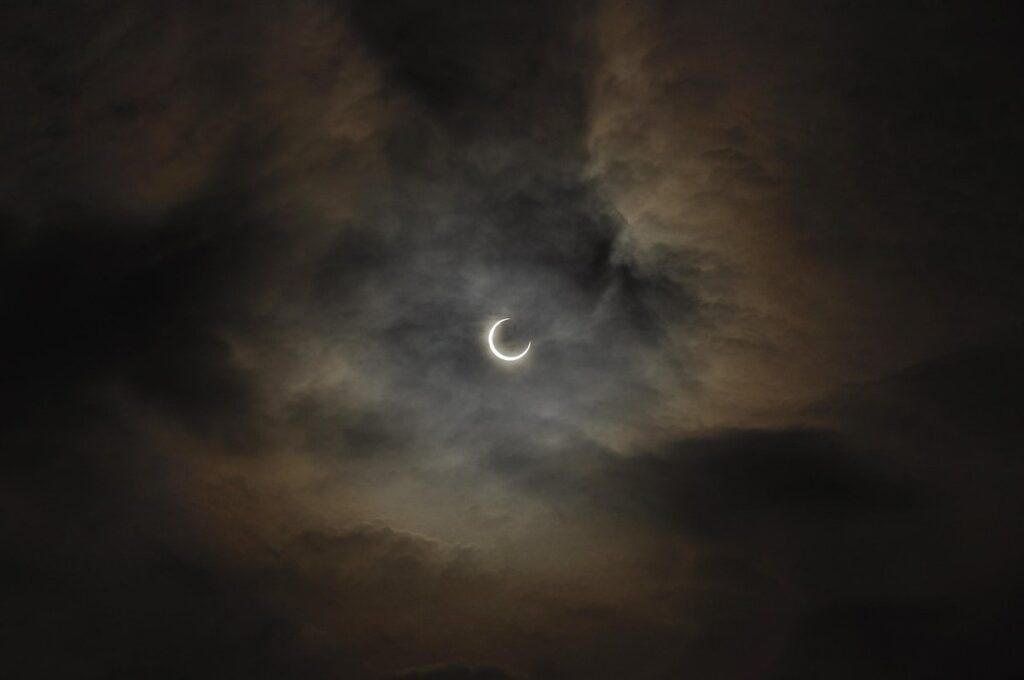
What is a Total Solar Eclipse?
A total solar eclipse occurs when the Moon perfectly aligns with the Sun and Earth, blocking the Sun’s light and creating an otherworldly spectacle. This alignment is extremely rare and a sight to behold for those lucky enough to witness it.
Definition and Explanation
A total solar eclipse is a rare and awe-inspiring astronomical event where the Moon passes directly between the Earth and the Sun, blocking the Sun’s light and casting a shadow on the planet. This occurs when the Moon is at the right distance from Earth to completely cover the Sun’s disk, an alignment that only happens during a new moon phase.
The key difference between a total solar eclipse and other types of eclipses is that it is the only type where the Moon appears large enough to completely cover the Sun. During a partial or annular eclipse, the Moon does not fully cover the Sun’s surface, resulting in a ring of light visible around the Moon.
To put this into perspective, imagine looking up at the sky and seeing the Moon slowly move across the face of the Sun, gradually blocking more and more of its light. As the Moon reaches the point where it covers about 90% of the Sun’s disk, the sky darkens, and stars become visible during the day. If you’re lucky enough to witness a total solar eclipse, you’ll see the Sun’s corona, or outer atmosphere, glowing brightly around the Moon’s shadow.
Total solar eclipses are brief events that last only a few minutes at most, but they offer a unique opportunity for scientists and sky gazers alike to study the Sun’s behavior in unprecedented detail.
Frequency and Rarity
Total solar eclipses are relatively rare events due to the specific alignment of celestial bodies. On average, a total solar eclipse is visible from a particular location on Earth about once every 360 years. However, most people will only witness one or two total eclipses in their lifetime.
The rarity of total solar eclipses can be attributed to several factors. Firstly, the Moon’s shadow has a narrow path on Earth, measuring about 100 miles wide. This means that even though there are multiple lunar eclipses each year, only a small fraction of these will result in a total solar eclipse visible from a specific location.
To put this into perspective, consider that the United States sees a total solar eclipse approximately once every 18 years on average. However, most of these events occur over remote areas or oceans, making them inaccessible to the general public. For an observer to witness a total solar eclipse, they typically need to be within a narrow corridor, usually about 70 miles wide, where the Moon’s shadow falls directly on Earth.
Preparing for a Total Solar Eclipse
To safely experience the breathtaking spectacle of a total solar eclipse, it’s essential to prepare and plan ahead, including choosing the right viewing location and gear.
Choosing a Safe Viewing Location
When choosing a safe viewing location for the total solar eclipse, consider two critical factors: distance from the path of totality and accessibility. The path of totality is usually about 70 miles wide, so it’s essential to select a spot that falls within this narrow corridor. You can check online maps or consult with local authorities to determine if your chosen location is within the path.
Accessibility is equally important. Opt for a site with clear roads leading to the viewing area and ample parking spaces. Avoid areas prone to congestion, such as popular tourist spots or major highways. Additionally, consider locations with minimal foliage, which can obstruct your view of the eclipse.
A good rule of thumb is to choose a location at least 100 miles from the coast, where atmospheric conditions are more stable and reduce the likelihood of haze or cloud cover. Some national parks, state forests, and designated viewing areas often offer optimal viewing spots and amenities for spectators. When selecting a site, prioritize those with minimal human-made structures that could potentially obstruct your view or pose a fire hazard during the eclipse.
Specialized Equipment and Safety Measures
When observing a total solar eclipse, it’s essential to have the right specialized equipment to ensure your safety. The most critical tool is solar viewing glasses, which must meet international safety standards (ISO 12312-2). These glasses filter out 99.9% of both UVA and UVB radiation, allowing you to gaze directly at the sun without harming your eyes.
Another option is handheld solar viewers, which are similar to binoculars but specifically designed for viewing the sun. Make sure they also meet the ISO safety standard. Some popular brands include Baader Planetarium and Thousand Oaks Optical. When choosing either of these options, be aware that fake or counterfeit products can still pose a significant risk.
Some specific features to look for in solar viewing glasses or handheld solar viewers include:
- A clear label stating compliance with ISO 12312-2
- A secure fit over your eyes (to prevent accidental removal)
- A sturdy design that won’t shatter easily
- A protective case for storage and transport
Remember, never look directly at the sun without proper eye protection. Even brief exposure can cause serious eye damage or even blindness.
The Science Behind Total Solar Eclipses
Total solar eclipses are rare and awe-inspiring events that occur when the moon’s orbit aligns perfectly with the sun, casting a shadow on Earth. This alignment is crucial for these celestial spectacles to take place.
Eclipsing Bodies and Their Paths
During a total solar eclipse, two main types of eclipsing bodies come into play: the Moon and the Sun. The lunar eclipsing body is the Earth’s satellite, which passes directly between our planet and the solar eclipsing body – the Sun. As a result, the Moon casts a shadow on the Earth’s surface, with the path of totality being about 7,000 miles wide.
To better understand this process, consider the paths these celestial bodies take during an eclipse. The lunar eclipsing body has two distinct paths: the penumbra and umbra. The penumbral path is broader and covers a larger area, where the Moon only partially blocks the Sun’s light. In contrast, the narrower umbraal path experiences total darkness during the eclipse.
The solar eclipsing body follows a fixed orbit around the Earth-Sun system. As it moves across the sky, its apparent size relative to the surrounding stars appears smaller due to its distance from our planet. This alignment of celestial bodies results in the rare and awe-inspiring spectacle we know as a total solar eclipse.
Coronal Activity and Eclipse Observations
Total solar eclipses offer scientists a rare opportunity to study the sun’s corona, the outer atmosphere of the sun. Normally invisible during the day due to its faintness and the brightness of the sun’s surface, the corona becomes visible as a glowing halo around the moon during an eclipse. The corona is composed of hot, ionized gas – plasma – which can reach temperatures of up to several million degrees Celsius.
The study of coronal activity during total solar eclipses has revealed some fascinating insights. For instance, scientists have observed that the corona’s composition and behavior vary depending on the location of the eclipse. The most notable example is the appearance of bright coronal loops and plumes, which are thought to be caused by intense magnetic activity in the sun’s atmosphere.
To make the most of these observations, astronomers use specialized equipment such as telescopes and cameras with narrowband filters to capture high-resolution images of the corona. By analyzing these images, scientists can gain a better understanding of the solar cycle and its impact on space weather.
Historical Significance and Cultural Impact
Total eclipses have captivated human imagination for centuries, leaving a lasting impact on cultures worldwide. We’ll explore how these events have influenced art, literature, and science throughout history.
Ancient Civilizations and Eclipse Legends
Total solar eclipses have captivated human imagination for millennia, with ancient civilizations leaving behind a rich tapestry of myths and legends. The Mesopotamians believed that such events signaled the beginning of war, while the ancient Greeks thought they foretold great calamities. In China, total eclipses were associated with emperors’ deaths or abdications.
The ancient Egyptians took a more nuanced view, associating total eclipses with the sun god Ra’s battle against the evil god Apep. Similarly, in some African cultures, total eclipses are seen as omens for great changes or upheavals. The Inca Empire believed that during an eclipse, the gods were playing a ball game, which would determine the fate of humanity.
These ancient interpretations reflect both fear and awe at the phenomenon’s majesty. Today, we know that total solar eclipses are relatively rare events, but they still hold significant cultural and historical value. Understanding these legends can provide insight into the way our ancestors perceived the natural world, highlighting their unique perspectives on astronomy and cosmology.
Some of these ancient interpretations have been documented through cave paintings and temple carvings, offering a glimpse into the lives and superstitions of people long past. By studying these accounts, we gain a deeper appreciation for the role total solar eclipses have played in shaping human culture and history.
Modern-Day Celebrations and Traditions
Total solar eclipses have captivated modern societies, inspiring unique celebrations, ceremonies, and events. In recent years, cities and towns around the world have transformed into vibrant festival grounds during these rare astronomical events. For instance, in 2017, viewers witnessed a total solar eclipse along a narrow path stretching from Oregon to South Carolina in the United States. Many communities organized festivals, concerts, and viewing parties, creating an electric atmosphere.
Some notable examples include the “Great American Eclipse” event in Nashville, Tennessee, which drew over 100,000 attendees, and the “Total Solar Eclipse Festival” held in Casper, Wyoming, which featured live music performances, astronomy talks, and viewing activities. These events not only promote scientific awareness but also foster a sense of community and shared experience among eclipse viewers.
In addition to festivals, some communities have incorporated traditional or cultural practices into their eclipse celebrations. For example, Native American tribes may perform sacred dances or sing songs associated with the eclipse event, while others may hold ceremonies to honor the celestial alignment. These modern-day traditions blend scientific curiosity with cultural heritage, making total solar eclipses an unforgettable experience for all involved.
Witnessing a Total Solar Eclipse: Tips for Viewers
Witnessing a total solar eclipse is a once-in-a-lifetime experience, but it requires careful planning to ensure you get the most out of this celestial spectacle. To maximize your viewing pleasure, consider these essential tips for observers like yourself.
Best Times and Places to Observe
Optimal viewing locations for a total solar eclipse typically lie along narrow paths on Earth’s surface called path of totality. To increase your chances of witnessing an eclipse, plan to be within this specific area. The duration and frequency of the eclipse also play significant roles in determining the best times and places to observe.
The path of totality is usually about 7,000 miles long and 100 miles wide, but it can vary greatly from one eclipse to another. For instance, during the August 2017 total solar eclipse, the path of totality spanned across 14 states in the United States, while a more recent eclipse observed over Antarctica was confined to a much smaller area.
When considering timing, note that the duration of totality varies between 2 and 5 minutes. The longer the duration, the better it is for observation and photography. Aim to be within the path of totality during the maximum eclipse period to maximize your viewing experience. Some popular locations known for their optimal viewing conditions include national parks, observatories, and designated eclipse festivals.
To further enhance your viewing experience, check the weather forecast beforehand and plan accordingly. Clear skies can significantly improve your chances of witnessing a safe and awe-inspiring total solar eclipse.
Photography and Observation Techniques
To capture stunning images during a total solar eclipse, you’ll want to use a camera with a high-quality lens and manual controls. Bring a tripod to keep your camera stable, as even slight movements can blur your photos. Set your camera to its highest ISO setting (typically 800-1600) to allow for the shortest exposure time possible.
For photography, you’ll need to use a solar filter to safely observe the sun’s corona. These filters can be fitted over your lens or used as a handheld device. When taking pictures of the eclipse itself, focus on the sun’s disk and use an f-stop of at least f/8 for optimal image quality.
When observing the eclipse, consider using binoculars or a telescope with a solar filter to get a closer look at the corona without damaging your eyes. Take note of any unusual solar activity, such as prominences or filaments, which can be visible during an eclipse. Keep in mind that the best time for observation is typically 30 minutes before and after totality, when the sun’s disk is still partially covered by the moon.
During this period, you may also notice changes in temperature, humidity, and even animal behavior as the sudden drop in solar radiation affects your surroundings.
The Technology Behind Total Solar Eclipse Visualization
Advanced software and computational techniques play a crucial role in visualizing total solar eclipses, allowing scientists to create detailed simulations and animations that bring these events to life. We’ll take a closer look at how this technology works.
Computer Simulations and Modeling
Computer simulations and modeling play a crucial role in predicting and visualizing total solar eclipses. By using complex algorithms and sophisticated software, scientists can recreate the eclipse’s path, timing, and duration with remarkable accuracy. These models take into account various celestial factors, such as the Earth’s rotation, the Moon’s elliptical orbit, and the Sun’s corona.
To create realistic simulations, researchers rely on high-resolution images of the Sun’s surface and the Moon’s libration (its apparent wobble). They also use data from previous eclipses to refine their models. For instance, NASA’s Total Solar Eclipse Model uses computer simulations to predict the eclipse’s path, duration, and timing within a 1% margin of error.
These advanced tools enable scientists to anticipate rare events like total solar eclipses, allowing them to plan extensive observation campaigns. They can also help researchers study the Sun’s corona, which is usually invisible due to its low brightness. By analyzing these simulations, astronomers gain valuable insights into the Sun-Moon-Earth system and better prepare for future eclipses. This expertise has led to more precise predictions, facilitating safer viewing experiences for eclipse enthusiasts worldwide.
Digital Tools for Real-Time Monitoring
Total Solar Eclipses offer a unique opportunity for scientists to collect data on the Sun’s corona and observe the effects of the eclipse on the Earth’s atmosphere. Real-time monitoring is crucial to capture these phenomena accurately. Various digital tools and software enable researchers to track the eclipse event in real-time.
Some notable examples include the Solar Dynamics Observatory (SDO), which provides high-resolution images and data on the Sun’s magnetic field, temperature, and other properties. The SDO’s Atmospheric Imaging Assembly (AIA) instrument captures ultraviolet images of the Sun’s corona, allowing scientists to study its structure and dynamics during an eclipse.
Other tools include NASA’s Eclipse Web Site, which offers real-time updates on the eclipse path, timing, and weather conditions along the path of totality. The site also provides educational resources for teachers and students. Additionally, software like Solar Monitor and Spaceweather.com offer real-time data and forecasts for solar activity during an eclipse.
These digital tools enable scientists to collect valuable data and make observations that would be impossible in person. By leveraging these technologies, researchers can gain a deeper understanding of the total solar eclipse phenomenon and its effects on our planet’s atmosphere.
Frequently Asked Questions
Can I still observe a total solar eclipse safely if it occurs during cloudy weather?
Yes. If the cloud cover is only partial and you can still see the sun’s disk, you can use specialized viewing equipment to observe the eclipse. However, if the clouds are thick or you can’t see the sun at all, it’s best to wait for clearer skies or consider an alternative observing location.
How do I know when a total solar eclipse is about to occur in my area?
You can download mobile apps or sign up for notifications from astronomy organizations that provide real-time updates on solar eclipses. These services will alert you when the eclipse is approaching and provide information on viewing locations, timing, and safety precautions.
Can I use regular sunglasses to view a total solar eclipse safely?
No. Regular sunglasses do not offer sufficient protection for your eyes during a solar eclipse. You need specialized solar viewing glasses or handheld solar viewers that meet international safety standards (ISO 12312-2) to observe the eclipse without damaging your vision.
What if it’s overcast and I can’t see the sun at all – should I still try to view the eclipse?
While it might be difficult to observe the eclipse through clouds, you can still experience other aspects of the event. Many people find that the partial phases before and after totality offer a thrilling spectacle even when the sky is cloudy. Consider using this as an opportunity to learn about solar astronomy or enjoy the festive atmosphere surrounding the eclipse.
Can I use a camera with a solar filter to capture images during the eclipse?
Yes, but be sure to use a high-quality solar filter that meets international safety standards (ISO 12312-2). You can also consider using a DSLR or mirrorless camera with a solar filter attachment specifically designed for astrophotography.