
Halley’s Comet has captivated human imagination for centuries with its periodic returns to our solar system. You might be surprised to know that this comet has been observed and recorded by astronomers and ancient cultures alike, making it one of the most well-documented celestial bodies in history. With its discovery dating back to 240 BCE, Halley’s Comet has not only sparked scientific curiosity but also influenced art, literature, and culture throughout the ages. Its cultural impact is undeniable, with numerous works of art and literature inspired by its appearances. This article will take you on a journey through the fascinating history, science, and cultural significance of Halley’s Comet, exploring its discovery, periodic returns, and enduring impact on human society. By the time you finish reading, you’ll have a deeper understanding of this remarkable celestial event.
What is Halley’s Comet?
Halley’s Comet has been a source of fascination for centuries, and understanding its basics starts with what makes it unique among celestial bodies. Let’s start by exploring its origins and composition.
Definition and Discovery
Halley’s Comet is a periodic comet that has been tracked and studied for centuries. Officially designated as 1P/Halley, it is one of the most well-known comets in history. Edmond Halley, an English astronomer, first identified the comet in the early 18th century. At the time, he recognized that three separate comets observed in 1531, 1607, and 1682 were, in fact, the same celestial body.
Halley’s discovery was a significant milestone in astronomy, as it marked one of the earliest attempts to understand and predict the behavior of periodic comets. Using his calculations, Halley predicted that the comet would return in 1758. This prediction proved accurate, and the comet’s reappearance confirmed its orbital pattern. Since then, 1P/Halley has been observed several times, with each passage providing valuable insights into its composition, structure, and behavior.
The designation “1P” indicates that Halley’s Comet is a periodic comet, meaning it follows an elliptical orbit around the Sun. Its orbital period is approximately 75 to 76 years, making it one of the most predictable comets in our solar system.
Composition and Structure
Halley’s Comet has a distinct composition that sets it apart from other celestial bodies. At its core is an icy nucleus, a dense and frozen center made up of water ice mixed with dust and rocky particles. This nucleus is estimated to be about 9 miles (15 kilometers) in diameter, making it a relatively small object compared to the vastness of space.
As the comet approaches the Sun, the ices on its surface begin to vaporize, creating a bright and visible coma – a cloud-like appearance surrounding the nucleus. The dusty coma is composed of gas and dust particles ejected from the comet’s nucleus, which can stretch out for millions of kilometers into space. This dramatic transformation contributes significantly to Halley’s Comet’s spectacular appearance in the night sky.
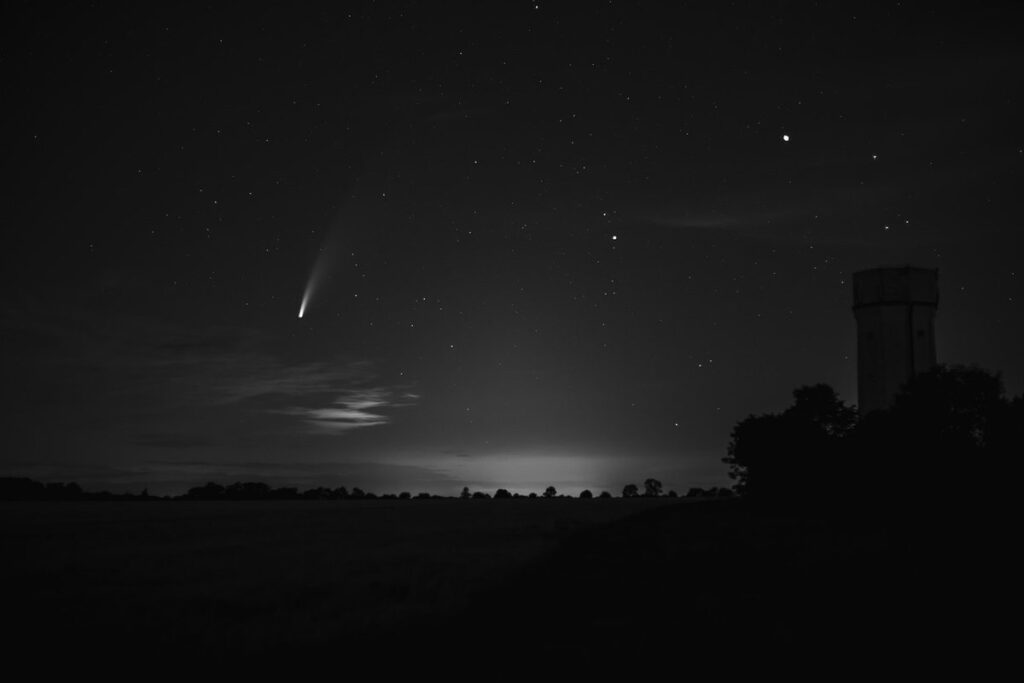
The interaction between the comet’s ices and solar radiation also gives rise to a vibrant tail of gas and dust, often visible as a glowing streak behind the comet. The unique combination of an icy nucleus and a gaseous coma makes Halley’s Comet one of the most recognizable and awe-inspiring sights in astronomy.
Characteristics and Behavior
As we continue our journey through the fascinating world of Halley’s Comet, let’s examine its unique characteristics and behavior that set it apart from other celestial bodies.
Orbital Pattern and Periodicity
Halley’s Comet has a highly elliptical orbit, which is the primary reason for its periodic return to the inner solar system. At perihelion, the comet approaches within about 1.3 astronomical units (AU) of the Sun, while at aphelion, it recedes to around 4.2 AU from the Sun. This significant difference in distance from the Sun leads to a substantial variation in the comet’s orbital velocity and period.
The 76-year orbital period is a critical aspect of Halley’s Comet’s behavior. During this time, the comet completes one full orbit around the Sun. Notably, its closest approach to the Sun occurs at perihelion, which marks the beginning of a new orbital cycle. The comet’s elliptical shape and relatively short orbital period make it an ideal target for astronomers studying cometary activity and solar system dynamics.
A key consequence of Halley’s Comet’s periodic return is that its orbit is heavily influenced by the gravitational pull of the giant planets in our solar system, particularly Jupiter. This interplay between the comet and the solar system’s larger bodies results in a complex dance, with each orbital cycle offering valuable insights into the comet’s behavior and the underlying dynamics at play.
Perihelion and Aphelion Passages
When Halley’s Comet approaches its closest point to the Sun, known as perihelion, it appears brighter and more radiant than at any other time. This occurs approximately every 76 years, when the comet is about 1.31 astronomical units (AU) from the Sun. As it nears perihelion, the comet’s icy surface begins to vaporize, creating a vast cloud of gas and dust that scatters sunlight and produces its characteristic tail.
In contrast, at aphelion – the farthest distance from the Sun – Halley’s Comet appears much fainter and more diffuse. This occurs when the comet is about 3.29 AU from the Sun, or roughly four times farther away than it is at perihelion. During this phase, the comet’s tail is less visible, and its overall brightness diminishes significantly.
The differences between perihelion and aphelion passages are not just visual; they also reflect fundamental changes in the comet’s behavior. As Halley’s Comet approaches or recedes from the Sun, its rate of solar energy absorption increases or decreases, respectively. This affects the comet’s temperature, composition, and even its trajectory through space. Understanding these variations is essential for astronomers seeking to study this iconic celestial body in all its forms.
Observations and Sightings Throughout History
Throughout history, Halley’s Comet has made its presence known to astronomers and stargazers alike, with recorded sightings dating back thousands of years. Let’s take a look at some of the most notable encounters with this celestial wonder.
Ancient Civilizations and Mythology
Ancient civilizations were fascinated by Halley’s Comet, often associating its appearances with significant mythological events and omens. In ancient China, for example, Halley’s Comet was seen as a harbinger of war and disaster, while the Egyptians believed it signaled the death of an important pharaoh. The Babylonians recorded Halley’s Comet in their astronomical tablets around 164 BC, noting its appearance in conjunction with a lunar eclipse.
In Greek mythology, Halley’s Comet was linked to the return of the hero Hercules, who was said to appear in the sky as a comet when he was about to undertake his final tasks. The ancient Greeks also associated the comet with the myth of Orestes, who was said to have been aided by the gods during his journey back to Argos.
The Bible mentions Halley’s Comet in Revelation 6:13-14, where it is described as a “star” that falls from the sky, signaling the end times. While these ancient interpretations are often shrouded in myth and superstition, they demonstrate the significant cultural impact of Halley’s Comet on human societies throughout history. By studying these accounts, we can gain insight into the ways in which ancient cultures understood and interacted with this celestial body.
Historical Sightings and Notable Encounters
Halley’s Comet has been a subject of fascination for centuries, with numerous notable encounters recorded throughout history. One of the earliest recorded sightings was by Chinese astronomers during the 240 BCE passage, who documented its appearance as a bright, fuzzy object in the sky. Similarly, ancient Greeks and Romans also observed Halley’s Comet, with the Greek historian Hipparchus noting its return around 125 BCE.
In more recent times, notable encounters include Edmond Halley himself, who correctly predicted the comet’s return in 1758 based on earlier observations. The public was abuzz when Halley’s Comet reappeared in 1835, with many people traveling to witness its passage. Astronomers like Friedrich Bessel and Giovanni Schiaparelli also made significant contributions to our understanding of the comet during this time.
Halley’s Comet has continued to captivate astronomers and the general public alike, with notable encounters occurring in 1910 and 1986. In 1910, many people witnessed a spectacular display as Halley’s Comet passed close to Earth, while the 1986 passage was observed by millions around the world. These sightings have not only deepened our understanding of this celestial body but also underscore its enduring impact on human culture and society.
Scientific Significance and Research
As we explore the fascinating world of Halley’s Comet, let’s take a closer look at its scientific significance and the ongoing research that continues to unravel its mysteries. This includes studies on its composition, trajectory, and impact on Earth’s climate.
Astronomical Studies and Discoveries
Halley’s Comet has played a pivotal role in advancing our understanding of cometary science. Its regular appearances have provided astronomers with opportunities to study its composition and origin up close. By analyzing the comet’s material, scientists have gained insights into the formation and evolution of our solar system. For instance, the 1986 return of Halley’s Comet revealed a surface composed primarily of dust and frozen gases, including water, methane, and ammonia.
This discovery led to a significant shift in cometary theory, as it challenged the previously held notion that comets were simple balls of ice. Instead, scientists realized that comets are complex bodies with diverse chemical compositions. The study of Halley’s Comet also shed light on its possible origins, suggesting that it may have formed in the outer reaches of our solar system.
The data collected during the 1986 encounter has been instrumental in refining our understanding of cometary science. It has helped scientists develop more accurate models for predicting comet behavior and composition, which has, in turn, improved our ability to study other comets. The knowledge gained from Halley’s Comet has also contributed significantly to ongoing research on solar system formation and evolution.
Implications for Solar System Formation and Evolution
Halley’s Comet offers a unique window into the solar system’s early development and evolution. One key characteristic of the comet is its highly eccentric orbit, which suggests that it originated from outside the solar system’s main disk. This theory is supported by the presence of cometary material in the Oort Cloud, a distant reservoir of icy bodies surrounding the solar system.
The implications of Halley’s Comet’s composition and structure are also significant for understanding solar system formation. The comet’s dust-to-gas ratio, which is unusually high compared to other comets, indicates that it may have formed in a region with abundant gas and dust. This could provide insights into the conditions necessary for planetary formation.
Furthermore, studies of Halley’s Comet suggest that its highly eccentric orbit may be a result of gravitational interactions with the giant planets early in the solar system’s history. This raises questions about the role of planetary migration and the stability of the solar system over time. Understanding these processes is crucial for developing accurate models of solar system evolution.
Cultural Impact and Legacy
Halley’s Comet has been a source of fascination for centuries, influencing art, literature, and even inspiring scientific breakthroughs. From ancient Egyptian depictions to modern-day pop culture references, its cultural impact is undeniable.
Artistic and Literary Representations
Halley’s Comet has been a source of fascination for artists and writers throughout history. From ancient civilizations to modern times, it has inspired countless works of art, literature, and popular culture. In medieval Europe, Halley’s Comet was often depicted as a harbinger of doom or a sign of impending disaster, reflecting the comet’s association with catastrophic events in ancient mythology.
In literature, authors have used Halley’s Comet as a symbol of transformation, change, and the cyclical nature of time. For example, Chaucer’s Canterbury Tales features a passage describing the comet’s appearance in 1381, which is seen as a sign of impending doom for England’s medieval society. Similarly, Shakespeare’s Hamlet contains references to Halley’s Comet, which was visible in the sky during the play’s composition.
Halley’s Comet has also made appearances in popular culture, such as in films like Deep Impact and Armageddon, where it is depicted as a catastrophic threat to human civilization. These depictions reflect the comet’s enduring cultural significance, serving as a reminder of its awe-inspiring beauty and potential for destruction.
Symbolism and Significance in Modern Times
Halley’s Comet has long been a source of fascination and wonder, but its symbolism and significance extend far beyond ancient mythology. In modern times, Halley’s Comet is often seen as a harbinger of change and renewal. Its return to the inner solar system every 76 years marks a rare moment when our planet aligns with the comet’s elliptical orbit.
Many cultures around the world associate Halley’s Comet with significant life events, such as birth, marriage, or death. In some societies, its appearance is believed to signal a new era or cycle of growth and transformation. For example, in Japan, the comet’s return in 1910 was seen as an omen for the end of World War I.
Some people believe that witnessing Halley’s Comet can be a transformative experience, offering a glimpse into the vastness and mysteries of the universe. This phenomenon has inspired countless art pieces, literature, and music, reflecting humanity’s ongoing quest to understand and connect with the cosmos. While its significance may vary across cultures and individuals, Halley’s Comet remains an enduring symbol of our place within the universe and our aspirations for knowledge and exploration.
Conclusion and Future Predictions
As we conclude our journey through the fascinating world of Halley’s Comet, let’s take a final look at what the future holds for this iconic celestial body. We’ll explore its expected return and other predictions that astronomers are making about its next appearance.
Recap of Key Points
Halley’s comet is one of the most iconic celestial bodies in astronomy, with a rich history spanning over 2,000 years. To recap, let’s revisit some key points covered in this article. Halley’s comet was discovered by English astronomer Edmond Halley in 1758 and named after him. Its composition primarily consists of dust and gas, which gives it its characteristic bright tail during perihelion passages.
We discussed the comet’s orbital pattern, which takes approximately 76 years to complete one cycle around the Sun. This periodicity makes it a reliable target for astronomers and sky gazers alike. The comet has had numerous notable encounters throughout history, including sightings by ancient civilizations such as the Egyptians and Chinese.
In terms of scientific significance, Halley’s comet has provided valuable insights into the formation and evolution of our solar system. Its perihelion passage in 1986 was particularly significant, allowing astronomers to study its composition and structure up close. The comet’s cultural impact extends beyond astronomy, with it being a symbol of hope, renewal, and change in various artistic and literary representations.
In conclusion, Halley’s comet remains an essential subject for astronomical research and public interest alike. By understanding this celestial body, we can gain valuable insights into the workings of our solar system and appreciate its enduring impact on human culture.
Final Thoughts on Halley’s Comet
Halley’s Comet remains a vital part of our understanding of the solar system, its orbital pattern and periodicity offering insights into celestial mechanics. Its frequent returns have allowed astronomers to study its behavior up close, making it an invaluable tool for research. The comet’s perihelion passages also provide opportunities to examine the effects of solar radiation on its composition and structure.
One area where Halley’s Comet continues to contribute is in the field of cometary science. Studies of the comet’s coma and tail have shed light on the processes that occur when a comet approaches the Sun, providing valuable information for understanding other comets and their behavior. Moreover, the comet’s periodic returns allow scientists to track its changes over time, offering a unique perspective on the solar system’s evolution.
In practical terms, continued study of Halley’s Comet can also inform our understanding of potential hazards in the solar system. By examining the comet’s orbital path and predicting its future returns, astronomers can better prepare for potential impacts or close encounters with other celestial bodies.
Frequently Asked Questions
Can I see Halley’s Comet with my naked eye?
Yes, it is possible to observe Halley’s Comet with the naked eye during its perihelion passage. However, the comet’s visibility depends on various factors such as atmospheric conditions, light pollution, and the time of observation.
What if I miss seeing Halley’s Comet in person? Are there any digital alternatives?
Yes, there are several online platforms, apps, and websites that provide live feeds and images of Halley’s Comet during its passage. These resources can help you stay updated on the comet’s position and appearance without requiring physical observation.
How does Halley’s Comet’s orbit affect its visibility from different parts of the world?
Halley’s Comet’s elliptical orbit means it is visible from specific locations on Earth only during certain periods. The comet’s path across the sky changes with each return, affecting its visibility from various regions. Understanding these orbital patterns can help astronomers and enthusiasts plan their observations.
Can Halley’s Comet be seen in the southern hemisphere?
Yes, Halley’s Comet is visible from the southern hemisphere, but the best viewing opportunities occur when it passes through the constellation of Scorpius or Sagittarius. The comet’s path across the sky changes with each return, making some years more favorable for southern hemisphere observers than others.
Is there a specific time frame to observe Halley’s Comet during its perihelion passage?
The optimal viewing time for Halley’s Comet varies depending on your location and the comet’s position in the sky. Generally, it is best to observe the comet about 1-2 weeks before or after perihelion when it is brightest and most visible.