
Eclipses have captivated humans for centuries, with their rare and awe-inspiring displays of celestial wonder. You may have wondered about the different types of eclipses that occur on our planet, but do you know the distinction between solar and lunar eclipses? Solar eclipses are a relatively rare occurrence, where the moon passes directly between the Earth and the sun, blocking its light. Lunar eclipses, on the other hand, happen when the Earth gets in the way of the sunlight shining onto the moon’s surface. Both types have significant effects on our planet’s rotation, causing temporary changes to the Earth’s axis. In this article, you’ll learn about the various causes and effects of solar and lunar eclipses, as well as gain insight into their importance for astronomers studying celestial phenomena. By the time you finish reading, you’ll understand how these rare events impact our understanding of the universe.
What are Eclipses?
So, you’re curious about eclipses and want to know where they come from. Let’s start at the beginning: what exactly is an eclipse and how do these rare events occur in our sky?
Defining an Eclipse
An eclipse occurs when one celestial body moves into the shadow of another. This phenomenon can happen with either a solar eclipse, where the Moon passes between the Earth and the Sun, or a lunar eclipse, where the Earth blocks sunlight from reaching the Moon. To determine what type of eclipse is happening, astronomers consider the Moon’s distance from Earth and its apparent size in the sky.
There are three main types of eclipses: partial, annular (ring-shaped), and total. A partial eclipse occurs when only a portion of the Sun or Moon is covered by the other body. Annular eclipses occur when the Moon appears smaller than the Sun, creating a ring-like appearance around it. Total eclipses happen when the entire Sun or Moon is completely covered.
The type of eclipse that occurs depends on several factors, including the alignment of the celestial bodies and their relative sizes. For instance, if the Moon is too small to cover the Sun entirely, an annular eclipse will occur. If the Earth’s atmosphere scatters sunlight during a lunar eclipse, the Moon can take on a reddish hue. Understanding these basics is crucial for predicting and observing eclipses accurately.
History of Eclipse Observation
Eclipse observation has been a part of human culture for thousands of years. Ancient civilizations such as the Babylonians, Greeks, and Chinese recorded solar eclipses, often interpreting them as omens or signs from the gods. The earliest known record of an eclipse is found on an ancient Sumerian tablet from 2100 BC.
The Greek philosopher Aristotle wrote about lunar eclipses in the 4th century BC, noting that they occurred when the Earth passed between the Sun and the Moon. However, it wasn’t until the 16th century that astronomers began to understand the true cause of eclipses: the alignment of celestial bodies in space. This understanding was made possible by the work of scientists like Tycho Brahe and Johannes Kepler.
One notable milestone in eclipse observation is the use of telescopes during the 17th and 18th centuries. Astronomers like Galileo Galilei and Edmond Halley used their instruments to study eclipses more closely, making detailed observations and calculations that helped refine our understanding of celestial mechanics. Today, we continue to study eclipses using advanced technology, including spacecraft and satellite imaging.
Types of Solar Eclipses
There are three main types of solar eclipses, each with its own unique characteristics and viewing experiences for sky gazers. We’ll explore the differences between these celestial events in more detail below.
Total Solar Eclipse
A total solar eclipse occurs when the Moon passes directly between the Earth and the Sun, blocking the Sun’s light entirely. This phenomenon is relatively rare because the Moon’s orbit is tilted at an angle of about 5 degrees with respect to the Earth’s orbit around the Sun, meaning that the Moon’s shadow on the Earth’s surface is usually narrow and falls on a specific region.
On average, a total solar eclipse is visible from a particular location on the Earth’s surface only once every 360 years. However, this frequency varies depending on the location due to the Earth’s slightly ellipsoidal shape and the Moon’s orbit. During a total solar eclipse, the sky darkens, stars become visible, and the temperature drops rapidly.
Observing a total solar eclipse requires proper eye protection, as direct sunlight can cause serious eye damage even when the Sun is completely covered by the Moon. Use handheld solar viewers that meet international safety standards or specialized solar viewing glasses to safely observe the eclipse. It’s also essential to note the timing of the eclipse and plan accordingly, as the totality phase usually lasts only a few minutes.
Annular Solar Eclipse
An annular solar eclipse occurs when the Moon passes directly between the Earth and the Sun, but appears smaller than the Sun’s disk. This creates a ring of light around the Moon, giving it an “annulus” or ring shape. Unlike a total solar eclipse, where the Moon completely covers the Sun, an annular eclipse leaves a narrow ring visible.
The main difference between an annular and a total solar eclipse is the distance between the Earth, Moon, and Sun. For an annular eclipse to occur, the Moon must be at a farther distance from Earth than it would be for a total solar eclipse. This results in the Moon appearing smaller compared to the Sun’s disk.
During an annular eclipse, observers can see a bright ring of light around the Moon, but not the Sun’s corona or any Baily’s beads (small spots of sunlight visible during totality). The experience is often described as eerie and surreal. To spot an annular solar eclipse, it’s essential to be in the path of annularity, which is usually narrow and specific.
Partial Solar Eclipse
A partial solar eclipse occurs when the Moon covers only a portion of the Sun’s disk, revealing a ring of light around it. These eclipses are relatively common, occurring about twice a year on average. However, they often go unnoticed by the general public because they usually occur during sunrise or sunset, when the sky is already bright and the eclipse may be difficult to observe.
In terms of visibility, partial solar eclipses can be observed from anywhere along the path where the Moon’s shadow falls, but the experience varies greatly depending on one’s location. Observers closer to the path’s center will see a larger segment of the Sun obscured by the Moon, while those farther away will see only a small sliver.
Astronomers take note of partial solar eclipses because they can provide valuable insights into the Earth-Moon-Sun system. By tracking the timing and duration of these events, scientists can refine their understanding of the Moon’s orbit and its effects on our planet’s tides. For example, NASA uses data from partial solar eclipses to improve predictions for total solar eclipses, which are more spectacular but also less frequent.
Types of Lunar Eclipses
There are two main types of lunar eclipses: penumbral and total, each occurring when Earth’s shadow falls on the moon in different ways. Let’s take a closer look at these distinctive events.
Total Lunar Eclipse
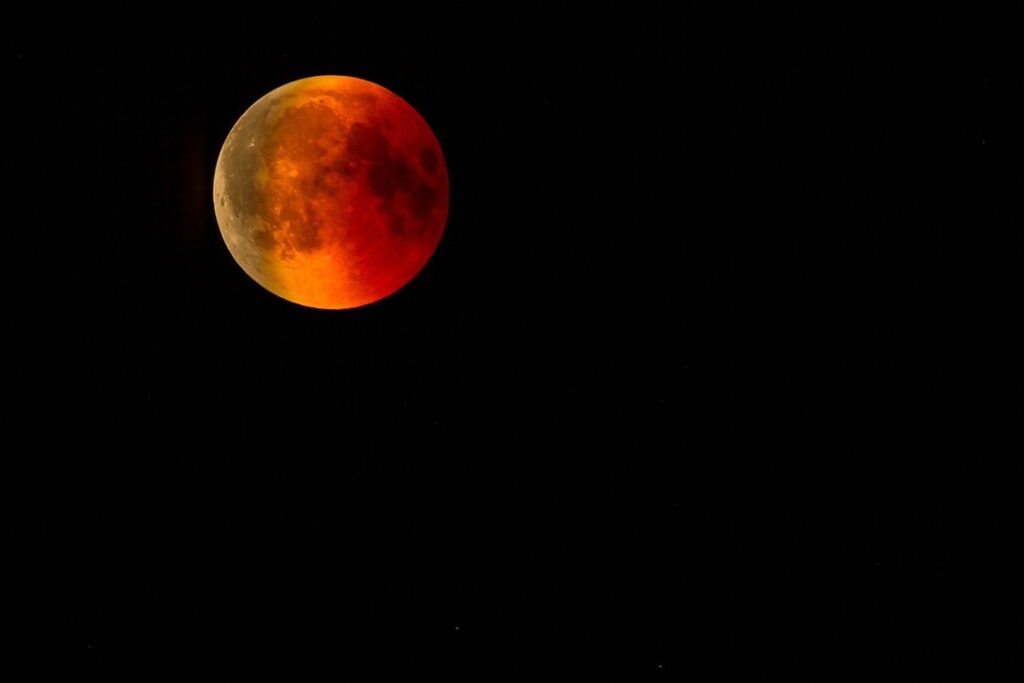
A total lunar eclipse occurs when the Earth passes directly between the Sun and the Moon, blocking the sunlight that normally reflects off the Moon’s surface. This can only happen during a full moon, when the Moon is on the opposite side of the Earth from the Sun. The Earth’s shadow falls on the Moon, causing the Moon to darken and sometimes take on a reddish hue.
The totality phase of a total lunar eclipse can last anywhere from 5 minutes to over an hour, depending on the alignment of the celestial bodies involved. This event is often referred to as a “blood moon” due to its distinctive color.
One of the most notable total lunar eclipses in recent history occurred in September 2015, when a series of four total lunar eclipses took place within a span of six months. This was significant not only because of the frequency but also because it affected the Earth’s rotation slightly. According to NASA, each total lunar eclipse causes the Earth’s rotation to slow down by about 1 second due to the conservation of angular momentum.
This effect may seem minor, but over time it can add up and have a noticeable impact on our planet’s rotational period.
Partial Lunar Eclipse
A partial lunar eclipse occurs when the Earth’s shadow falls on only a portion of the Moon’s surface. This type of eclipse is less frequent than total lunar eclipses and typically visible from anywhere on the night side of the Earth, though its visibility is affected by the observer’s latitude.
During a partial lunar eclipse, the Earth’s umbra does not completely cover the Moon, creating an irregular shape that appears as a darkened patch or “bite” taken out of the Moon. The extent to which the Moon is eclipsed varies depending on the angle of the alignment between the Earth, Sun, and Moon.
A partial lunar eclipse can be observed with the naked eye, but its appearance may vary depending on the amount of the Moon’s surface that is covered by the Earth’s shadow. The effects on the Moon’s appearance are subtle, making it more challenging to notice than a total lunar eclipse. To observe a partial lunar eclipse, find a location with an unobstructed view of the eastern horizon and be prepared for the event with binoculars or a telescope if desired.
Partial lunar eclipses occur when the Earth is too far away from the Moon’s orbit to produce a total eclipse. This alignment creates a shallow angle between the Earth, Sun, and Moon, resulting in only partial coverage by the umbra.
Hybrid Eclipses
Hybrid eclipses are a rare and unique type of solar eclipse, where the Moon’s shadow has two distinct regions: an annular ring around the Moon. We’ll explore what makes hybrid eclipses so special and how they differ from other types of eclipses.
Understanding Hybrid Eclipses
Hybrid eclipses are a unique type of solar eclipse where the Moon is close enough to Earth to cover the Sun completely, but not so large as to leave no gaps between its disk and the Sun’s. This results in an eclipse that has both total and annular characteristics.
To understand hybrid eclipses, it’s essential to consider the Moon’s orbit and how it intersects with the Earth-Sun plane. The Moon’s elliptical shape means its distance from Earth varies throughout the month, which affects the type of solar eclipse observed during a specific lunar phase. When the Moon is at perigee (its closest point to Earth), it can appear large enough to cover the Sun entirely, resulting in a total solar eclipse.
However, if the Moon is at apogee (its farthest point from Earth) or has a slightly smaller apparent size due to its elliptical shape, it will not be able to cover the entire Sun. This creates an annular effect, where a ring of light appears around the Moon’s disk. Hybrid eclipses occur when these two conditions are met: the Moon is at perigee and the Earth-Sun-Moon alignment allows for partial coverage.
Hybrid solar eclipses are relatively rare because they require precise celestial alignments. According to NASA, about 40% of all possible solar eclipses are hybrid events. This phenomenon occurs when the Moon’s orbit crosses paths with the Sun’s disk at a specific angle, creating a unique eclipse type that exhibits both total and annular characteristics.
It’s worth noting that predicting hybrid eclipses can be challenging due to their specific alignment requirements. Astronomers use advanced algorithms and orbital calculations to determine the likelihood of a hybrid eclipse occurring during a particular lunar phase.
Rare and Unusual Eclipses
Some eclipses are so rare, they’re almost mythical, occurring only once in a lifetime for viewers on specific parts of the globe. We’ll look at these extraordinary events up close.
Transit of Venus
A transit of Venus occurs when the planet passes directly between the Earth and the Sun. This rare alignment is significant for astronomers because it allows them to measure the solar system’s scale with great accuracy. During a transit, Venus appears as a small black dot moving across the Sun’s surface.
One of the most famous uses of transits was made by British astronomer Edmond Halley in 1679. He observed the transit and used it to estimate the distance from Earth to the Sun, known as an astronomical unit (AU). This measurement helped astronomers refine their understanding of the solar system and paved the way for further exploration.
The transit’s significance lies not only in its rarity but also in its potential for scientific discovery. By observing transits, astronomers can gain insights into Venus’ atmosphere, surface temperature, and orbital patterns. In recent years, space agencies have used transits to study Venusian clouds and atmospheric composition, revealing new information about our celestial neighbor.
Transits occur in pairs, separated by eight years, with the next pair visible from Earth in 2028 and 2035.
Planetary Alignments
Planetary alignments during eclipses occur when multiple celestial bodies line up in a straight line, typically including the Earth, Sun, Moon, and one or more planets. This rare alignment can have several effects on our planet. For instance, the gravitational pull of nearby planets can cause the Earth’s oceans to bulge, resulting in higher-than-usual tides. In some cases, this tidal displacement can be so pronounced that it triggers coastal flooding.
The planetary alignment can also impact the Earth’s atmosphere, as the increased gravitational force from the aligned celestial bodies can compress and distort the air molecules near the surface. This compression can lead to a range of atmospheric phenomena, including changes in air pressure, temperature fluctuations, and even minor earthquakes.
A notable example of a planetary alignment during an eclipse is the 2017 total solar eclipse, where Mercury, Venus, and Earth aligned with the Sun in the sky. While this rare event did not produce significant tidal effects due to its relatively small size compared to other planets, it highlights the potential for planetary alignments to have subtle yet measurable impacts on our planet’s environment.
Planetary alignments are often difficult to predict and require precise astronomical calculations.
Conclusion: The Significance of Eclipses
Eclipses have been captivating human imagination for centuries, and their study has led to significant advancements in our understanding of astronomy. By exploring the different types of eclipses, we can gain a deeper appreciation for the celestial mechanics that govern our universe. The rarity of these events makes each one a unique opportunity to observe and learn from nature’s spectacle. In particular, solar eclipses offer a glimpse into the Sun’s corona, revealing intricate details about its structure and behavior. Similarly, lunar eclipses provide insight into the Earth’s atmosphere, demonstrating how it interacts with the Moon’s reflected light.
Eclipses have also played a significant role in shaping human culture and history. Many ancient civilizations revered these events as omens or harbingers of change, while modern societies continue to be fascinated by their beauty and scientific significance. By embracing our curiosity about eclipses, we can foster a greater appreciation for the natural world and its intricate workings.
Frequently Asked Questions
What If I Miss an Eclipse?
Yes, it is possible to miss an eclipse due to its rarity and limited visibility from certain locations. However, with the help of technology and online resources, you can still experience eclipses through live streaming or virtual events.
How Often Do Eclipses Occur in a Given Region?
Eclipses occur relatively infrequently in any given region, but their frequency increases as you move towards the Earth’s polar regions. For example, during an eclipse season (a period of about 36 years), some locations on Earth experience multiple eclipses.
Can I Observe Eclipses with Basic Binoculars or a Smartphone?
Yes, basic binoculars and smartphone apps can help you observe solar eclipses, but it’s essential to note that for safe viewing, you should use certified solar viewers or handheld solar telescopes. These devices filter out the Sun’s intense light, allowing you to safely observe the eclipse.
What Happens If I Look Directly at an Eclipse?
Looking directly at an eclipse can cause serious eye damage, including solar retinopathy. To avoid this, always wear certified solar viewing glasses or use handheld solar telescopes that meet international safety standards for direct solar observation.